- Regarding PRs. I have a an opinion which has become very unpopular since the rise of github.
The way github does PRs is great for open source projects where you have submissions from a very diverse set of developers. You need to evaluate the whole PR as whole and accept it or reject it.
But it is not ideal where you have a small team working on single product. The PR review becomes a gate and it has been my experience as a developer that you spend a LOT of time trying to get your PR reviewed.
My preferred approach is to do smaller and more frequent commits that are merged directly to the main branch. Developers learn to break a problem into very small changes which is a skill by itself. It is the responsibility of a lead or Sr engineer to check the commits as they come so they can provide feedback as soon as possible. This was the spirit of the original continuous integration ideas back in the day.
- Stacked diffs let you not have to evaluate the whole PR as a whole, and encourages smaller and more frequent commits.
Basically, I agree with you that large PRs are a problem, I just don't think it means you need to throw pre-land code review out the window.
- Agree too bad stacked PRs aren’t really native to GH and you probably need to go with not so standard tools to manage them
- Yes, it is unfortunate. I did link an announcement below that some form of this feature is coming, we'll see what it actually looks like when it goes public.
- > The way github does PRs is great for open source projects where you have submissions from a very diverse set of developers.
Not really, it's awful for that and always has been, which is why Git wasn't designed around the concept and Linux and Git itself overwhelmingly use patch submission instead of contributors showing up and meekly requesting that a maintainer pull from your branch. Everything about pulls and remotes in Git are very deliberately designed with trusted collaborators in mind—people with an ongoing relationship to each other—and not randoms who don't otherwise have any real history or authority within the project.
If those project outsiders are the first class of casualties of GitHub's choices, what you're describing is the second class of casualties. Everyone pays the price.
GitHub's entire pull request workflow is this massively clunky thing that makes no sense from a 100-foot view until you realize that it's by design, because that's how all dark patterns work. It exists only because it's the vestige of what started as a Facebook-inspired growth hack to both drive on-site engagement and to introduce slightly more friction for contributors who aren't/weren't hosting their own projects on GitHub.
Perhaps by GitHub's 20th anniversary in 2028, they'll realize that it was a success and they don't have to make everyone continue paying the cost of the fork- and PR-heavy workflows.
- That's pretty much how Google does dev, though not everyone there is consistent about small CLs or the <24 hour SLO for code review.
But yeah, if the team lead is aware of what everyone is working on, and prioritizes fast CLs review, huge amounts of friction and slowdown are removed from the process
- Modern software engineering culture is a treadmill ever in search of the next best practice that must be applied to a field made up of bespoke scenarios.
- What does the full story look like in your preferred approach? Regarding releasing for example
- [dead]
- > Once you have the power to do a bunch of small self-contained changes, you want PRs to consist of one or two commits. You want to build on previous changes without needing to wait for them to be reviewed. Lubeno helps you to do exactly this.
Why would I want to build on changes that haven't been reviewed and accepted? That's a good way to waste my time having to redo something because the foundation it was based on was flawed and got rejected later.
There's a reason git and most accepted development workflows are linear.
- I do that a whole lot because most of the time I know the foundation will be accepted mostly as-is, maybe with small tweaks but not major changes.
So I branch of a previous PR instead of development when the changes are related, and continue development, and rebase after the previous PR has been merged.
Usually this leads to less rework and fewer merge conflicts.
Very occasionally it means having to rework subsequent work because the approach was actually wrong, but I'll take that over the hassle of continuing to work from a base I know is already outdated.
- Because those changes might depend on those other changes. Git merges aren't linear. They're branched. And PR reviews are meant to just examine the merge of 1 branch back into master. They're not really meant to review multiple steps along the same branch to make it easier to review.
There are so many times where I want to create 3-4 Merge requests that all build on each other along the same branch instead of creating one giant MR but the UI for reviewing them doesn't really work that way.
- If you’re getting to the point where you’re submitting PRs if you don’t know whether the foundation of the change is flawed, you have more pressing issues than wasting time in code review fixes.
- There's only a limited amount of context and decisions that can be effectively communicated informally without looking at the code. Sometimes it is required that people look at the actual suggested implementation, and when doing so they might spot fundamental issues that had not been found beforehand. The conventional format for doing such a review is a PR.
- And thus, you don't have to build on every single unreviewed PR - but often it's quite sane to do so.
- You can just start a new branch in parallel if you don't need to build on top of the foundation. But if you are happy with the foundation and the next feature requires it, you can also continue working on something else. Jujutsu's automatic change propagation to children can also help if you need to adjust the foundation. For me work is mostly continues, like a flow.
- If your PRs are more than one commit, you've already introduced work that builds on top of previous work before it's been reviewed.
Stacked diffs just let you review one commit at a time, rather than requiring a full review of the entire thing, while still letting you see that these changes are related, so you can go look at the full context if you'd like.
This lets you do things like "hey, backend person, please review this backend commit, frontend person, please review this frontend commit" instead of "both of you review this full PR". This can save the frontend person time if, for example, the frontend code passes review, but the backend reviewer hasn't had time to review the backend changes yet. They won't be pinged by the other review.
- Often it's very likely that previous ones won't need to change significantly, in which case disposing of having the full context while waiting for that review ends up slowing you down a lot. In those cases, often the main cause of extra busywork is Git administration, having to manually rebase sub-branches, and then losing in-progress reviews on those PRs as well.
- Anecdata, but I don’t find myself making major changes to code during review often. That speaks to a deeper problem (miscommunication of requirements, author skill, overly pedantic reviewers, etc).
Also, I don’t have time to wait around for a review to work on other parts of the same codebase.
- I will say, I love the idea of re-thinking PR's in the age of AI. I think it will be needed and I don't see GitHub pulling it off. I think they will just double down on trying to get AI to review it for us.
I haven't signed up, but I'm not convinced the stacked PR's is a good route. This is mostly because I'm thinking about it in terms of how I work now, so maybe after a trial run I would see it differently. My experience with launching software is people don't want to change their workflows.
So the way I imagine how this would get used by real accounts is they will still review individual PR's and merge them in like normal and avoid doing stacked PR's because a lot of us mostly care about the final result and less about the how you got there.
That is until we need to understand the how lol So being able to visualize this is probably a very useful tool for retroactive inspection over being part of the PR review workflow.
I hope the author doesn't feel like I'm dunking on them, I really love the idea of re-thinking PR.
- I appreciate you recognize there is still a reason for grouping commits into mergeable units (PRs). Some go too far and only want every commit to be independent.
I also appreciate the ordering. In my projects, we put an extra focus on tests by having having a commit that adds new tests to reproduce the bad behavior so when you diff the tests with the fix commit, you get a visual of how things changed.
I also find that the order can be PR specific. I wonder about allowing the contributor or reviewrs reorder on per-PR basis.
There are also times we have a lot of test or doc changes. I wonder about grouping items to jump between or collapsing to more easily navigate around than opening and browsing a file picker.
- i think the time is just over where i would consider a saas for code review instead of a local first tool that i can use for my local agents exactly the same way as for my colleagues right where i build the software not on some website.
- How do you communicate the results of this review to your colleagues?
(This is a genuine question, I think local first review is very interesting, but at some point, you've gotta send that feedback to the person you're reviewing.)
- Ideally via the git host in something like a gerrit compatible git notes object.
- Jujutsu is interesting in that it appeals both to Git enthusiasts, and people who strongly dislike Git's UX. It's great to see it spurring more innovation in the ecosystem around it.
Though if it can just make stacked PRs widespread, I'd already be very happy.
- I work in between two teams that would prefer no code review except for by pair programming (militantly arguing that this is the only true trunk based development, those small PRs are something else) and a team that every individual wants to own the dev cycle end to end. So its either pushes to main youre forced to catch up on that you had no alerts or knowledge of, or +6000 -500 diff PRs with way too many features and no story to tell in the commits.
Maybe this tool would help, but nothing in this pitch convinces me.
- On my first load of this page, it took 4.85 seconds to get meaningful content and the whole page took 8.09s. The vast majority of the delay seems to be from assets like the PNG images and the fonts, which don't seem to be on a CDN. I am located in Tokyo, Japan, with a 1Gbps symmetric connection, so while I am regionally quite distant from the site, I assume, I still think there are ample CDNs available that would speed this up.
- Lucky you. Blog.js fails for me with a TypeError and I'm disinclined to debug someone else's javascript on a whim, so I don't get to see any of the content at all.
To the OP: JS is for enhancements. If you are using it in such a way that it becomes a potential blocker for all of the content then you are not going to reach the audience that you otherwise would. If you are on somebody else's platform/framework then by all means pass this up the chain.
- Mobile is particularly bad
https://pagespeed.web.dev/analysis/https-lubeno-dev-blog-rei...
- Sorry about that! Performance is really important to me, I just didn't get around to configuring CDN caching and optimizing the assets. All the HN traffic hitting our server also didn't help.
- I signed up and I'm finding browsing a repo quite snappy. Good job.
- There’s an interesting nugget of an idea in this ad. But the current implementation leaves a lot to be desired. What I want out of the PR interface is to be able to ask an agent questions and get back supported answers and to be able to easily see the changes live in a system so I can test them. That requires solving a huge problem of iterative deployments but if you could do that the value of stacked PRs would be immense. If someone doesn’t do this then PRs will just be abandoned.
- There's a much more interesting idea that I'm waiting for somebody to do, which is just have AI break down a PR into digestible chunks for me. Stacked PRs are a nice idea but they require the developer to follow the pattern. I'd rather be able to get a big 50+ file PR, and have it be broken down into bite size areas I can review and check along as I go.
This would be especially helpful for mobile, where reading a traditional diff is basically impossible.
- This is a really good idea. Especially if the chunks are marked as read as you are guided through them and you can validate you've seen all the code by the end
- The platform this is an ad for looks to be very bare-bones, but I’m still very glad to see a new entry in the code forge space focusing on stacked PRs since Graphite went all-in on clanker review. Extremely keen to see what will come out of ERSC [0]
[0] https://ersc.io/
- Just to be clear about it, we’re not “the stacked diffs company,” that is, we consider stacked diffs table stakes for good code review, not the entire point and focus of the product.
That said, we haven’t talked a ton publicly about what exactly we’re building yet, because we’re very focused on building it. But if you or anyone else is dealing with pain around source control management, I’d love to hear about it: steve@ersc.io
- Let's forget that this post is an ad. I feel like there is a use for LLMs that could help us do stacked PRs better.
Right now there are effectively three ways to do a PR:
- a bunch of small commits, some of them related to the feature, some fixes, some mixing both -> a PR with 'n' commits -> they don't really make sense as atomic commits, you have to review the entire PR to make the sense of it
- a squashed PR
- some uber principled reorganisation of commits that separates key implementation concerns into smaller commits (effectively stacked PRs but clean)
The last option would be desirable but it's unreasonable to expect anyone to do it by hand. So this is where <maybe> an LLM could parse my garbage intermediate commits, the final diff and generate a stack instead?
- The last option is absolutely not unreasonable to expect people to do by hand, as the article states it’s simply a problem of tooling. JJ makes this extremely easy to do, but some of us have been doing just the same in git for a long time and it is extremely achievable once you know your way around a rebase.
- Maybe it just shows my lack of tolerance for process/overhead.
As a fellow rebase enjoyer, I will do it occasionally for smaller PRs but to me, it becomes unwieldy for large ones.
Do you have any tips or aliases that makes it more workable?
- Yep, ensuring RERERE and autostash are enabled eliminate 80% of the tedium for me, but honestly just try jj; it seriously is a gamechanger and (so far, in ~6mth of use) it has had literally zero drawbacks in comparison to git, because it is still git and if I don’t know how to do something with jj, I can use the git commands I do know and it Just Works™
- I have had good success lately with asking Claude to do your last option. jj also works fantastically for this, because you can easily jj new up a bunch of empty changes with the descriptions you want to have, and then jj restore the state from your original stack into them. If the process goes poorly for any reason, you still have your original stack around.
You don’t have to do it this way, you could use the oplog to undo it all if it’s not to your satisfaction, but it’s much simpler than trying to edit the commits into the right shape directly.
- > Reinventing the pull requests
I've got some wheels spare, care to have some?
- This blog post is self-promotion, essentially an advertisement for a paid product, Lubeno, submitted by the developer of the product.
- ... on a website owned by the VC that invested in the developer.
I believe that the ideas in the blog post are novel enough and should spark curiosity and interesting discussions. Also I submitted this last week, someone must have hand-picked and given it another chance because it's a good fit for HN.
- > ... on a website owned by the VC that invested in the developer.
Thanks for disclosing the financial conflict of interest, but this doesn't change the self-promotion factor.
- I apreciate the fact that they mention that sometimes a commit change needs a fix before it ever even was pull-request ready. I think it would be great to have the ability to easily reorder/modify commits while in active development, and then lock them into permanent history afterwards. Apparently (according to the article) Jujutsu can do that, but I've never had personal exoerience with that VCS.
- > I think it would be great to have the ability to easily reorder/modify commits while in active development
Take a look at `git rebase --interactive`.
- I wonder how may engineers contribute to their code base on a daily basis.
- This is just an ad.
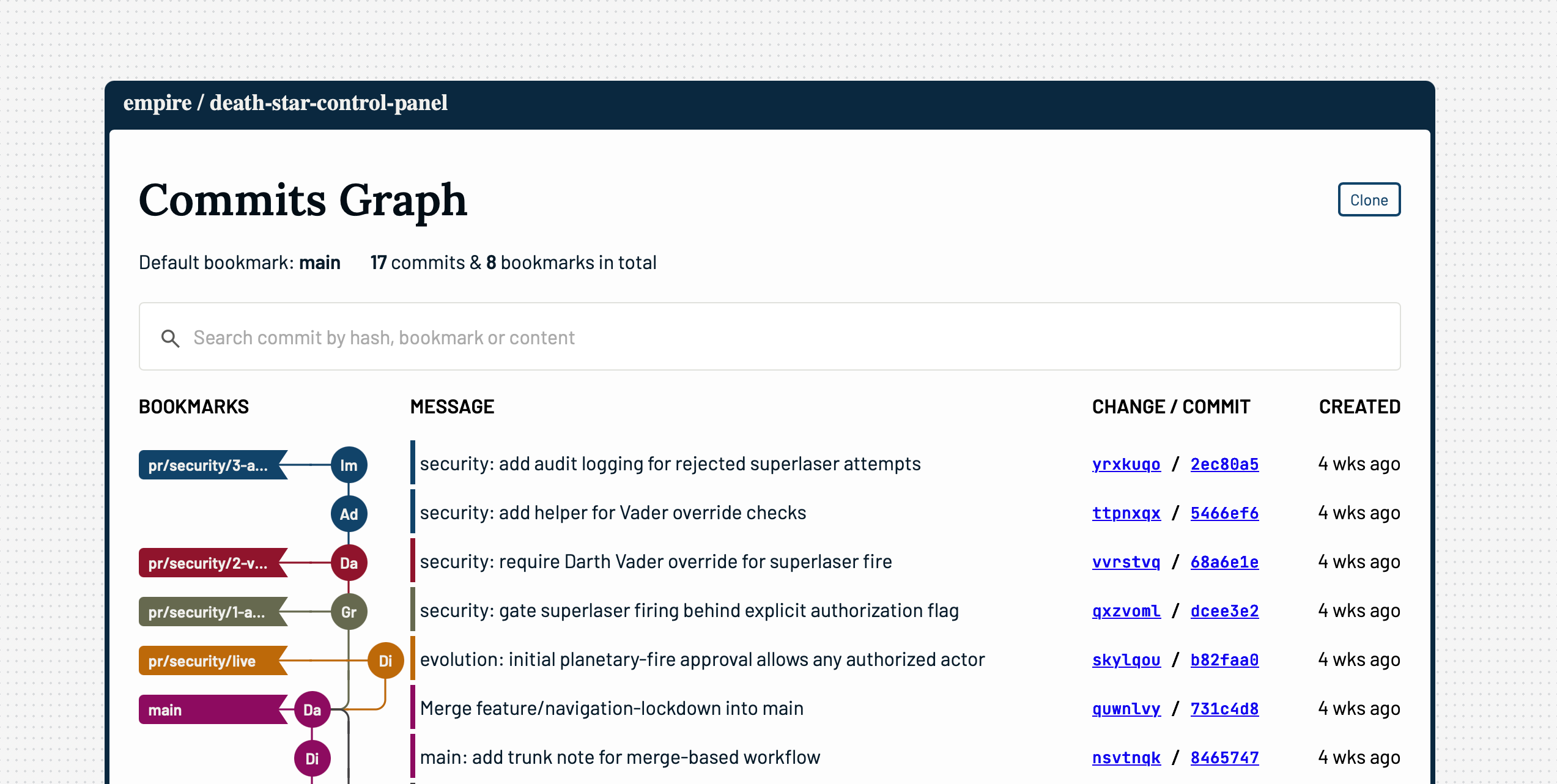
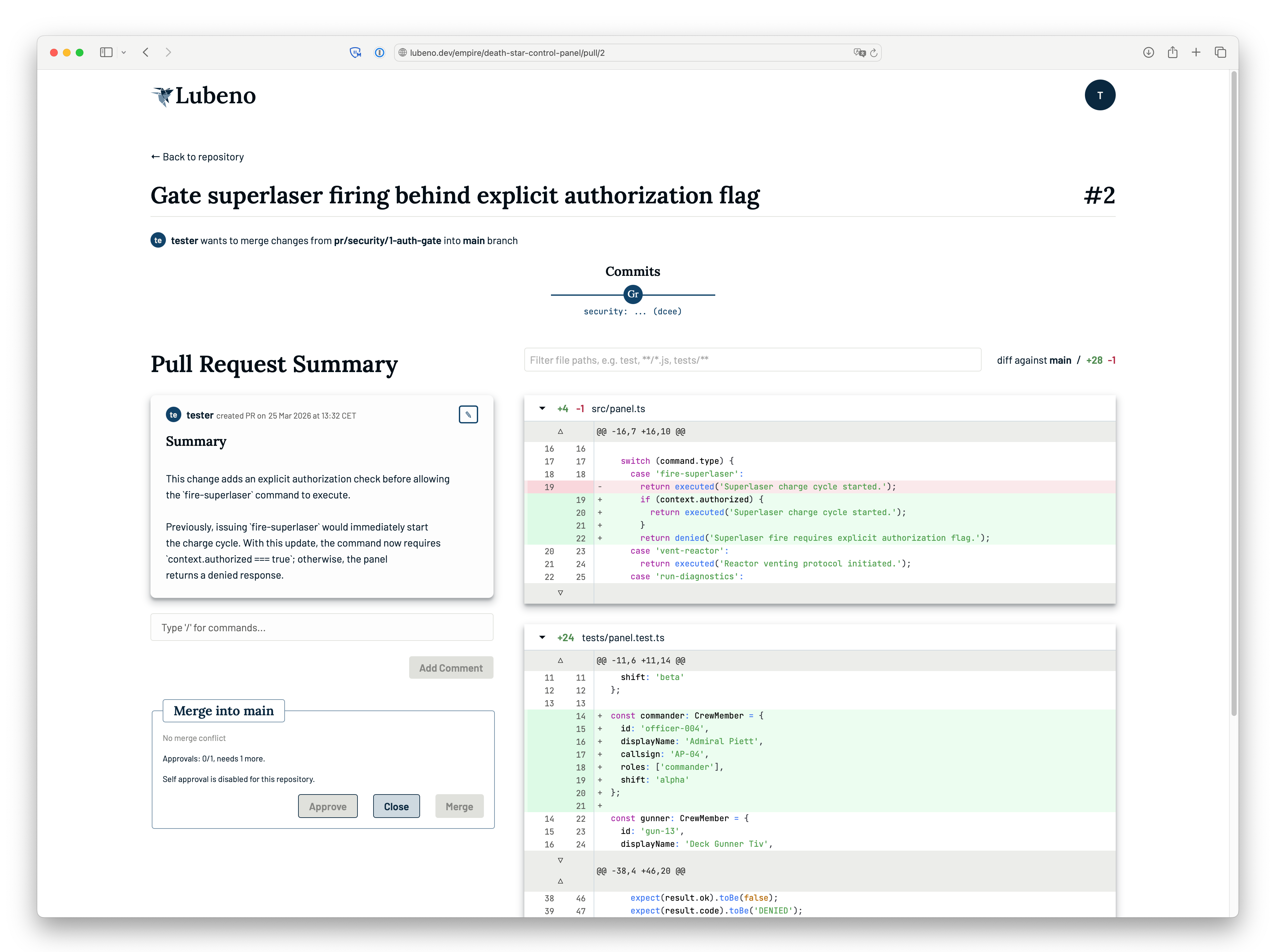
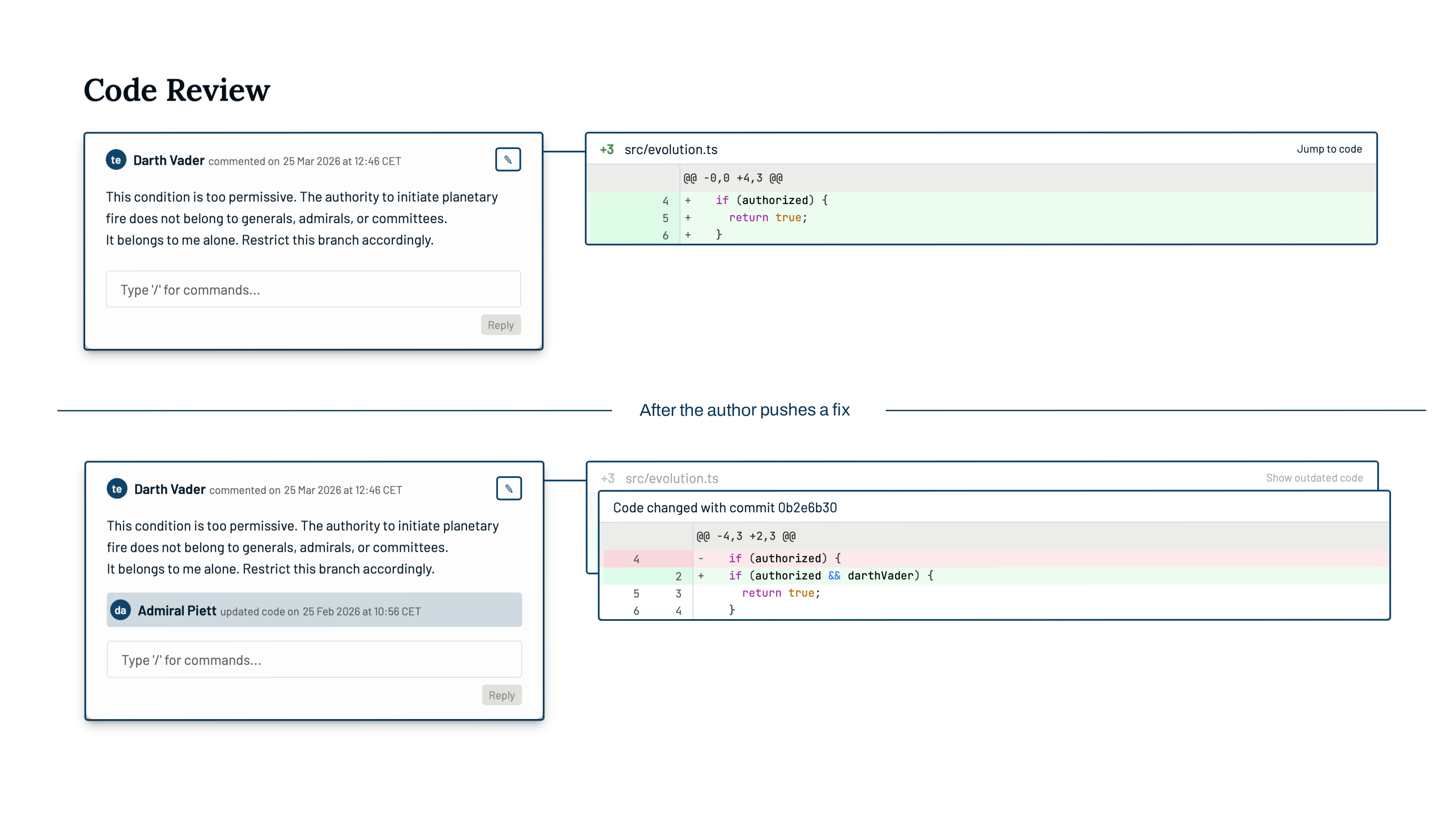
- It would be nice if I could click the images to make them larger. As is it's not actually possible to see anything novel being done.
- Direct links to the images, until I implement popup on click:
https://lubeno.dev/assets/images/blog/lubeno-repository.png
https://lubeno.dev/assets/images/blog/lubeno-pr.png
https://lubeno.dev/assets/images/blog/code-review-before-aft...
- I don’t want to reinvent the pull request. I want to commit to main like an adult.
- It blows my mind that Github still doesn't support stacked PRs. Do they never do work that depends on an open PR? Like, as soon as they open a PR they're like "right, better stop doing anything until it's merged"?
The file priority thing is a great idea too. That would be even more useful for search. The number of times I'm searching for something on Github and it just shows me a gazillion tests.... Yeah you can look up their advanced search syntax and exclude them probably, but it's always a hassle.
- GitHub is putting stacked PRs into private beta around now, actually.
- link?
- https://github.com/github/roadmap/issues/1218 is the tracking issue for it
- https://x.com/jaredpalmer/status/2019817235163074881
(this was a follow-up to the initial announcement months ago, also made via X)
- Ah nice! I hope this actually works across repos rather than just being nicer UI for the existing functionality.
- You can manually stack PRs by making the merge target another branch.
The workflow just makes it a pain, since you have to manually rebase in both the branch and the UI after the original PR merges.
- That doesn't work if the base and PR branch are in different repos, which is the most common way of doing things in Github.
- [dead]
- [dead]