- In my small island community, I participated in a municipal committee whose mandate was to bring proper broadband to the island. Although two telecom duopolies already served the community, one of them had undersea fiber but zero fiber to the home (DSL remains the only option), whereas the other used a 670 Mbps wireless microwave link for backhaul and delivery via coaxial cable. And pricing? Insanely expensive for either terrible option.
Our little committee investigated all manner of options, including bringing municipal fiber across alongside a new undersea electricity cable that the power company was installing anyway. I spoke to the manager of that project and he said there was no real barrier to adding a few strands of fiber, since the undersea high voltage line already had space for it (for the power company’s own signaling).
Sadly, the municipality didn’t have any capital to invest a penny into that fiber, so one day, one of the municipal counselors just called up a friend who worked for a fiber laying company and asked them for a favor: put out a press release saying that they were “investigating” laying an undersea fiber to power a municipal fiber network on the little island.
A few weeks later, the cable monopoly engaged a cable ship and began laying their own fiber. Competition works, folks. Even if you have to fake it.
- this is a great example of where the government should step in and say “welp, you took too long, we’re now funding municiple fiber and we’ll give it to everyone cheap. sorry.”
i truly do believe competition can often drivr things forward but we have countless examples where executives get comfortable and decide their best course of action for profits is to do little to nothing.
if a community has been screaming for fiber internet for years and the service companies cry “oh it’s just too expensive” when we know that isn’t true, then the people who pay the taxes should say “ok, apparently you’re not up to the job, you and/or your business model is clearly a failure, we’ll do it and provide it cheaper than you would have anyway.”
maybe this would force the competition we know can often work. if they can’t figure out a way to do it without subsidies, then we’ll do it ourselves. you can call it “spooky government” all you want, but that’s just another term for “us”
something to the effect of: ok, this thing has become integral to society. ceos, you have 5 years to compete and prove that you’re up to the task by delivering A, B, and C for $N. can’t do it? not up to it? no worries, thanks for trying.
- > this is a great example of where the government should step in and say “welp, you took too long, we’re now funding municiple fiber and we’ll give it to everyone cheap. sorry.”
That's what my town (Longmont, CO) did! We had laid a fiber loop around the city back in the '90s for traffic signal coordination. Over the years the town would engage different private companies to try to get them to lay fiber (or even directional wifi) to the door. None of them took off, so the city decided to do it themselves. Xfinity tried to sue us and ran a weak attempt at astroturfing, but after about five years of concerted back-hoeing most of the town has gigabit. It isn't 25 gigabit by any means but it works.
Bonus: you call a 303 number for support and somebody who lives here picks up like "What can I do for ya, hun?" (I exaggerate, but not by much). Half an hour later your problem is solved.
Edit: It's $50/month for that.
- https://communitynets.org/content/community-network-map
https://communitynetworks.org/content/municipal-ftth-network...
How to Build a Fiber Network on a Small-City Budget [video] - https://www.youtube.com/watch?v=OUhtdBZbOMc
Getting Fiber to My Town [video] - https://news.ycombinator.com/item?id=24424910 - September 2020 (126 comments)
- > where the government should step in and say “welp, you took too long, we’re now funding municiple fiber and we’ll give it to everyone cheap
Thereby accruing not only a capital expenditure but ongoing operational obligation? How is this better than scaring the cable company into fronting the cash to get the same outcome?
- In which way this is a viable strategy that you can repeat more than once?
- > In which way this is a viable strategy that you can repeat more than once?
I’m not saying commit to bluffing. But after the other guy has folded, continuing with your threat just to be petty is kind of dumb.
- > after the other guy has folded, continuing with your threat just to be petty is kind of dumb
Your community is still going to be paying whatever the cable company wants to charge for the service. There's definitely a reason to run it yourself.
- Or not if you want the threat to work a next time.
- > not if you want the threat to work a next time
You don’t care if it works next time. It worked this time. If it doesn’t work next time, build it next time.
- Cool, but isn’t this “the next time”, after “the next time”, after “the next time” already? These companies have been threatened, sued, and incentivized in numerous ways over many years, which has yet to be successful, and yet it seems like you are suggesting “just one more time” will be the impetus for change…this time…you swear…probably?
Note: I don’t disagree or agree, rather, I’m pointing out how flawed the logic is that just one more time will be what it takes.
- If the outcome is you need to pay the next time, but not the first time…. Doesn’t it at least save you from having to pay for it the first time?
- Australia did that but also paid out the telecom companies a gazillion dollars for infrastructure that had only been privatised like a decade earlier.
- they voted a conservative government who did what conservative governments do.
what did people think abbot and turnbull were selling? wasn't better service for users, it was servicing telstra and murdoch.
- > this is a great example of where the government should step in and say “welp, you took too long, we’re now funding municiple fiber and we’ll give it to everyone cheap. sorry.”
In the US, this would likely end with ISPs suing the government, tying the case up in court for years.
- Isn't this the Chinese system? Using state corporations to spur competition.
- That's nice in theory, but look at how much money has gone to Verizon in the name of rural broadband, and how much they (haven't) delivered. And the consequences.
- What does giving money to Verizon have to do with municipal (i.e. operated by the municipality) broadband?
- [dead]
- Municipalities don't know anything about the job and few have the resources and personnel to become sufficiently experienced. I know every other poster on HN has a story where they personally stepped in and saw their local government through the process for incredibly cheap, hey that's great, but how is some random municipality without an elder tech god living with them supposed to get "municipal" internet without contracting with an ISP who actually knows how to get that work done?
We're talking rural broadband. These municipality don't have great human capital for this kind of stuff. Hell, they struggle to just fill potholes.
- That is not how it works here. Municipality owned fiber is common here in Sweden (called stadsnät). Often several smaller municipalities join together and co-own the venture.
A common variation is that they just provide the physical infrastructure and you can then select which ISP to use on top of the fiber, from a list of about 15 or so usually. This seems to work fine in rural Sweden, so I don't see why it wouldn't work elsewhere.
As to potholes, that is not a big problem? It is usually a larger problem in the cities than out in the countryside.
- i was only using fiber as just one example. but in the case of fiber, there are plenty of non rural areas that still can’t get it and are stuck with terrible options.
even so, even in rural areas, nothing at all stops them from hiring people the same way they hire a weatherman or a police man or a fireman or a city accountant. there are educated intelligent people in rural areas…
- I guess we have different versions of HN cause the one I read has headlines on the front page pretty regularly about people (collectives, not individuals) doing their own broadband successfully. There's a reason right-wingers and lobbyists are against this and try to pass laws preventing it. It's because it works and undermines their position as rent-seekers who don't invest in their infrastructure.
- lol he thinks big ISPs upgrade their infra or care.
- Did I say that? No, you made it up. Why you chose to make that up, I can only imagine (or should I make things up too?)
Also everybody else responding to me is ignoring the point that most rural municipalities can barely afford keep their roads marginally flat, let alone tear up the roads, lay fiber, then repair those roads. Municipal fiber is a pipe dream in most scenarios, but workable in reasonably high density regions that have a tax base to work with.
- That's the opposite of what was proposed above. Stop paying them altogether and replace them in the places where they aren't competing. I think that was the message.
- Counterpoint: rural fibre is unbelievably expensive and starlink is solving it in a better way.
- i’m sorry, but no, starlink is not comparable to fiber.
better than dsl? i mean, sure? but absolutely not even close to better than fiber. there’s a reason data centers in rural areas run fiber for miles and miles to their centers and aren’t on … starlink.
- My charitable interpretation: adding a turn-key competitor is a better way to incentive the incumbents than a long fight to add a government competitor.
- > starlink is not comparable to fiber
Straw man. It doesn’t need to comparable. Just sufficient. If a rich rural community wants to pay to lay fiber into the boonies, they can still do that. But it shouldn’t be a shared cost across society. (I live in a rural community.)
- What exactly made it possible to get copper wire into effectively every house in the country?
We didn't say "if a rich rural community wants telephones or electricity in the boonies..."
Maybe we need a new Ma Bell that's Uncle Fibre. Give them a very tightly bordered but lucrative monopoly in exchange for mandates to actually build and maintain the network. Perhaps some sort of scheme where consumers actually pay the regulator instead of the service provider, so they can hold payments hostage in the event expansion and QoS goals are not met, giving it real teeth.
It might end up being the same ~USD75-100 per month for 1Gb that many of us are paying for cable now, at least initially, but the cost would be funding making sure people in rural counties are getting modern infrastructure, and gradually ticking up speeds as more and more infra is paid down, rather than on yachts.
- > What exactly made it possible to get copper wire into effectively every house in the country?
Subsidies.
> making sure people in rural counties are getting modern infrastructure
Sure. This is inefficient when an alternative is more than sufficient.
Again, I live in a rich rural community. I have gigabit fiber to my home. I have neighbors ditching wired internet for Starlink because it’s cheaper and good enough and they can also put it on their truck when they travel.
My property value does well from the subsidy. But it’s inefficient.
- [flagged]
- If it was easy to do with a lot of margin it would have been done by someone else in the private sector. In fact, they tricked these companies into making investments that weren't worthwhile for them. Sounds like the kind of people the deserve the shitty internet they have.
- That’s not necessarily true. A lot of companies are very risk averse and will sit there creaming off profit and not making any investment.
If someone came to you and said - you have two choices:
Work incredibly hard, raise a lot of money, build a bunch of infrastructure. And at some point in the future you will make some more money.
Or - keep taking your very nice high guaranteed salary for the foreseeable future.
What would you pick?
- I hear vending machine ppl often have 1-3 very profitable locations and 10-40 locations that only barely make sense often only because they already are in the business.
I imagine hiring someone to fix or restock them makes a lot more sense if you have 100 machine rather than just one.
It really depends what the goal is. Profit with fiber or fiber with profit?
Here public transport is required to cover all routes. Postal service is the same. Fiber doesn't seem that different?
- Depends on how much margin there was. Sounds like there's not enough.
- The problem is all the regulatory stuff that means the bigger you are and the longer you've operated for the better you understand and have relationships with the often pretty inept regulatory bodies that can stop you.
- Then as the local government, maybe start by removing that regulation. Or if the regulation is required, you're going to have to pay a premium for people willing and able to put up with it.
- The problem isn't knowing the solution. The problem is incentives.
- This is a fundamental problem of value creation and value extraction. Just because the ISP's can't extract the value of adding the additional fiber capacity doesn't mean it doesn't confer that value to the customers. We live in an age of value extraction, what's colloquially known as "enshittification", that can't go on forever. Somebody has to create the value that is being extracted.
It's the old Marx quote: "From each according to his ability, to each according to his need". Except you know, the opposite.
- I have a lot of ability. I'm not gonna flex it for others without pay that gives me significantly higher living standards than the average person. Are you going to force me to work?
- No, however there's a bunch of people with your abilities that will do it because they're capable of seeing that something as crucial as internet access is a public good. You can choose to not work, plenty of us will make things move forwards without you, nor care about your living standards.
- Thanks for writing a reply. I was wondering why this comment was floating around 0. I realize it's pretty contentious politics on HN, but I figured the philosophical point is at least interesting anyway, and that HN would be able to separate the two. Your reply helps me adjust that assumption.
- If people truly want something and it can be done profitably, just start a company and do it yourselves.
If you need subsidies, that means the people who don't want that think are paying for it, just so people who do want it can have it cheaper.
With subsidies, the cost is still there, it's just hidden in some tax or other.
- just start a company and do it yourselves.
Do I recall incumbent providers lobbying to ensure that competition be forbidden, so that they can continue to charge a lot for bad service? I think at least a couple of years ago, 16 US states had banned community internet at the behest of Comcast and chums.
I suppose that municipal broadband being banned at the behest of incumbent monopolies and duopolies isn't quite outright banning competition; just making it a lot harder to do.
- > If people truly want something and it can be done profitably, just start a company and do it yourselves.
There is a specific problem with last mile services: It costs approximately the same amount to install fiber down every street whether you have 5% of the customers or 95%.
So you have an incumbent with no competitors and therefore no incentive to invest in infrastructure instead of just charging the monopoly price for the existing bad service forever. If no one new enters the market, that never changes.
However, if there is a new entrant that installs fiber, the incumbent has to do the same thing or they're going to lose all their customers. So then they do it.
Recall that it costs the same to do that regardless of what percent of the customers you have, but they currently have 100% of the customers. Now no matter what price you charge, if it's enough to recover your costs then it's enough to recover their costs, so they just match your price. Then you're offering the same service or the same price, so there is no benefit to anyone to switch to your service now that they're offering the same thing, and inertia then allows them to keep the majority of the customers. Which means you're now in a price war where you'll be the one to go out of business first because customers will stay with them by default when you both charge the same price. And since this result is predictable, it's hard to get anyone to invest in a company destined to be bankrupted by the incumbent.
Which means that if the customers want someone to compete with the incumbent, they have to invest in it themselves. At which point going bankrupt by forcing the incumbent to install fiber is actually a decent ROI, because you pay the money and then you get fiber. Furthermore, you can even choose to not go bankrupt, by making the basic fiber service "free" (i.e. paid for through local taxes), which then bankrupts the incumbent and prevents the local residents from having to pay the cost of building two fiber networks instead of just one.
- There is an elegant way to solve this. Mandate that whoever install the fiber lets other companies run their ISP on top of it (with a small but reasonable cut of the profit presumably). I believe this happens (mandated or not) already for mobile phone networks in the form of MVNOs.
And here in Sweden we have the same for fiber. I don't think it is mandated here, since not every place has multiple options like that, but many do. If you have municipality owned fiber (stadsnät) it always work like that I believe, often you have a choice between 15 or so different ISPs.
- why would we do that? not everything has to skim profits to a certain group of people just because they exist. they can use magical competition and build it if they want a piece.
if an area has been waiting for… (what would it be now? around 30 years since the internet took off?) so these companies had 3 decades to build out and have refused, if we the tax payers step in and we pay for it, why should we let them in? they have refused to do anything for literal decades… even worse, many of these companies took billions in subsidies and still did nothing. they’ve refused to be good boot strappin capitalists, for decades.
(i want to reiterate what i said above, i believe competition can often work really really well. but if we dont understand by now that it fails sometimes too, we're not seeing clearly.)
think about how long that is, like some people become grandparents at around 35. someone born in the windows 95 days might have a grandkid and the poor sap still wont be able to get fiber. even in tons of urban and suburban areas.
some of these same ceos have gone on about how perfect the marketplace is, how awful taxes are, how magical the marketplace is… decades later if we have to build it, why should they get a piece?
- Having the municipality run the whole thing would be even better sure. I'm not sure why we do that mix here in Sweden, but it worked out OK for us I think.
Also, wouldn't those subsidies come with a legaly enforceable requirement to actually build out infrastructure? If not, I think that is where you went wrong.
- im saying we shouldnt give them subsidies at all. if they cant make it work in the marketplace, if they arent up to the task, then the competitive marketplace is a failure in that instance. and thats ok.
no subsidies. if they cant do it, fine, we'll do it and we'll provide cheaper than they ever would have. and in the case of fiber, we know this is the case. there are plenty of municipally owned fiber areas that are solid and cheap af.
its ok to admit that the market doesnt always work. often, absofuckinlutely. always? not at all.
a lack of subsidies would make it obvious where those failures exist so we can just do it ourselves (the spooky government) for cheaper. tell them "you had your chance" and move on with our day.
- This line of thinking comes up so often, but ignores second order effects. I don't need schools because I have no children, but I will certainly depend on well educated children entering the workforce.
Or, more facetiously, I don't need a subsidised fire service because no building I visit is currently on fire.
- Yes but you cannot make up more than about 10-15 examples everyone will agree with, seeing as those are subsidized in practically every country on earth, and then apply the thinking the guy above you gives for everything else.
In my opinion internet access is as fundamental a right now as water access so I think it should be subsidized to a fair degree.
But not for example if it is to supply only a small island of rich people just because they happen to want to live there and force the rest of the state to supply them. There's nuance to these things and we can't just outright subsidized everything and we can't market economy everything either
- I agree with you. The internet is now important enough that it's required for almost everything past basic sustenance. Governments worldwide are moving services to the internet, so it's not even optional any more.
- As precedent, the framers of the US Constitution specifically authorized the government to run a national service provider of last resort...
In that technological era of horses and handwriting, it became the US Postal Service, but I think if it occurred today it would be the US Networking Service.
- > Sadly, the municipality didn’t have any capital to invest a penny into that fiber […]
Would borrowing money (issuing a bond) be an option in cases like this? Pay it off over the course a decade (two/three?), and make the payments part of the fee put to users?
- Yes, they could have borrowed money. It requires a referendum, but I believe it would have passed. Alas, many small community politicians are retired folks (who else has time when you’re getting paid $500/mo) and in my case, they just didn’t get how crucial this stuff is.
- I wish there was a way to achieve that same outcome in my internet backwater of San Francisco.
Nearby blocks have symmetrical GB fibre from Sonic but we only have shity 30MB up from Comcast.
- Is there a possibility to create a wireless point-to-point link ?
- Yes. You can actually buy pairs of antennas (basically an AP pair) that do just that. The only downside is that the signal quality varies based on weather.
If you want something more or less weather proof, you can get microwave P2P links that run in licensed bands and you don't get any signal interference from similar nearby antennas.
Both WiFi and Microwave equipment act just like bridges and you can connect them to a switch or router.
- Sounds like you do know a way: Buy a spool of fiber and lay one from your house to the nearby block. Make it public knowledge that you're doing this and sharing internet with your neighbours (even if you're not). The incumbent will quickly upgrade your area.
- A few years ago I learned that the only thing keeping me on 20/2 ADLS was a few 100 meters of already built but empty cable channel. I easily could buy that much fibre, borrow a fibre splicer and cable puller, patch it up to a relative in one of the already wired buildings and share their gigabit link with my entire apartment building. Half of my building was on the ISP that owned the empty channel, so moving to a competitor would've directly hurt their bottom line.
Except that opening the manholes is a crime, using the ISP's channels would be at least a civil cause of action, laying such infra requires a municipal permit... The ISP was not worried about such "competition".
Now try doing this in the US, the land of endless red tape, NIMBYs and HOAs. And without having an already dug cable channel. Sure, that's going to scare the probably multi-billion-$ incumbent ISP...
- This, more than anything, is the cause of limited space utilities monopolies. Companies have to license use of the backing infrastructure, and most often municipalities only give these easements to a tiny number of players. It's a textbook government granted monopoly.
- To be fair, that's not necessarily a bad thing. I don't want five different fibre lines going to every apartment building. That's more construction, more space use and more material costs. Ideally, we'd have one run going to every building, which the ISPs could share. Instead of 5x the fibre to every building, we'd get 5x the buildings with fibre.
To put it another way, the building of infrastructure should be a monopoly, but the use should be free (as in speech, not beer)
- > I don't want five different fibre lines going to every apartment building
It’s funny that you’d mention this. My apartment fiber has four lines going into my unit, all under AT&T service, apparently for redundancy. I only use one.
- People are too afraid of breaking the law. Look at every multi billion dollar company - all of them got where they are by breaking the law. How's it going to look in front of a jury when the government says "this man illegally brought cheap and fast internet to a neighbourhood?" The companies don't even have narratives that nice.
Even YC startups are encouraged to break the laws. The key is knowing which laws you can break, how much you can break them, and what's likely to happen if you're caught. When an illegal good thing is caught, the response is usually to slap on the wrist and legalise it.
A lot of current ISPs did start out illegally too.
Don't splice into other people's fibers though. That's a much worse crime of property damage.
- You can break the law if you have money. That's it.
You won't be in front of a jury for "setting up fast internet". You'll get caught climbing into a manhole with electrician tools and charged with terrorism. The jury will be fed a story of how you had expensive specialized equipment on you, so this was a well-funded professional attempt at sabotaging critical infrastructure. You'll have a shitty public defender who will only realise that fiber in this case is about internet not clothing because he first read the file in the taxi to the courthouse. You'll take a plea deal because you can't afford a trial.
The system doesn't work how you think it does, at least not for the people on the ground.
- You'll have money because you'll be selling fast internet to people. If YCombinator startups can make it work, so can you. Wear a hi-vis vest.
- ROW?
- It's easier to ask forgiveness than permission, especially if nobody notices.
- What speed can you get from Monkeybrains?
- I think this demonstrates that while there are many factors at play, including difference in geography as many have pointed out, the main factor is priority. American's generally have different priorities, sometimes that just prioritizing our personal comfort by not having to fight against the current "system". So, even if we would love to have better internet, other things are more important. I'm one of those people. My cellular based rural internet would be considered poor by most people on Hacker News, but it's good enough for us. I have no motivation to pay for faster. I only rarely download large file and have always been willing to let them download in the background and come back hours later. If I'm going to campaign for something I currently have far bigger priorities.
- > Competition works, folks. Even if you have to fake it.
Sometimes it works in ways you don't expect though https://arstechnica.com/uncategorized/2008/07/telco-wont-ins...
- Local municipality power companies put fiber in the ground whenever they put power. The result is fiber almost everywhere at very low cost. Even along rail and major roads.
- Absolutely. Once you’re laying anything at all in the ground, tossing down a fiber costs nothing.
- It seems incorrect to call this competition.
I'm glad you got your broadband but what happened sounds much more like American politics than ordinary market processes. And in this political environment, corporations can engage in a variety of other tactics than placating a squeaky wheel - they can outlaw competition, buy off officials, pay for shrill media hit pieces and so-forth.
- It's clearly competition. The incumbent company saw a potential competitor and acted upon it. That's literally what happens when there's competition. It doesn't matter that the competitor didn't actually exist if the incumbent behaved as if it did exist.
I'm never sure what the point of comments like this is. "It seems incorrect". But it isn't. You just don't want to admit that competition is good and necessary.
- If they ever find out they've been duped, they'll certainly go out of their way to make something worse down the line at the expense of the people.
These are the kind of short-sighted tactics that competition and capitalism breeds that belongs in luxury markets, not utilities or essentials.
- OK, I should have said "economic competition" though I imagined that it was implied.
If you just say "competition", you can point at the efforts of ten people to gain a seat on the politbureau as a clear case of this.
- No, it's called market manipulation. OP's action caused spending at the expense of the companies. Not going to "won't someone think of the shareholders", but calling competition is misleading
- Either side of the spectre lies enshittification:
- more competition comes with margin squeezing and cheapest source for service or goods
- less competition brings the monopoly, the dream of any capitalist (owner, not user).
Either way comes enshittification, and there's no middle balance, it drifts towards one of the sides always.
- This German supermarket system has strong compettion , low margins but it is cheap and reliably good quality what most German wish.
So I disagree.
- False dilemma
- During the Soviet Union years, tourists to it knew that the thing to do was pack blue jeans in their luggage, which were highly desirable under communism. Wearing blue jeans in the USSR was a mark of status.
- we still had luxury goods without monopolies, so I think I'll take more competition please.
- [flagged]
- [flagged]
- > What exactly did they prove?
They proved that the Free Market doesn't automatically provide functional competition, if you think about it, the Western-style free market is very keen on creating and maintaining monopolies, even cheating isn't going to help you here.
> The company laid down fibre because of what they saw as a potential competitor (municipal fibre).
The OP is about free market failures, not about competition. As another example, many people have pointed out that there is much more competition in China than in the US. Hope, this is enough for you to understand the difference.
- Free markets don't automatically do anything. There's nothing automatic. It's about giving individual people the opportunity to take action.
- Free markets tend toward monopoly which restricts individual people’s opportunities for action. In this example, there was a cable monopoly mentioned. The only way to coerce it (not even to defeat it in some way) was through baseless deception, not free market competitive action. The monopoly remained.
- > Free markets tend toward monopoly
Not true and oversimplification. Some markets tend toward monopolies, but you rarely will get one unless enforced/protected by a state. If you navigate through history, you will find almost exclusively monopolies on salt extraction, coal mining oligopolies (with the help of worker unions), silk... Curiously, the Standard Oil was accused of being a monopoly, and the proof was they were offering lower prices than anyone thanks to their scale, destroying the competence. The reward for offering low prices was disolving the company (notice that they never reached the hypothetical price hike stage).
It is also common practice for the state to declare something "public utility" or "natural monopoly", on things like snail mail distribution, telephone or TV, that were clearly not a natural monopoly and could be offered by free market. Here fall a lot of ISPs, that get a "public utility" status and only then can abuse that monopolistic position with the help of the state.
A lot of free market sectors tend to atomization: think hair or nail saloons, masonry, plumbers, carpenters... if you know someone in the sector, it seems that as soon as they get a size over 5 or 6 people, two of them always decide to split and go by themselves.
- You're right on most of these, but wrong on telephony. That actually was a natural monopoly.
It's exactly how OP describes it. It's unproductive for multiple companies to maintain disconnected, parallel telephone infrastructures. The most productive use of resources is to lay more wires to more houses, not to lay more wires to places which have already been wired up for telephone service by somebody else. That creates a monopoly, and the government should step in.
With modern tech, you can mandate local-loop unbundling and fix some of this, but that wasn't possible with 1970s (and earlier) phone infrastructure.
- We use "natural monopoly" too freely and too quickly, almost as a free card to actually implement monopolies that last for decades. Anecdo-time: in my small city there is a small "natural" monopoly in public bus service: the municipality offers a monopoly on which buses can operate in the city, that lasts for 25 years or so. I lived through a renewal that was a bit rocky, the bus company went on a strike, and as a result there was a vacuum of monopoly for six months. That resulted in a flood of other companies, big and tiny (as in 1 bus only, serving 1 very demanded route), doing the routes. They were as cheap as it gets, offering month cards outrageously cheaper than previous public-natural-monopoly. It was so cheap, and the offer was so high that cars seemed to vanish from the city center, that was so full of buses that you didn't even check the timetable: you just waited for the next for 5 minutes.
Eventually the municipality renewed the previous contract with the same previous company, a contract that forbids other companies from entering the city center, and we went back to the worse service we were used to. Of course they were a lot of narratives: they were trying to capture the market, drive competence away and then hike the prices; they were bounded to bankrupcy at such prices; that many buses were damaging the roads, and others. But the reality was that for a brief time we had the best bus service in the modern world.
As for telephone wires, we went through some years, between copper-IDSN and fiber (the DSL bridge) that a lot of companies found a way to make it profitable to put new copper cable parallel to what it already existed. The only thing the municipality did was to make it mandatory that the first to install it must use a wider-than-needed conduct (a solution much less disruptive than giving a natural monopoly, latest shown by new small companies born everywhere), so if a company wanted to add more cable later could use the same tubing. Predictions about company A blocking their tubing showed false, as other companies could retaliate in other places. No second tubing was allowed until the first tube was full, this was the only state intervention in the issue. The same tubes have now the optic fiber.
I am not fully anti-state, but there are undeniable overreaching everywhere, and a lot of zealots of intervention that are itching to issue mandates and interfere with everything, and then fix what fails with more interventions.
- Markets are just a tool. This tool functions on information. OP explained how information (in this case, the rumor of a competitor laying fiber) caused action within the market.
Hmm. Seems the tool is working as expected.
- The OP is about telecom. I took a look and learned [1]:
> The telecommunications industry in China is dominated by three state-run businesses: China Telecom, China Unicom and China Mobile.
A little slippery to bring China into the telecom free market discussion and contrast it with “Western-style” while failing to mention the structure of its telecom industry.
[1]: https://en.wikipedia.org/wiki/Telecommunications_industry_in...
- > The OP is about telecom. I took a look and learned [1]:
Untrue - in the context of the OP, telecom is just an example. Look at the title.
> The telecommunications industry in China is dominated by three state-run businesses: China Telecom, China Unicom and China Mobile.
"More competition" doesn't mean "no monopolization". Communications are political everywhere, I'd be surprised if they were a subject of less control in China than in the US. However, even on Amazon and even with tariffs, there's more competition between Chinese sellers than between sellers of other origins.
- Western free market doesn’t create monopolies. Where did you get that idea?
The only place monopolies tend to emerge is heavily regulated areas that allow for regulatory capture (laying fiber is a great example of this).
- > The only place monopolies tend to emerge is heavily regulated areas that allow for regulatory capture (laying fiber is a great example of this).
No, actually laying fiber is a great example of the problem with a free market.
It's not regulations that make it hard to put down fiber, it's property rights. Without some sort of regulation or government action (such as eminent domain) it's impossible to build out modern infrastructure. There will always be some person with property right in the way of a cable line. You can beg and plead with them to let you bury a line (including pointing out that it's very temporary disruption of soil) and they can still just say no.
It isn't unusual for a phone company that's looking at a difficult land owner to say "ok, screw it, we'll just have to take a 90 mile detour because the guy that owns that 500 yard strip won't let us bury here". Imagine how much harder that is if the land owner is related to or owns stock in a competitor company.
We have been able to lay as much fiber as we have in the US because there's a bunch of regulations around right of way that ultimately grants burying rights near public roads to utilities companies like ISPs. Without those, it'd be almost impossible.
- Property rights are regulation. You’re just vehemently agreeing with me. Markets filled with laws that make entry difficult are subject to monopolies.
- Ok, let's imagine property rights are gone. Now it's impossible to build a fiber line without also employing an armed guard of that line. Sure, the open market allows for anyone to build out their lines where ever they like, but since we've eliminated all property rights and laws it means the most natural thing to do to your competition is sabotage.
That means if you are a new comer, you have to employ significant military strength to guard and defend your line going in. Otherwise, existing powers will simply stomp it out as soon as they get a whiff that someone is trying to compete with them. That, or they'll simply take your line by force.
That is probably the most difficult form of entry because it requires someone to be independently very wealthy before they could dream of putting in new infrastructure and it requires them to enforce their own property rights since there's no government doing that.
Are you an anarco-communist by chance? That's about the only group I'm aware of that would advocate for the complete elimination of property rights, but they also usually don't advocate for a "free market".
- If property rights are regulation, then so is anything that allows you to ignore them.
Once you get down to the level of property rights, the only alternative left is total might-makes-right anarchy.
Property rights are some of the earliest and most basic things protected by governments—indeed, to a large extent they precede governments, being protected with force by the people who wish to assert them.
Wipe out all regulations, all laws, all property rights, and try to run fiber across someone's property without their permission, and they're likely to come out with a shotgun and start shooting everyone digging. Follow the steps logically from that point, and you'll fairly quickly start reinventing governments and regulations.
- The "only" place monopolies tend to emerge in is any market with a significant barrier to entry. Regulatory regime can be one such barrier, but e.g. up-front capital costs and network effects are other barriers to entry that can and will lead to monopolies.
- > Western free market doesn’t create monopolies.
To quote myself: "the Western-style free market is very keen on creating and maintaining monopolies"
Guess who's the highly influential investor, with strong connection to the WH who said the following:
"Competition is for losers".
This sums up pretty well what the free market is keen on.
- A participant is not the market. Competitors very famously hate competition.
- It is well known that individual businessmen often want to reduce competition, because it's best for them. That is why the government's important role in the free market is to promote competition. But just because the market is imperfect and can be captured without the government making sure that people play fair, does not mean that the free market is "a lie" as TFA claims. It means that it's imperfect, as are all human endeavors.
- > to quote myself
Okay, totally meaningless, it didn’t prove anything.
- Or in places where network effects make it impossible to compete.
- So this shows competition works, but I thought the original post was about the free market. When the two companies were asked to fill a need for the people, they refused, and the people were not otherwise about to independently provide the service based on their own funds. I feel as though if the only way of getting companies to do something without organic competition is to use underhanded methods (such as lying about another competitor), then the free market has some places for improvement, no?
- Competition works up to a certain point its best for short term returns and not for long term as the time and capital investment increases the chances of monopolies forming increases. This is the reason why I think most public infrastructure should be invested in and owned by the government. Let companies compete on building, running and maintaining it.
- > ...one day, one of the municipal counselors just called up a friend who worked for a fiber laying company and asked them for a favor: put out a press release saying that they were “investigating” laying an undersea fiber to power a municipal fiber network on the little island.
They called in a favor that put pressure on the company from public expectations.
- Yes. What do you think happens in a competitive marketplace? Sony heard about Nintendo partnering up with Philips for the SNES CD expansion, so Sony made their own console. That's literally competition.
The details of how the "public pressure" came to be don't matter, because the monopoly didn't know about that. All they knew was there was a potential competitor, so they behaved according to that information. That's how it works.
- Maybe i misinterpreted the original comment, but having the government step in to pressure a company is not usually what i find people mean when they talk about competitive markets. Let alone when the pressure is through a side channel.
- Frankly, I think you're trying to poke holes in a straightforward concept. And now you've dug your heels in and you're trying to justify it. But... let's ignore opinions and interpretations...
> Sony heard about Nintendo partnering up with Philips for the SNES CD expansion, so Sony made their own console
This is completely inaccurate in every way possible. You even have the order of events backwards (Nintendo and Sony partnered first). There is in no way in which even the most charitable interpretation of this statement could bear out. Just about the only correct part is that you have some (but not all!) of the relevant parties involved.
If you're wrong about such a well documented, cut and dry matter of historical record, then what else are you wrong about? :)
- That isn’t actually refuting his original argument. Just proving his example false.
Then you beg the question with a bit of a straw man fallacy thrown in.
- I don't understand this line of thinking. The spreading of a false rumor is an example of a competitive marketplace? If this took place in a different domain wouldn't it be fraud? That it was in the public benefit seems orthogonal.
- Yes, if a simple unsubstantiated rumor is enough to get your competitors to spend potentially millions of dollars to fight you, that's a competition. Literally what else could it be?
It can be two things, anyways. You can utilize fraud to manage your competitors expectations. CEOs lie constantly about the state their products are in, in order to drum up more sales.
It has absolutely zero requirement to be beneficial to the public in order to be a competitive marketplace. They're also competing to make as much profit as possible, which has effectively zero benefit for the public.
- > They're also competing to make as much profit as possible, which has effectively zero benefit for the public.
The end result is plenty of cheap stuff for people to buy. It's why free markets have full supermarkets and socialist markets have long lines.
Take the free market in software, for example. My entire software stack on my linux box cost me $0.
- Plenty of cheap stuff is a consequence of companies interested in people's money and, yes, presence of at least nominal competition between providers (i.e. they can be essentially a cartel, mirrioring each other exactly, but each still wants to step into other's money supply and retain its own). Choice for customer is present but also equally nominal.
In deficit economy, economic agents aren't really interested in people's money, and competition is between consumers - who'll bid higher and offer something of real interest to provider. So providers hoard stuff and there are long lines.
Benefit for public is not a boolean, it's a spectrum. Lots of cheap poor stuff readily availible is better than having to compete for stuff, but less good than having choice between cheap poor stuff and more expensive better stuff, for example. For the latter, you need non-nominal competition and providers having to compete whithin the market, not outside of it, and also each individual provider having infinitesimal effect on whole market.
- "Companies optimize to make as much money as possible, which is why there is cheap stuff" does not logically follow. I get what you're saying, but it's not related to the concept of companies trying to make as much profit as possible. Some will simply chase higher profit margins.
- > Some will simply chase higher profit margins
That's constrained by the Law of Supply and Demand.
> "Companies optimize to make as much money as possible, which is why there is cheap stuff" does not logically follow.
Standard Oil gained great profits by reducing the price of kerosene by 70%.
- >That's constrained by the Law of Supply and Demand.
Law of supply and demand works in the really free market, when providers are essentially infinitesimal and are not able to exert their will upon consumers. If a single provider is capable of significantly affecting the prices and supply of the whole market, it can bend law of supply and demand.
>Standard Oil gained great profits by reducing the price of kerosene by 70%. They (I suppose, don't know for sure) had plenty of margin for that, and as price-demand relation is not linear, increase of volume was larger than margin reduction. That is often not the case, and race to (quality) bottom and shrinkflation happens.
- Standard Oil made more money by lowering the price. They had margin to do that by being very good at lowering costs.
> race to (quality) bottom
When people aren't willing to pay for quality, there's no point in increasing the costs for more quality.
- The math doesn't support this. There is great confusion about this point. Imagine, for example, that there are people that want to buy one unit of a product made by a monopoly that is a greedy corporation trying to maximize profits. And to keep things simple, make everything discreet in dollars.
10 people are willing to pay $2
5 people are willing to pay $3
1 person is willing to pay $4
and no one is able or willing to pay more than $4
So this would be the demand curve.
Now, let's do the supply curve. Keep it simple and assume a constant cost of production equal to $1 per unit.
The question is, if you are a greedy corporation, then how much should you charge to maximize your profits?
You should charge $2.
At that price, you will make $10 selling to the poors, $5 selling to the middle, and $1 selling to the rich. $16 bucks in profit for the greedy corporation.
If you charged $3, you would make $10 in profit selling to the middle, and $2 in profit selling to the rich, for only $12 in profit.
12 < 16. The greedy monopoly prefers $16 in profit to $12 in profit. That's why it lowers prices.
If you charged $4, you would make only $3 in profit.
3 < 16
In other words, it is profit maximization + law of demand + law of one price that drives down prices in the face of a demand curve.
People get this all wrong, they think that it requires perfect competition or some set of unobtainable market assumptions to make stuff affordable, it does not. It's just the law of demand (charge more and you get fewer customers) plus the law of one price (everyone pays the same amount).
This is why things like government subsidies to the poor to help them buy stuff actually drives prices up. It's why businesses wage an eternal war to be able to price discriminate. Health care, for example, would be much more affordable if hospitals had to post their prices and could not charge different rates to different people based on what they could squeeze from their insurance or based on how much money they had. It's why programs to help the poor by giving them more cash to buy stuff end up making things unaffordable for everyone else. It's why section 8 rental subsidies drive up rents. It's why during the covid subsidies, the new car price index went up from 147 to 188, but after the imposition of tariffs, it didn't change at all. So much of the world is explained just by some simple math, the law of one price, and the law of demand.
Because the companies are already charging the most to maximize their profits. They are not charities. Whenever a business says "if I have to pay this extra tax, it will just drive up prices", then ask them "Are you a charity? If you could charge more, then why aren't you charging more now? If you can't charge more now, why do you think you will be able to charge more tomorrow?"
Now, I'm not saying that there is no relationship between costs and prices, and that everything is set purely by demand and the law of one price. To get supply in there, you need more assumptions about the type of competition and the cost curve. But in general, supply only enters into the picture in that if you raise a firm's costs, then some firms go out of business because they can't pay the higher costs, and for the firms that are left, there is less competition, and it is this reduced competition that allows (some) of the increase costs to be passed on to consumers.
Always remember -- firms are already charging the most they can possibly charge in order to maximize total profits. That's the normal state of affairs, and it is what drives prices lower. Whether you are modeling a monopoly, or monopolistic competition, or an oligopoly, or perfect competition, it does not matter. They always charge the most they can possibly charge, and the law of demand, working with the law of one price, drives prices down.
- Except it doesn’t scale at all like this. There are companies selling sandwiches on private jets for $150/ea. Some people sell a candle for $5 at Target while others sell them for $45 at a farmer’s market. If you’re making websites for a living, it’s common advice to raise your prices to keep away people who aren’t very serious or who will balk at every expense.
There are countless companies working with excellent profit margins.
- None of those are monopolies, unless you consider someone selling a sandwich on a particular plane as a monopoly and the people on the plane are your market, in which case it is exactly this situation, and why that sandwich doesn't cost $100.
So instead of trying to think of complications, you need to first understand the argument, and then you can see it everywhere once you understand it.
- It is not fraud to claim that one is considering doing something, and publishing that information.
Imagine how that would actually play out if you were right. (You’re not)
- But in the case of the grand parent the company had no intention of following through and did it seemingly at the request of the friend.
> one day, one of the municipal counselors just called up a friend who worked for a fiber laying company and asked them for a favor: put out a press release saying that they were “investigating” laying an undersea fiber to power a municipal fiber network on the little island.
- Sometimes commenters all over the internet write like this because they just got incredibly jealous after reading the parent post. I've been thinking more and more about how most posts are jealous or depressed outtakes against the world, system, or other person. This fundamental human behavior won't change, and is as reflexive as a monopolistic company reacting to a press release, proving the parent correct despite their scathing response of the child.
It's worth noting that 4chan and Reddit also live here because both sites are insufferable.
- [flagged]
- This is a perfect example of competition in microeconomics. If you've only been exposed to an introductory economics, you've missed out on a lot.
This type of situation sounds like an amalgamation of a few exam questions from my first year of an econ PhD. "Cheap talk in a Bertrand market with entry costs and capacity constraints" or something. No I haven't worked it out but my intuition is that it would predict exactly what was observed: the threat of a new entrant with enough capacity risks loosing your entire business so you invest to expand your capacity to prevent that entry.
- The problem isn't that econ PhDs don't have classes giving more nuanced views of the world, but the fact that people spend so much time with “introductory economics” that even Nobel prices will make nonsensical arguments based on those flawed concepts.
It seems that spending several years working with models assuming that the earth is flat isn't being well compensated by one class on “imperfect flatness”.
(I've contemplated doing an econ PhD myself before changing course, and I've been exposed to much more than econ 101).
- > with the notable exception of people with lots of capital to wipe the competition out of the market then do a rug pull after the fact
They used to be called robber barons.
- Ironically, during the anti-trust trial of Standard Oil, Rockefeller's market share kept slipping. His competitors figured out how to compete with him.
As for Rockefeller being a "robber", the rise of Standard Oil resulted in the price of kerosene dropping 70%.
- If technical advances make cost go down 90% but prices only goes down by 70%, someone is making tons of money at the expense of consumers.
That's what happened with the telco by the way, the price is is still significantly lower than 40 years ago, but in the US it's still more expensive than it should.
- This is provably not true. You can look at computers (besides Apple), cell phones (besides Apple), TVs, any commodity item, etc
- Interestingly enough, all the examples you cited are being produced by Asian brands, where the various governments have specific policies designed to make companies actually engage in such a competition in order to take over the world markets.
Now do banking, retail, real estate, insurance, healthcare, software, or any business where Asian governments are not actively subsidizing a race to the bottom competition and you'll see it how it works.
- Software is easy - look at the App Store. Every piece of software and even the console market is moving away from pay once to shady pay to win mechanics.
Google and Facebook make most of their money by giving things away and selling to advertising.
The biggest retail stores squeeze their suppliers and compete on prices, healthcare everywhere else except the asinine system in the US is government backed.
The fast food places compete on price and “fast casual” that costs slightly more are dying
- As Peter Theil literally said, "Competition is for losers."
- [flagged]
- I don't know. I feel like "price fixing until maybe there was a hint of competition" is pretty far from frictionless sphere, supply and demand economics.
Competition was possible but was not working. A fake news brief is the supposed solution. That's not really competition actually lowering prices. That's the price fixing regime blinking for an unsubstantiated reason.
It would be a different story if the friend's fiber laying company actually saw an opportunity and pursued it, but they didn't.
- ISPs and other extremely capital intensive industries with a relatively fixed demand are always going to be warped markets. Nobody thinks they’re a spherical cow.
Despite that, the single mechanism that works so well in a competitive market, the threat of competition, (this time) worked just the same in a 2 person market where you would expect the inefficiencies of a price fixing regime and for all decisions and investments to have to pass through (and have funds allocated to) an army of lawyers, politicians and special interest groups.
That is objectively what happened and reframing it into a negative light is a choice grounded in emotion and not analysis.
Have you ever taken an economics course? Nobody finishes a basic micro/macro course without an introduction to game theory. Game theory is the EXACT reason that N=2,3,4 markets struggle with competition and provide insights into the regulation and “rules” needed for markets with very low suppler cardinality.
You thinking that anyone else expects a local ISP market to function efficiently and competitively is a failure of your own understanding, not of the system.
- [flagged]
- In other words, competition works, and lack of competition leaves you vulnerable.
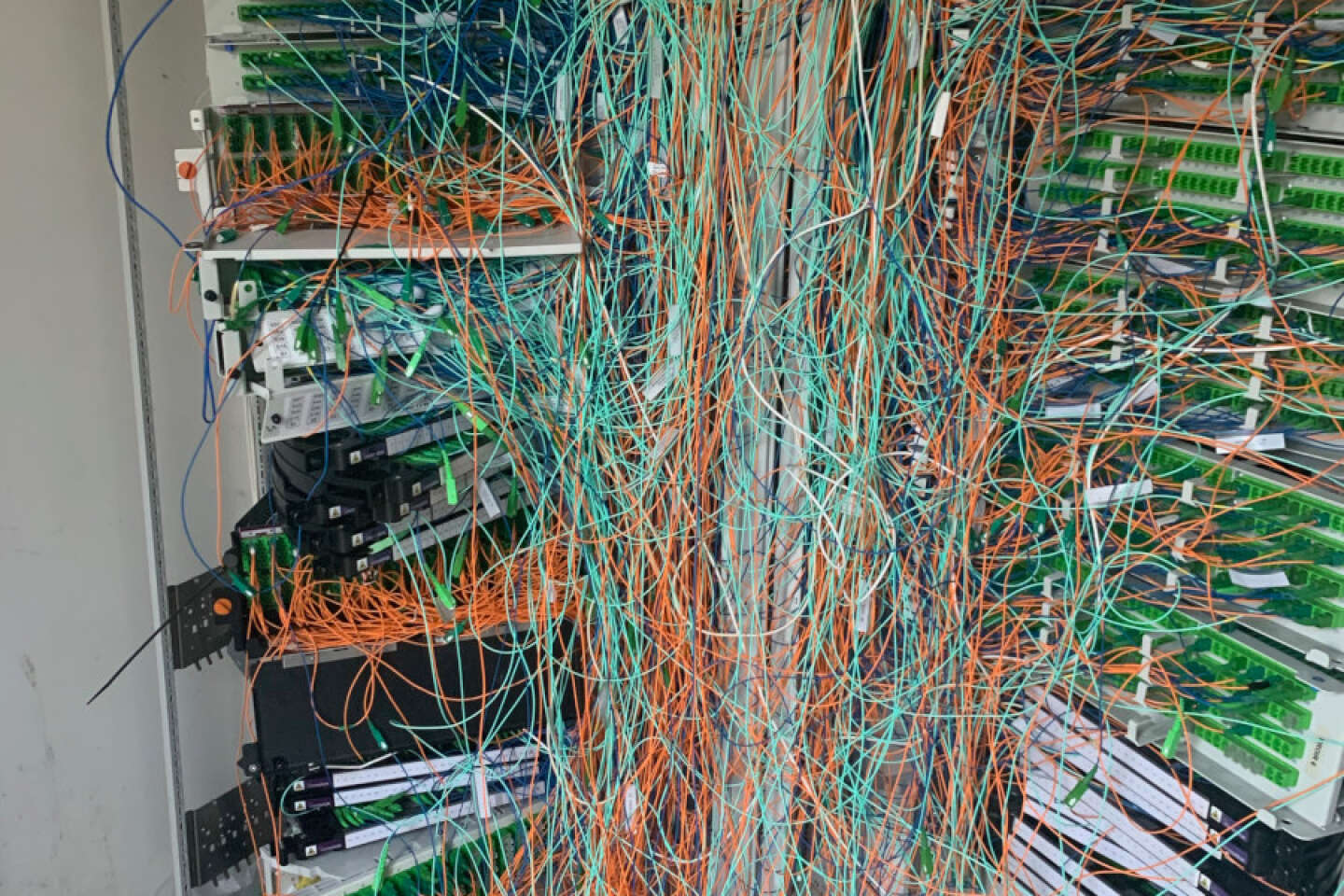
- France has 90% FTTH coverage in 2025, with 60% of households over 1 Gbps. One of the incumbents, Free (my employer), deployed P2P fibers in very dense areas but is switching to P2MP for economic reasons (and because this was not a competitive advantage). It's unclear to me if Switzerland plans to achieve this coverage with P2P. What looks great in Switzerland is not that each household has four dedicated fibers to the CO, but that Swisscom has responsibility for these fibers. In France, we have competition between operators for both services and infrastructure. In very dense areas, each building can have its own infrastructure operator (with an obligation to share); in less dense areas, this is by district (with an obligation to share); and in rural areas, this is a subsidized network (with an obligation to share). The downside is that there are "mutualisation points" where each ISP can go to plug or unplug subscribers, and they become a mess (https://img.lemde.fr/2020/06/04/300/0/900/600/1440/960/60/0/...).
BTW, I am also disturbed by AI-generated images. The ones with the three workers laying cables look highly unrealistic and made me pause for a couple of minutes, wondering if they lay cables that way in Germany. The ones about how households are connected to CO look like you get multiple 720-fiber cables to the same household.
- I took the image to be showing how inefficient it was to run that much fiber three times instead of just once. It’s unlikely that they’d do it at the same time but it seems very difficult to show buried fiber and a backhoe ripping up the street.
- In reality, this does not happen that way. If a path already exists, you can pay to use the same duct (unless it's full) to install your own fibers. At least, it works this way in France.
- It absolutely does happen that way in Germany. We had Fiber Company A rip up the entire city a year ago, and Fiber Company B ripped up the streets again just a few weeks ago.
ETA from my ISP to actually get any of those lines into my apartment is still 2028.
- This is a coördination problem: the municipality can mandate that every company has to install a larger conduit so that (say) 3-6 (?) other fibres can be run.
So if one company is doing the east part of the town, and another company is doing the west, at some point they could leverage the infrastructure of each other.
- > […] the municipality can mandate […]
I don't think so. German open access law says if you're in a "market dominating" position, you have to share access to what you have. I'm at least unaware of a law that allows forcing telcos to build more than they want. (And even if there were, it'd be balanced by them deciding to just not build at all.)
- [dead]
- I'm glad it works that way there. In the Netherlands, I've never seen a fiber duct laid in residential areas, it seems just plain fiber cables are buried.
Worse, two companies are chasing each other, so you have the ground being opened, closed, and within half a year the other company does the same. Even worse, they let the fiber cables stick out of the ground until the house subscribes to them, so a lot of houses have 1 or 2 ugly orange cables sticking out of the ground for years near the front door.
- at least in the Netherlands you got these nice street bricks, so it's not always a waste of concrete and patched streets. https://www.youtube.com/watch?v=Cq1kV6V_jvI
- Zoom in to see the real terror. Exited the article after seeing that.
- I’m curious as to how those numbers skew rural vs urban, as my experience in France couldn’t be further from fibre - have had a house there for decades, and we went straight from dialup to starlink, as there still isn’t even DSL available there. Fibre… don’t make me laugh.
It’s not like we’re super rural, either - small village, about 8km from two middling towns. The cell network isn’t much better - it’s 5g in the towns, and 2G or nothing as soon as you’re a few km out of them.
There is a fibre trunk running down the main road, 1.5km from the village, but when we enquired France telecom quoted about €250,000 to extend the fibre up to us. We passed.
Edit: same kinda deal with free.fr. If I check availability by address, it fails, as while the commune exists, the village does not, never mind the roads within it. If I enter the land line number, it says it is a mobile number and refuses to proceed.
So: your figures say 90%, but I suspect that’s a theoretical number rather than a real one.
Maybe it’s 90% of the 60% of addresses which got included in the statistics.
Edit edit: Ah hah, yes. I’ve looked at arcep’s methodology. That 90% is inventoried premises (homes & businesses) which:
- could be connected to FTTH, theoretically.
- exist in the arcep database
- are within several km of a live fibre
My home would be counted as “connected” by their methodology, even though there’s a quarter million euro bill to pay to make it so, and several km of fibre to run.
So - the stat is self-aggrandising bullshit, sorry.
- Plus, the fiber trunk that runs near your house is not necessarily relevant. What matters are the _endpoints_ of that trunk line. They’re not just going to dig it up and splice your house into the middle of that fiber bundle. (This is a critical difference between fiber and water/sewer services!)
Instead there will need to be a central office (CO) in or near those towns that has a fiber trunk running to it. Then smaller fiber lines can be run from the CO outwards towards potential subscribers. The cheapest way to do this is with PON (passive optical networking) service, where a single fiber carries 10Gbps or 40Gbps service that can be split using prisms to service dozens of customers. XGSPON is 40Gbps, serves up to 128 customers, and has a maximum service distance of 16km. If you’re the first subscriber in that area, that €250k might be for opening up a whole new CO plus running a PON fiber bundle the whole 8km between it and your neighborhood.
- Did you check on https://cartefibre.arcep.fr/? If your address is there, you will know the status of your address and notably the infrastructure operator, which has the obligation to cover your zone before 2030. If your address is not there (and the zone is empty, otherwise, this is up to your municipality to fix the missing address), it means there is no infrastructure operator yet. This is up to your local government to make a deal with an infrastructure operator to cover this zone.
As for the numbers, as it is open data, there are some sites like https://infofibre.fr/ where this is easier to see where we are. You can see that even rural regions have more than 90% of household coverage.
As for definitions, there are two cases for availability: immediate availability (infrastructure operator present up and you have at least one commercial operator after 3 months) or delayed availibility (the infrastructure operator has 6 months to make the address available after being asked by a commercial operator).
- It is heavily dependent on the history of your area.
I am near Lyon (12km away), I had 20mb then 100Mb coaxial cable very early because the "département" built a public network and eventually leased it to private companies.
I finally switched to fiber 3 years ago when it became available in my street.
The cell network is fairly bad however (even with 2 cell towers less than 1km from my place).
So geography and history count a lot.
- 12km away from Lyon is urban for all practical purposes. (It's literally the 3rd most populated city proper in the country.)
- Most states in America ban municipal fiber. They saw EPB (Chattanooga) and said, no, we must make sure that doesn't ever happen again. That is how 'free' market is done in US, all the rules are to make sure the richest people become richer.
- > That is how 'free' market is done in US, all the rules are to make sure the richest people become richer.
In all fairness, we put an awful lot of effort into making the poor poorer as well.
- This statement is easily refuted by looking up statistics on poverty.
- Except the definitions of poverty are defined to make it seems like it's not poverty. When you have a massive amount of the population that lives paycheck to paycheck, is one small medical emergency away from bankruptcy / can't pay their rent/mortgage. Will lose their job because of little to no protections. Very little social safety nets... most people are a lot closer to 'poverty' than looking at simple statistics.
- The definitions of poverty are used to measure relative wealth, not whether someone lives paycheck to paycheck. As income increases, paycheck to paycheck reports decrease, but at a certain point it then increases again. Living paycheck to paycheck is a poor measure, because you can buy a house that’s too expensive for your income, or a car, eat out too much, or make a variety of other poor life choices. That’s why the poverty index is good at measuring relative decreases in poverty because it ignores poor life choices.
- Living paycheck to paycheck is usually a choice: people earn a lot of money and spend it immediately. The fact that this leaves them vulnerable to misfortune doesn't mean they're poor.
- While this can be true, this absolutely is not true for the majority of paycheck-to-paycheck people. You truly need to get your head out of your ass if you honestly believe this is what is causing people to be poor.
- Do you know any of those people? Yes it’s almost entirely a choice. Typically a combination of poor life choices in tandem with poor financial choices.
- This is the most American shit ever. Pro-consumer regulations are rejected to the point that they start regulating against their own constituents.
- woah, I didn't know this. How many states have laws banning municipal fiber?
- https://broadbandnow.com/report/municipal-broadband-roadbloc...
It’s from 2023 but says 16 to 19 states.
- this is insane. I guess it's that easy for telcos to lobby the legislators for keeping up their rents?
- > guess it's that easy for telcos to lobby the legislators
16 states having restrictions while two go explicitly pro-municipal broadband doesn’t seem like a lobbyist’s panacea. Skimming the list of states with restrictions, they look like red states trying to bridle their blue cities. Partisanship seems the more-parsimonious explanation.
- ~100 million consumers (assuming average sized states are impacted) being essentially defrauded by a cartel of telcos - doesn't really matter what you wanna call it but I'd say it's a pretty major deal.
- You're assuming they are giving these people hundreds of thousands of dollars, they aren't. These are mostly state politicians that make between $50k-80k who rarely get a campaign donation above $10k. These corporations absolutely give them the bare minimum (seriously talking between $500 to $4k maybe), it's only federal Senators that typically make the big bucks since they have the ability to single handedly gum up the system to prevent legislation.
But yeah, it's not only easy it's very cheap. This is why you need a workers party so workers can effectively collaborate together to either primary the politician or convince them otherwise.
Oh and you can't just do this once either, it takes an entire life's worth of work and it never ends.
- I'd say first of all you need to put a lid on it, call this kind of thing again what it is (bribery), and make it illegal. Secondly, if someone wants a public office: pay them well (they'll still have the revolving door afterwards anyways), but all their finances will need to be published on a quarterly basis. It's not exactly rocket science, this kind of thing is implemented in many jurisdictions.
- What happened on Chattanooga?
- Resident here, it's great. EPB is the power company and internet provider. They run fiber anywhere they run power. They also have good customer service, local knowledgeable phone support, and inexpensive support services like installing ethernet drops for $50 each.
- It was apparently very successful:
- Unfortunately too successful!
- good cherry picking there
- I agree that's a scourge. But of course, it would be very disingenuous to call that a free market. It's not free due to corporate interference, which is why the situation is so bad for consumers.
- I think that's why they had 'free' in scare quotes.
- Swiss here. Just a minor clarification on the article: fibre is not available everywhere in Switzerland. Actually the rollout has been quite slow, and chances are that if you live in a rural or suburban area (like me) or in an older building then you might not have fibre, and are limited to (fairly decent) copper.
- i'm swiss and also own property in central berlin. while i was having insanely fast internet in all the places i lived in switzerland since the year 2000 (first cable, then fiber), german telekom has still not been able to connect my flat to fiber, even though the street facing building side is and i'm stuck with semi fast but fully overpriced dsl, which on top is spotty because someone decided to install cheap copper - while cable internet is not an option because 2 cable providers fight over who owns the access to the building.
whatever the roll-out in switzerland is, it's heaps better than in germany and most other places.
- Indeed rural areas are not as well covered [1], but in cities it doesn't matter if you live in an old building. As long as your street has fiber (most do by now), when you switch to a fiber connection from your ISP, contractors will connect it to your house (even if you only rent an appartment) and install an optical outlet in your appartment, all for free.
[1] https://map.geo.admin.ch/#/map?lang=en¢er=2634455.81,119...
- Yeah I used to live in Zurich before moving into the boonies. We were the first party in the house of 8 to want fiber, filled out a form, ISP contacted house owner and everything was up and running in a manner of days.
I now own (or rather the bank does) a small house in a more rural canton, and while it’s possible to apply for fiber, you have to pay a significant part of the cost yourself, last I checked it was more than 5K CHF. Not really worth it. I get 400 MBit/s over copper at home from Init7. When fiber is rolled out in the street, they will upgrade it for free.
Edit: added link to https://www.swisscom.ch/de/about/netz/anschluss/ftthondemand...
- Can confirm this guy is Swiss
Has arguably the best infrastructure and system in the world and will still find issue with it. A real Swiss hardly knows the horror show that is the rest of the non-Switzerland world.
yeah, fiber rollout is slow outside of the cities. It’s still better than 95% of the developed world. All perspective.
- We also have great chocolate.
- People endlessly complain that the SBB is 'always' late.
- Like if you have a semi-important meeting in Zurich at 9am It's perfectly fine to take a train which arrives in Zurich at 8:53.
And in an unlikely scenario that the train is late, everyone will agree that it's a valid circumstance.
- Assuming zero time to walk into office (just saying), one day they will start scheduling meetings at 8:53 because we all do get here at 8:53.
- Better to arrive (a couple minutes) late than to leave one minute early.
- My favorite example is here in the Phoenix metro area. We had DSL and cable internet pretty early compared to the rest of the country (mid/late 90s), but then things stagnated.
Then in 2014, Google Fiber announced they were expanding here and, all of a sudden, the local telco and cable companies (Centurylink and Cox) started rolling out fiber all over the place -- like pretty much overnight. Then Google backed off, and the incumbents slowed their roll too.
It was a on-the-nose reminder that these companies can move fast when they think a real competitor might show up.
- Weirdly, I live in a somewhat rural part of Brazil, and all providers are small players. They’re all offering 1Gi FTTH and are now competing on price. Meanwhile, the closest metro area still suffers with cable internet topping at 600M and low availability.
Some big cities have seen a surge of small providers too, which has been great for consumers.
That said, I dont buy the “natural monopoly” argument at all, especially trying to compare it to water supply.
- My wife is from Rio Grande do Norte and I'm always impressed that most of it has 1GB fiber, but roads are generally in poor repair and cell service is lacking outside of cities.
The ISPs are not always good at maintaining that raw capacity, though.
- Switzerland is 1/6 the size of Michigan and has 90 percent as many people as Michigan (9M vs 10M). With a higher population density I'd expect better rollout of things like internet service. And that's just ONE average size US state - there are 50, some of which are larger with even fewer people. It's not really a fair comparison regardless of which business or political factors are in play.
- So what's your excuse for why New York has equally bad internet?
- City or state?
City: just take a walk through manhattan and in a block or two look at the giant open-pit excavation with a 200-year-old morass of undocumented infrastructure under the street. This is before you even try to run fiber up to units in buildings which were built before electricity was standard. I am hardly saying it can't be done, simply that it is not as easy as density makes it seem.
State: the exact opposite problem -- just drive two hours north of NYC and (if you're not still in manhattan) you'll be in some fantastic areas of the state, but, the exact opposite problem exists.
Of note, I do think both of these problems are solvable and we should fundamentally solve them. Just anybody who thinks it's easy or cheap to do so is being myopic. If spent wisely, could be a very useful investment of our money, however.
- I was wondering why there wasn't yet a comment dismissing any change or progress in the US citing its land size, forgetting that the US has hundreds of large, dense cities where this "argument" does no hold.
Never change!
- These threads are always the same. "No way the we [the US] can have $nice_thing because density, size, heterogeneity". Applies to internet, trains, functioning democracy, a lack school shootings, and all things decent. It's all bollocks of course. Nobody is asking for a dense railway network across a desert or fast internet for every last cabin in Alaska.
It's such a bore.
Granted, Europeans (so me) can be arrogant about these things.
- The argument loses even more weight if you look to China's infrastructure over their massive country.
- I have a gentle rule, which is when discussing (geo)politics with friends, we should try not to use Switzerland as an example. It's just too good, too rational, too sensible, too well run, in myriad ways that other countries should be able to emulate, but consistently and constantly don't.
- I have a gentle rule, which is "if you can do it in one place, it is probably possible to do it in a second". The Swiss are not a separate species.
- There are a lot of things you can do in a rich, tiny, homogenous country that you can't do in a enormous, diverse country.
If my house were a country, I'd be in the top 0.1% of household internet speeds compared to other countries. Obviously everyone should be just like me!
- It's so homogeneous that there are 4 national languages, one of which is german with tons of loval dialects. It's so homogeneous that each canton has own sub regulations. It's so homogeneous that in it's biggest city, Zurich, 34% of people are foreigners and 45% born outside of Switzerland.
But we can look at the opposite part of spectrum - Moldova, poorest country in Europe - 85% of infra is covered by fibre, >90% of population has option to get 1GBit fiber
There are always reasons why something can't be done, just like solving frequent school shooting problem in US
- > It's so homogeneous that there are 4 national languages
Perhaps he's talking about a different kind of homogeneity (one that conventionally falls under the "racism" category)
> Moldova, poorest country in Europe - 85% of infra is covered by fibre
Do not arm him with arguments
- Americans are so used to racialized society that they tend to see "white" as a natural diversity/homogenity category, same with "Asian". And so they see "white Switzerland" as a homogeneous country.
That is absurd for anyone who lives in the Old World. Some of the worst wars in history were fought amongst people whom you wouldn't be able to tell apart in a sauna.
Heck, even Palestinians and Israeli Jews are physically very similar.
"White", "brown" etc. aren't meaningful categories in the Old World, with a few exceptions like South Africa. Most of the Old World is intensely tribal.
- [dead]
- > 34% of people are foreigners
I remember moving there, hearing talks about how international Zurich was, and then realizing most of those foreigners were German. :-) It's diverse on paper (and probably to the Swiss), but it's not like it's a cosmopolitan melting pot.
- Most immigration happens between neighboring countries e.g. the biggest immigrant group in Los Angeles are Mexicans.
If you exclude neighboring countries Zurich has a foreign born population share of 27% (compared to 18% of Los Angeles). If you only look at the last 10 years Zurich has foreign born non neighboring immigration of 10% (compared to 4% for Los Angeles).
If you only look at intercontinental migration then Los Angeles wins with 14% (compared to 8% of Zurich).
So yes Zurich is less cosmopolitan then LA, but most of it is just because the US has more diverse neighbors.
- Maybe you should visit Geneva then, or most of the "Arc Lemanique".
It's way more diverse than Zurich. Well, if you mean "diverse" as "more brown people" as your comment seems to imply.
- They really aren't.
- > There are a lot of things you can do in a rich, tiny, homogenous country that you can't do in a enormous, diverse country.
The US is a large collection of a whole bunch of rich (by global standards), tiny, fairly homogenous areas. We manage roads and schools at state, county, and local levels; we could do municipal broadband.
- The US being different is no excuse - this is really just a shortsighted retelling of American Exceptionalism.
Intelligent folks look at a system and figure out ways they can adapt it to their own situation. You can take systems they use for rural areas and figure out ways to do it on your own. The US is enormous, but most folks live in cities. States are tiny portions of the US, and some of those states would likely mirror Switzerland in diversity, density, and size.
It wouldn't matter if the country had a population density similar to the US and was similar in many ways. It'd still need adaptation because of the differences in culture, laws, and so on.
- Switzerland is one of the least homogenous countries in Europe! Four languages, relatively weak federal government with strong local (canton) governments. Most state services are handled on a localized (canton) level.
- The difficulties of American internet speeds have little to do with the total size of the country, but how far individual families are from each other. Spain is roughly the size of Texas, and Spain has a higher population, but you need a lot less fiber to each home, because metro areas are so much denser, and therefore it's so much easier to lay the fiber.
As usual, blame the suburbs, which make all kinds of infrastructure quite a bit more expensive per capita.
- But the US has long lagged behind in even dense areas. It's more than just the distribution.
- Right. It’s things like Baltimore (when I lived there) requiring that high speed internet had to roll out in poor areas first, before it could go into the rich neighborhoods.
But this was the early 2000s and the internet was still “new”. Only the richer areas cared and were willing to pay the price. Letting them have first (or even equal!) access would have made it easier to fund the rollout in low income areas.
- Huge swaths of our densest metro areas, in our largest cities, do not have any fiber option, just one cable provider.
- The NEC, which is the only area of the US that really has any density to speak of, does have pretty good fiber penetration.
https://www.reviews.org/app/uploads/2024/11/Verizon-Fios-cov...
- > There are a lot of things you can do in a rich, tiny, homogenous country that you can't do in an enormous, diverse country.
US states are little islands entirely capable of doing things like building infrastructure. There is no excuse for our states and their lack of movement, certainly not “the entire country is just tooooo big. whoa is us.” nonsense.
- The enormous, diverse country excuse is a good thought-terminating cliche but doesn't really hold up when the population of such enormous, diverse country is well concentrated along the coasts, with very dense rich pockets.
Sweden, for example, is tiny in population compared to the US but geographically its size covers from north Florida to NYC, with barely 10m people it's able to have great public transportation, fiber coverage to 80-85+% of buildings, cellphone coverage to 98% of the population even in remote locations.
Being enormous like the US might leave a vast area of low density population centres but it doesn't excuse at all that the areas where the vast majority of people live are dense enough to have these services very well covered. That doesn't happen though so the issue isn't being an enormous, diverse country at all.
- Many US states are richer than Switzerland, what's their excuse?
- >homogenous country
Tell me you know nothing about Switzerland without telling me you know nothing about Switzerland. Try asking a German Swiss what they think about a French Swiss or either about the Romansch.
- I wonder if there is some sort of metric for classifying how similar cultures are to one another. Are e.g. German Swiss more dissimilar to French Swiss, than are Florida rednecks dissimilar to Compton gangsters?
- I’m not even talking about the languages, we have 20% immigrants in the population, and an even larger part has foreign roots.
We also don’t have weapons in every household, if we’re talking myths
- > We also don’t have weapons in every household, if we’re talking myths
It all depends if you did your military service (which implies that you're swiss) and if you didn't decide to drop out of it or deemed as unfit. I don't think it's a myth really, it just happens to be that a lot of people don't do their military service and thus don't have to keep a weapon at home
- You’re right about the source of the weapons wrong about how many there are. An estimated one in five household has firearms, with a significant percentage not having ammunition at home at all.
Both LA and Miami speak Spanish, no?> I’m not even talking about the languages, we have 20% immigrants in the population, and an even larger part has foreign roots.
Only the Republicans have weapons in every household?> We also don’t have weapons in every household, if we’re talking mythsI'm joking, I realise that you are Swiss, but until I looked at the username I wasn't sure which side of the comparison you were referring to. Goes to show that even the nations' stereotypes are not dissimilar!
- HN layout got the best of me haha.
- If you ever heard them talk about each other, you would definitely assume as much.
- Homogenous? Tell me you don’t know anything about Switzerland without telling me…
- Rich is a key attribute here. Tiny, not really. The key is dense. That makes terrestrial connections cheaper. A country with the population of the US and the richness and density of Switzerland would be just as capable of building out high speed internet connections. It would have ~38x the population of Switzerland, cost ~38x more to wire, and have ~38x the resources with which to do it.
Incidentally, the northeast of the US has a similar or greater population density as Switzerland and is pretty rich. That area, at least, should be as capable of this sort of thing. Doing it for, say, everybody in Alaska would be a bit tougher.
I don't know what diversity has to do with anything here. As far as I've seen, people from all sorts of different places and cultures seem to like high speed internet about equally well.
- Infrastructure is laughable in northeast. And no, we do not have competition here in NJ. Yay "free market"
- Lately I come to believe that success stories are not necessarily transferable. They can require some traits of the system that are not available. USA is made for corporations, so you just cant replicate internet access from Switzerland in USA. Corporations will fight you to death in courts and they will win. They are not going to lose their monopoly. To change that you need to change USA in a massive ways, I can't imagine how it can be done.
- So one would think.
And yet, living in Switzerland after the UK involved one after another discovery of how well-ordered and -run a country could be. And then moving to Germany was like stepping back even further behind my memories of the UK.
I'm sure you could find examples of countries that do specific things as well as Switzerland; but I'm not aware of many places that do almost everything so excellently. (Maybe Japan, in many respects, but I lack sufficient direct experience to adequately judge.)
- I don't doubt there are differences.
I doubt they're insurmountable. Again, because the Swiss aren't some genetically superior subspecies. Culture can be changed.
I see Americans talk about how impossible universal healthcare is as if the rest of the developed world hasn't largely figured it out.
- The healthcare system is actually one of the few things Switzerland isn't doing that well. It's somewhat "americanized", lots of "extra" insurances for random areas that will only accept you if you're healthy. Base insurance is regulated, has to accept all customers, and you're required to (pay for and) have it.
The FR and UK systems are better IMHO.
Just to be clear, the Swiss healthcare system is still very good. Just not perfect.
- Nothing is insurmountable; however each one of us must play within the practical constraints of our local geographies (political, social, financial and physical). The parent comment probably means that Switzerland is in a positive on all axes unlike the rest of the world.
- It’s politics. Boil most things down and the technical is inconsequential when compared to the politics.
Look at the political system of Switzerland and you will see a radically different setup.
And I think that’s the horse. The rest is cart. Yes they are rich but why? Yes they are relatively stable socially but why? Decentralised Canton government structure + direct democracy (referendums all the time for things that matter). That, I think, is why all the rest.
- I think there's more to it than that.
From a philosophical perspective, I love the cantonal/direct democracy model. But it's supported by a strong culture of awareness of current affairs, and involvement in the political process. (Of course, these two aspects are likely strongly synergistic.)
However, I'm not sure this unique political structure explains the trains running on time, the sensible choices made about the internet structure (per the article), the top-of-the-world healthcare system, the Swiss cheese science institute, or many other aspects of the broader country. It may partly explain the routinely excellent government bureaucracy (say that with a straight face anywhere else!), the convenient and reliable local public transport options, and the local police being well-resourced to the point of apparent boredom.
- Awareness doesn't happen automatically either. During referendums ppl also get flyers explaining the subject, positive and negative things about it
Ppl also recently voted for eid which should reduce bureaucratic hurdles
Imo in many cases public transport problems in other areas are heavily related to corruption
- Heh, you were walking right up to my viewpoint and then turned away. A parliamentary democracy with proportional representation has way more influence IMO, and you'll find another couple of relatively well-run countries that work like that.
- Switzerland uses a system similar to the original plan for Obamacare, where individuals are mandated to buy insurance, so if Switzerland is what you mean by "universal healthcare" then it's not only not impossible, but the USA already has a more voluntary take on the exact same concept.
- The ACA has been steadily kneecapped since its inception.
And the “more voluntary” bit is pretty important. As is it costing about double.
- The US system is more expensive partly because Americans throw a fit any time insurers try to constrain costs. The blowup over anesthetists is one example. Swiss insurers seem more able to tell doctors they're spending too much and to cut it out, without patients engaging in lobbying efforts to stop it. It's a cultural difference rather than an important difference in system design.
- For me, this is the point of the article. People fought and the best decision was the result. And I suspect there's a fundamental cultural difference that makes the fight much less fair in America.
- > Culture can be changed.
Over the course of a hundred or so years maybe. Culture is hard work.
- Been an American my entire life. 45+ years. I've never heard a single person say that universal healthcare is "impossible".
- I'm an American and I've heard it often, usually with a bunch of strange excuses. We're too big, we're too diverse, there's too many states, and on. None of those actually make very much sense, but I've heard it all for why universal healthcare could never work in the US.
- https://www.nbcnews.com/politics/donald-trump/trump-says-not...
> President Donald Trump on Wednesday said it’s “not possible” for the federal government to fund Medicare, Medicaid and child care costs, arguing that it should be up to the states to “take care” of those programs while the federal government focuses on military spending.
- I guess I'm pretty confused on what your point is here?
Universal Healthcare would be a new program in the US that would see a drastic tax increase, in that our healthcare spending currently going to insurance companies would instead go to a new federal agency. The amount of money companies and citizens spend on it may or may not also increase, but your quote has basically nothing to do with that.
- That’s sleight of hand. “Ooooh! A tax increase! Scary!”
If I can pay $100 in tax to save $200 in premiums and copays, that’s a win. The US is an extreme outlier in healthcare spend.
- It's like you're purposefully misreading what I'm saying. I wasn't saying it was scary. I was saying that Trump saying we can't afford current programs has nothing to do with universal healthcare. Universal healthcare would be funded through a large tax increase, the majority (or entirety) of which would be redirecting the money going to health insurance companies.
Again, no one has said this is impossible, which is my original point. Even Trump's idiotic rambling, which was mainly about child care costs, said nothing about the impossibility of universal healthcare.
- We must live on opposite sides of US cause I’ve never heard anyone say that it is possible (except few politicans who thought it may be a good way to win an election but also knew that it was not possible and gave up once they got elected)
- > I'm not aware of many places that do almost everything so excellently
Probably Singapore, which is sometimes described as the Switzerland of Asia anyway. 10 Gb symmetric fibre is broadly available at around SGD $50/month (about 35 EUR).
- This is not to say that it isn't well run, but I think it would be fair to mention that Singapore is one of the most densely populated countries on Earth (#3 overall; #1 among countries with population >1 million.)
Separately, I am not totally sure just how widely deployed FTTH is in Switzerland. Here in Zürich it's everywhere, but zooming in on some rural place on init7's map tells quite a different story (perhaps not surprisingly).
- Singapore seems very oppressive and medieval when it comes to punishment of crimes. I wouldn't want to live there.
- Well and a little bit of research, tells me it’s far from universal across Switzerland. This article is so provable false in many of its premises it’s worthless - see my other comment.
- It's also too tiny to be representative of most of humanity
- Switzerland has a population larger than all but ~11 US states.
- It's got 9m people. The US has 30x the people and 250x the space. It's not comparable.
- So why do we struggle to get the infrastructure to work in dense urban areas still? Or even just “not Wyoming”?
Switzerland and California have the same population density. Why can’t CA build high speed rail?
- > Switzerland and California have the same population density. Why can’t CA build high speed rail?
Go find the last major Swiss route that was built, and compare its land acquisition difficulties to what happened with the California project. I'll rankly speculate that difference will be the meat of your answer.
- Building infrastructure is a skill, a skill you have to constantly work on. If you do it enough and not once then you can learn to get good at it. There is a difference between a long term consistent execution of a infrastructure plan and a 'lets build high speed rail'.
I don't think rules and regulation in California are actually worse then in Switzerland.
- Just for the information Switzerland neither does ;)
- CA’s high speed rail isn’t high speed by European standards and it looks on the way to cancelation or significant curtailment. We can’t even manage what y’all would consider slow rail.
- I don't know but Swiss isn't the only train system that works but also Spain, Italy, France. Poland has a growing better train system . The swiss system has it's advantages but it is also very expensive.
It might also worth it to check them out
- The advantage of swiss system is fast transfers. Hsr would likely break this system (no point in arriving faster if your connection gets longer by 10-15min
- That's a very National focussed perspective and thus definitely a disadvantage of the Swiss train system ;)
- I'm Swiss and I disagree, and so do many experts. First of all, arriving earlier is always good, because many people who get off on that stop still arrive earlier. Also, people who connect to a different mode of transit, such as Trams or S-Bahns very likely can catch an earlier connection.
In addition, if we built proper high speed lines, would could increase the frequency so much that it doesn't actually matter anymore.
So it doesn't actually break the system, it improves it.
Join us in advocating for this vision: https://swissrailvolution.ch/#goals
- I’ve ridden on several.
“Others do it even better and cheaper” makes the US failure to build and maintain infrastructure like this even sadder.
- Switzerland has a few sections of barely-high-speed rail such as the Lötschberg Base Tunnel.
- you going for the cherry-picked-but-functionally-meaningless statistic of the week award?
- I'm going for the "Switzerland isn't a little village of 50 people, we can learn lessons from them just fine" award.
Every large country breaks things up into small chunks. No one says Vermont can't handle a school system just because it's small.
- What is this supposed to imply? us states are also a poor representation of humanity. This matters a great deal: switzerland is notoriously ethnically homogenous and unable to get along with anyone. Life on easy mode!
- It implies that Switzerland is by no means so tiny their lessons learned can't apply to other multi-million human sized regions.
Switzerland gets along with others just fine, to the point where Italy and France used to handle their air defense on the weekends (https://en.wikipedia.org/wiki/Ethiopian_Airlines_Flight_702).
> The Swiss Air Force did not respond because the incident occurred outside normal office hours; a Swiss Air Force spokesman stated: "Switzerland cannot intervene because its airbases are closed at night and on the weekend. It's a question of budget and staffing." Switzerland relies on neighboring countries to police its airspace outside of regular business hours; the French and Italian Air Forces have permission to escort suspicious flights into Swiss airspace, but do not have authority to shoot down an aircraft over Switzerland.
- Try 500 mil and you'll see china is the only interesting sample.
If the swiss were able to get along with others, they wouldn't have such a reputation as racist nazis
- China is, as the EU (450M), US (340M), and Switzerland are, broken into smaller subunits for local and regional government.
- There's only two countries with over 500 million people and they're complete freak outliers.
- My god, Switzerland is literally the least ethnically homogenous country on the continent (if we ignore tiny nations like Luxembourg, Lichtenstein and Malta), with a third of its population being foreign-born, which is percentage-wise double that of the US.
- Ethnically homogeneous, you guys really just spew nonsense without doing _any_research? Swiss here, you’re very, very wrong
- Plenty big enough to be an example to be examined and perhaps emulated though.
- Lets just exclude the best example, as everyone knows, we should never try to be the best. Being the best is dumb, liberal and possibly communist. Settling for 105th, that's freedom and democracy baby.
- [dead]
- The geographic and demographic orders of magnitude when comparing these two places makes it difficult to extrapolate applicability of best practices. Who's to say the Swiss model scales? Article doesn't convincingly address this.
For context:
41 US States are geographically larger than Switzerland. It's most comparable state in area is West Virginia. West Virginia is .064% of the national area.
Some fun distance contexts. Driving end to end in Switzerland is comparable in distance to: Driving from Pittsburgh to Philadelphia, Detroit to Chicago, or New York City to Washington DC.
- Extrapolating with this method, large cities should be as well equipped as Switzerland.
Los Angeles has 10x the population density of Switzerland and around the same population density in urban area. Same for Washington dc, San Francisco...
It doesn't have to be an all-or-nothing. Distance between cities may be large, but the order of magnitude is closer when comparing within cities.
- Exactly. Whenever anyone trots out the "Bbbbut the USA is too large and sparsely populated to have X!" excuse, ask them why New Jersey doesn't have X.
- Yeah but like 10x the population, 10x the GDP, etc.
You're saying they laid down rail in the US from end to end during wild West times but modern infrastructure can't be built to the same scale even with mechanisation?
Lmao sounds like the UK. It does make sense tho, the world is now filled with middlemen and getting any job done costs 10x because of parasites.
- > You're saying they laid down rail in the US from end to end during wild West times
At a time when labor was dirt cheap and safety regulations were non-existent.
The railroads specifically used Chinese laborers who were treated, and paid, like shit.
- And also a time when people were laying down ties with their hands and a hammer.
This isn’t a labor issue it’s purely political. Some people get rich from the status quo and bribe politicians to prevent competition. America is increasingly corrupt, particularly since citizens united and accelerating under the current admin
- This is the same American-branded copium we see during discussions of socialized healthcare, which every other first-world country on the planet seems to manage. China has 10G and 50G home fiber. Zurich is larger geographically than Manhattan, while having much lower population density.
- Unfortunately, problems like socialized healthcare are just far too complicated for contemporary America to solve. We used to be able to tackle big problems, but unless you're looking for ways to dodge taxes or rip people off, we're just not equipped for complex problem solving anymore.
Guess we should have invested more in education.
- I guarantee you 99% of China landmass does not have 50G. Most of the country is ultra poor rice paddy farmers. Get real.
- Fine, 99% of China "landmass" does not have 50G. 100% of the US does not have 10G. The fact that in NYC, the richest city in the history of cities, most buildings still only have access to cable from a single provider is absolutely ridiculous. Urban centers is what is worth comparison here, and the US falls massively behind.
- Not all landmass because most of Tibet/Xinjiang empty, but ~100% wireless coverage east of Heihe–Tengchong line where ~95% of population are. Including Tibet/Xinjiang remote areas, ~95%+ of administered population areas down to village level where poor farmers have access to 5g AND fiber hookup option by now.
Building infra and networking gear is cheap in society that knows how to build and carriers are required to install in administered villages even if it's not profitable. Fiber adoption rate actually higher among rice farmers because they get subsidies, 1Gbps gigabyte fiber for cost of 200 Mbps in city and because bunch of villages got hooked up in last 10 years - they skipped straight to fiber which was bundled with road/power buildout.
Meanwhile US so dysfunctional / can't brute force rural fiber, need to literally invent SpaceX to plug gap. Which TBH is good copium.
- Why have fiber for a $1 when you can have space fiber for $1000!
- Sure, and we basically force users to choose one or two providers. Some of these are compelled to serve rural customers as well.
I live in the SF Bay Area, and have Sonic internet. 10gbe for 60 bucks a month.
I ended up building my own router/firewall because it was cheaper than anything off the shelf that could deal with that sort of speed.
It is entirely possible to have these sorts of services in the states, when competition is allowed.
- I believe you mean 0.64%
- In Canada our internet became much faster for cheaper with better customer support when the government allowed competition from smaller players. Telecom also got better when they allowed a foreign competitor to compete against the government mandated oligopoly. But the market is still heavily regulated in a way that benefits the existing monopolies.
- I think Canada is a great example of how not to do it, despite some price decreases in recent years. We seem to have (near) the worst of all worlds: huge geography, little competition, and government regulation that props up the oligopoly without driving prices down like Europe. Mobile data is even worse.
- I'm running out my contract with TekSavvy (~$80 CAD for gigabit) before switching to Novus (~$60 CAD for 2.5), and my partner and I just switched to Fido (~$30 CAD for 80gig and international calls/SMS).
Considering the geography and all the per-capita math (and pain), I don't think we're doing too bad as a country any more.
- That last one is a phone plan.. not exactly apples to apples (it's good, but an 80GB/mo cap is rarely enough for home.. and nothing like a 2.5gbps internet plan).
- Canada is very urbanized so your huge geography does not matter much. It is much harder to get fast internet in a rural and mountainous country like Norway and they have succeeded way better than Canada. I think the Canadian telecom oligopoly is almost entirely to blame.
- > In Canada our internet became much faster for cheaper with better customer support when the government allowed competition from smaller players.
What the CRTC did was force the big players who own all the infrastructure to allow resellers to resell their services, and have to pay no more than cost to the big guy.
Those "smaller players" have a marginal involvement in the entire network aspect. They usually host ISP emails and sometimes DNS. Some of them do provide better customer service than the upstream big guy. At least until they need upstream help to resolve your issue, then it takes forever.
The other type of small players, who install their own infrastructure in smaller municipalities, were not impacted by this change. Some provinces (SK, QC) do give generous grants to those small players to install fibers. But AFAIK there is no federal involvement specifically to help them.
- This article gets ahead of itself.
The issue isn’t the splitting. There is no fiber to even split in most places. A lot of places in America had their “network” infra built 50-100 years ago on copper and no one wants to pay to basically rebuild all of it.
I happen to live in an area where there are still above ground utilities.
We got >5 gig fiber fast. We have 700Mbps 5G. I literally watched them string the fiber on the poles.
It’s still not shared, but it’s fast because it’s new. Shared would be preferred, but you need destroy + “new” first, and most people are fine with what copper gives them. Shared may even be cheaper but most people don’t think we need to rebuild anything.
- I'ts almost certainly shared. 99% of FTTH is (X)G(S)-PON which shares the fibre over a few properties. Usually something like 32 max.
The Swiss use point to point fibre (there are a few small pockets of this elsewhere). But in reality it is very hard to saturate. XGSPON has 10G/10G shared between the node. GPON has 2.4gbit down/1.2gbit up shared across the node.
In reality point to point is not really a benefit in 99.99% of scenarios, residential internet use cannot saturate 10G/10G for long, even with many 'heavy' internet users (most users can't really get more than >1gig internally over WiFi to start with).
And if it is a problem there is now 50G-PON which can run side by side, so you just add more bandwidth that way.
- XGSPON is actually 40Gbps down, 10Gbps up. The 40Gbps is actually four separate 10Gbps downlinks on different frequencies. Filters are used so that each customer only sees one of those downlinks. Just a little note.
> In reality point to point is not really a benefit in 99.99% of scenarios, residential internet use cannot saturate 10G/10G for long, even with many 'heavy' internet users (most users can't really get more than >1gig internally over WiFi to start with).
This is so true! The whole thing about Netflix is such a canard. A 4K stream from Netflix tops out at 16Mbps. Other streaming services use 25Mbps, or speeds in between. 40Gbps is 1600 individual 4K streams, but XGSPON can only be split to a maximum of 128 customers. I guess if all of those customers have more than 12 televisions going at once…
You’re more likely to see congestion from many customers all hitting a speed test server at once just to see how shiny the numbers are.
- You're confusing XGS-PON with NG-PON2. NG-PON2 isn't really used anywhere AFIAK, the "real" upgrade path is 50G-PON (50G/50G shared). NG-PON2's tunable lasers are expensive so didn't get traction.
- Residential 2.5gb equipment is just starting to appear as a “default” and 10gb is still pretty rare, though accessible if you want it.
I don’t even have 25gb and I’ve a home lab!
- Same, I've wired the house for Cat6 and have a Cat6 prosumer switch, so 25 wired devices pulling at 1Gbps?
I clearly set my ambitions too low and should follow the Swiss model :-)
- I had 600mbps down/200 up (I could have upgraded to 1GB) and I downgraded to 175 down/50 up (to switch to a more reliable provider) and didn’t notice any difference (family of 4).
- Interestingly enough, most providers still run PON, but all their equipment, including splitters, is at the telco's end of the P2P connection. Apparently it is slightly cheaper to build out a PoP like that.
- Probably just the equipment is far far cheaper now (customer ONTs and telco OLTs) than point to point is my guess?
- Yep, exactly! I live in Switzerland. The article is misleading. Switzerland doesn't have 25 Gbit consumer internet, quite obviously, as nowhere does. It has a state-owned telco that advertises 10 Gbit to ordinary consumers without making it obvious to the buyer that they won't be able to use anything above 1Gbit without exotic and expensive equipment they are near-guaranteed to not have (unless they're literally a high speed networking hobbyist).
I noticed this years ago and thought it was an extremely sharp and therefore unSwiss practice, that in a more free market with better regulation and a more feral press would have already attracted a rap on the knuckles from the truth-in-advertising people. But Swisscom is government owned and has fingers in a thousand pies, so they're allowed to get away with it.
Unfortunately because regular consumers just compare numbers and assume higher is always better, this practice has dragged fully private ISPs into offering it now too. So the entire market is just engaged in systemic consumer fraud by this point. God knows how many people are overpaying for bandwidth their machines literally can't use without realizing it.
That said, the basic point Schüller is making is sound that the fiber cables themselves are more like roads than internet. They aren't a natural monopoly but the cost of overbuild is so high that it makes sense to treat it like one. It's just a pity that in the end this doesn't make a difference as big as the article seems to be advertising in its title.
- Sweden doesn't use much PON either. If a countries fiber build out started before gpon was released or got popular you likely continue a lot with point to point. There's a small drawback, TDM/A for the uplink, introduces some jitter but guessing it's not as bad as cable.
- Well a GPON frame is 0.125ms. So the best jitter is ~0.125ms, but even if the entire upstream segment was saturated you'd be looking at probably 1-2ms at absolute worse case. The OLT will not allow one user to hammer the upstream badly like you get with DOCSIS.
So it's really a non issue (XGS-PON is even better as more data per frame means heavy upstream 'clears' the frames quicker), IME consumer routers add more jitter themselves even with ethernet on the LAN side (and WiFi is a lot worse).
- Not great but much better than cable. I remember mmthe difference in smokeping as I switched from cable (very oversubscribed as well) to fiber.
- > A lot of places in America had their “network” infra built 50-100 years ago on copper
That's no different to Switzerland so far…
> and no one wants to pay to basically rebuild all of it.
…but the Swiss seem to have decided it's worth the investment.
> I happen to live in an area where there are still above ground utilities.
If anything, that can make things cheaper. You don't need to bury everything, and in some places (e.g. earthquake prone Japan) it's really counterproductive. But even if it isn't, it's certainly more expensive.
Sent from a 25G internet connection. My laptop only has 10G via TB though.
- > …but the Swiss seem to have decided it's worth the investment.
West Virginia is 1.5x the size of the entire country of Switzerland. Let that sink in.
Texas is 16x times bigger.
The idea that it should be doable in a country that is 100x bigger, with 50 separate states, god knows how many individual counties because it could be done in vastly smaller one is where your problem is.
- Yet somehow the US did manage to get power to most places...
The thing with fiber is that it can go so much longer than copper without any active components. It is also very future proof, you won't be pulling it out of the ground/off the pole for at least 50 years if not longer.
If size is such an issue, how did you get power?
- > Yet somehow the US did manage to get power to most places...
You're not conflating 2 different infrastructure processes and ignoring the one took decades, are you? This is like saying "The US has built a road infrastructure why can't it do all light rails?"
The irony in your comment is that it government intervention, which is the opposite of a free market.
- Who said free market? Swisscom is 51% government. A government-ish entity is IMHO the most efficient way to do this.
You can't have 2 road networks, highway systems, or railway networks. You can have, but it is pointless to, 2 water systems or 2 electric grids. Or fire brigades, or police. (criminal, not mall cops) Same applies for fibre in the ground. "Free market" doesn't work when you can't effectively compete.
- I'm sorry, but your stance is completely fing ridiculous. First of all, nobody is saying you need to do the entire US in one go by one approach and one provider. Second, the US has about 30× the GDP of Switzerland. Third, have you looked at Swiss geography? They're pulling fiber up the alps to the damn huts. Fourth, they're burying pretty much everything, as I said you don't really have to do that. Fifth, 26 cantons can squabble almost as well as 50 states can. Sixth, you're somehow assuming Switzerland is the only country successfully doing this. Sure, not everyone is doing it to that level, but take a look at Brazil.
If you're looking for reasons to fail, you will fail. The only thing your argument really excuses is that it will take longer. But the US doesn't have the political will to even start.
(Same for Germany, to some degree, btw.)
- 26 cantons with a functioning federal regulatory mandate isn't remotely comparable to 50 states where broadband regulation has been in a decade long battle over jurisdiction.
> Third, have you looked at Swiss geography? They're pulling fiber up the alps to the damn huts.
This is apples and oranges. The US is vastly more sparse. I think what is "f'ing ridiculous" is continuing to compare the 2 countries in ways they aren't comparable.
- I made 4 other points.
> 50 states where broadband regulation has been in a decade long battle over jurisdiction
Thanks for making my point, all I'm arguing is that Switzerland had the political will while the US doesn't (yet?) You're essentially arguing the problem exists because the problem exists.
It's a political problem, but a solvable one. Pretending that it isn't solvable really doesn't help.
- I don't have to refute all your points to prove it's impossible.
> It's a political problem, but a solvable one. Pretending that it isn't solvable really doesn't help.
Pretending like you hvae any clue how the US works doesn't help either. There are over 3,000 different counties in the US all with different rules around right-away (which could be one of like 6 different jurisdictions). There are quite literally hundreds of ISPs in the US. And even if one did want to build in NYC for instance, it would be have to interact with dozens of jurisdictions that don't magically go away with a strengthened FCC.
And again, you're totally ignoring the physical geography of the land. So how exactly does that work at a legislative level? Forcing ISP in which communities specifically? Then, it not only becomes a political, but fiscal issue as well.
Which is why saying "it's a political problem" is grossly over-simplifying the situation.
- In Mumbai, a fiber plan with 300 Mbps symmetrical is around USD 20 with tax. A 1 Gbps is about 50 USD with tax. Also includes a landline number, Netflix (plan depends on which fiber plan you use, the 1 Gb ones have Premium) and a bunch of other local subscriptions (some of which include HBO shows). Have never had a single hitch, and I can switch providers if I want as long as they have infra in the city.
Despite presence of some very big names (Jio, Airtel), there still is healthy local competition, and the former haven't been able to play any monopoly-related games yet, since it's quite easy to switch. The past few years have been a significant upgrade compared to what I've observed happening in the US. Providers might even start offering 10+ Gbit for consumers in the future, but I doubt there's a market for it right now.
- The comparison feels off because it treats Switzerland and the United States as interchangeable test cases for “free market vs. not,” when they operate under completely different constraints.
Switzerland is a small, highly cohesive country with strong local governance, high trust, and tightly scoped systems. The U.S. is a continental-scale federation with massive regional variation, different institutional layers, and far more heterogeneous populations.
At that scale, you’re not comparing “policy choices,” you’re comparing system complexity. Many policies that work in Switzerland don’t fail in the U.S. because they’re bad, they fail because they don’t scale cleanly across 330M people and 50 semi-autonomous states.
So using Switzerland as a counterexample to critique U.S. market dynamics isn’t really isolating “free markets” as a variable, it’s bundling in size, governance structure, and social cohesion, then attributing the difference to ideology. I know Switzerland is great, I've been there, but it feels like a bit of an unfair dunk and very much "punching down".
- While you are right about the differences between USA and Switzerland, I do not see any relationship between those and the problem discussed here.
There is absolutely no doubt that the system used in Switzerland is the right one and the system used in USA is the wrong one.
As TFA says, the optical fiber infrastructure that connects all individual customers is a case of natural monopoly and it must be built in a standard way and it must be shared by all who compete for communication services, exactly like the distribution of water or of electricity or like the public roads, which are the best analogy, and which must also be shared freely by anyone who provides transportation services.
- Many states prohibit municipalities to do fiber. Regulatory capture and monopolies are your problem.
Sweden managed to build out fiber almost everywhere and are much more like some of your states.
- How much bigger is the US than Switzerland? Its like 200x the size of it. Do you think that it's size and division of 50 distinct states might make that task a bit tougher?
- Was talking about Sweden. But it's ok, I know Americans find geography challenging.
- My bad, I originally said Sweden, but then edited to say Switzerland after seeing the title and doubted myself.
It's okay, you don't have to argue with the point being made or anything.
- I made the point elsewhere. Sweden is larger than California yet has only 10m population. Fiber is not just common in urban areas, you have it in small villages and even cabins in the woods.
Basically no state gets close, urban or otherwise. People here keep talking about size, rural, many states, whatever. The problem is really regulatory capture and monopolies, many states ban local municipalities from putting fiber down.
- Because it isn't a free market in the USA. And those that regulate it don't seem to care. Or maybe it is those that have been granted a monopoly do everything they can to retain said monopoly. Things would be different if we actually had a free market
- Some markets just inherently turn non-free very quickly when left unsupervised. Especially infrastructure markets.
- That may or may not be true, but in this case many cities signed exclusivity agreements with cable companies in the 60s and 70s when cable was becoming popular. Back then it was not technically feasible to have multiple cable companies sharing the same cable; the same set of analog channels had to be broadcast to every subscriber. Multiple subscribers, often hundreds of them in apartments, were attached to the same run of coaxial cable in a daisy chain or using splitters. Those agreements carried over to internet service once the cable companies started offering it. It made sense 50 years ago, but today it means that we haven’t actually had much of a free market. Now the FTTH is cheap and readily available, that is starting to reverse simple because the monopoly agreements only apply to _cable_ networks, not to fiber networks.
- Most markets inherently turn non-free when left unsupervised. That's the insight that folks like Keynes came to (as does any honest, informed observer with two or more functioning brain cells). That's why anti-trust and competition-preserving regulators and laws are essential. Without them, a very few powerful players form [0] cartels and/or tri/du/monopolies and enrich themselves vastly out of proportion with the value that they provide to their customers.
[0] ...often legally protected...
- There won’t be anti-trust as long as elections can be bought and there’s a revolving door between regulators and industry. We need a firewall to separate capital and state.
- Yep. But everyone's realized this ship has sailed in the US right? Regulatory capture is complete.
- No they don’t. What happens is that people want to manipulate the market for a variety of reasons, so they do that, and then really really smart people come along later and try to claim that those manipulators weren’t actually the problem but the solution! It is completely backwards, like reversing cause and effect. It’s like blaming a person for standing in the path of a bullet instead of the one firing the gun.
Want a free market? Stop messing with it.
- > No they don’t.
Yes, they do. Price competition and R&D are expensive activities. Businesses seek to maximize profit, as they're not charities or governmental entities. Neutralizing competition (whether by eliminating it or colluding with it) and entering into private agreements with suppliers and vendors to box out any potential upstarts increases profit. Another fine way for a monopoly or cartel to increase profit is to make their product cheaper to produce by adulterating it with inferior ingredients, but mislead customers about the fact of the quality loss, the reason for the quality loss, or both.
The natural stable state of a profit-seeking business is the establishment of a monopoly or cartel. You get the most profit when there is neither a need to compete on price nor a need to expend resources on improving one's product.
- That isn’t really true though, monopolies are not sustainable. Pretty much the only way to create a long lived monopoly is to collude with the government (also a monopoly btw).
- > ...monopolies are not sustainable.
You might be surprised to learn that the private sector can enter into durable agreements much like the public sector does. It's how things like mon/oligopolies and cartels form and persist.
Anyway. I'd suggest you go read your histories, but you're either unlikely to, or don't have enough supporting information to understand what they're telling you. If you're young enough [0] to be alive thirty to sixty years from now, and you're living in a place -like the US- that's steadily dismantling its consumer protection regulations, then do pay attention to how things have changed between now and near to the end of your life. Take especial care to track down the root causes of the differences, rather than just uncritically swallowing whatever explanations you're handed.
[0] ...and lucky enough...
- Loool. It’s pretty funny to have someone condescendingly tell you to think critically while they parrot the most banal, propagandized justification for government interventionism. One thing I’m definitely observing is a K shaped economy and massive inflation leading to worsening quality of life. I don’t really wish to experience that same thing for the next thirty to sixty years thank you very much.
Anyways, the problem with monopoly pricing is that it’s unsustainable despite whatever agreements are made, as companies will defect and/or new companies enter. In other words, it’s competition itself which prevents monopolies from lasting very long, and that competition comes partially from having a low barrier to entry. There is a reason why the most expensive industries tend to be the most regulated.
- And even with a free market, there's areas where making up the investment would be difficult, because the amount of effort divided by the number of likely subscribers, still wouldn't pencil out for 20+ years. A lot of Americans live in suburbs that are just low density enough that updating the infra to get fiber anywhere near the house is expensive, and then you might have quite a bit of fiber specific to that one subscriber. The difference in how much infrastructure you need vs a city is substantial.
- Yes, the duopolies are due to regulatory capture in the US.
A lot of ISPs need permitting that they will never get in order to enter a new market/location.
- Free market enthusiasts' reasoning is literary the same as Communists': when their grand theory fails to deliver its grandiose promises, it's nver because their believes where nonsensical, but because “it isn't real Communism/free market”.
- Communist regimes, especially the USSR, had nearly unlimited power to impose exactly the policies that supposedly would help.
Open societies, in contrast, must balance many competing interests and voting factions, meaning that free market supporters have limited power to enact their preferred policies, meaning they rarely can be implemented in a “pure” form.
- That’s a nice story. In reality the “open society” is open to takeover by international finance capital. It’s like running a server with “admin”:”password” SSH credentials — a security vulnerability that cedes control to outsiders. Imagine China and Iran allowing Larry Ellison to own their media, or allowing Larry Fink to control a big chunk of their markets, or allowing George Soros to manipulate their currency and operate NGOs within their borders. That would be plainly idiotic and suicidal.
“Open society!” coos the fox to the henhouse. LOL, no thanks!
- Seems pretty reasonable to me. Is your contention that we _have_ achieved some pure form of free markets or Communism?
- The thing is none of the “pure forms” are realistic outside of books.
If your system needs absolute theoretical purity to work, then it's worthless. And that's true of both communism and free market.
- I'm not sure this is true. What you're describing is the local optimum problem. Yes, the local optimum is better if you can't push through to a better one, of course. And heading merely 'towards' the better optimum often makes things immediately worse. But that doesn't make the better optima worthless, or ever-unreachable.
It seems a bit like saying humans will never fly. It's a question of technology level, in the sense that governance is a form of economic technology. Which is what leaves it open to people saying it can be done better.
The best solution changes over time, essentially. It's a question of fitness to the current context.
- Until you get a technology that makes people acting perfectly rationally, with perfect information and getting marginal cost equal to average cost[1], free market is never gonna work.
And until you get a technology that prevents leadership to be egoistic and corrupt, Communism is never going to work.
I'm not holding my breath for any of those tech to happen.
[1]: interestingly enough, such a condition is pretty much antithetical to capitalism as it requires capital to be free.
- I'm not sure I really understand. What do you mean by "never gonna work"? Because markets obviously do largely work, despite the fact that people are not perfectly rational and there are other inefficiencies at the edges. They have their degenerate cases, of course, but I don't think anyone would say markets "don't work" in general.
Most successful economies are largely market-based, as things stand today. Even the successful command economies (i.e. China) use markets extensively.
Unless you mean perfectly free markets will never be perfect resource allocators. Well yes, perhaps, but what does that matter if there's no perfect solution? The nudges required to 'fix' markets are a form of technology, as discussed. As such, it either exists and is effective or not.
- With enough regulations, subsidies, strategic planning and government interventions when things turn bad, mixed economies do the job pretty well, that's right. And when the regulation is lacking the outcome is as well.
And even these economies are structured around monopolistic and oligopolistic actors.
They are as related to “free market” as northern European countries welfare state is related to Communism.
- Right, those are the current technologies we have to make markets work in a particular way. They don't preclude other technologies which work with freer markets.
Like there's a whole zoo of healthcare provision approaches, for example. Single payer can work fine (ala Norway), but so can Bismarck (ala Switzerland). The latter is a technological architecture that _enables_ similar or better outcomes, while being closer to a fully market-based approach.
- It's not “closer to a fully market-based approach” any more than climbing a hill makes you closer to the moon.
Also, if you call regulations “technologies” (which I don't disagree with) then “free market” means technology-free.
- But climbing a hill does make you closer to the moon. There's nothing wrong with incremental progress towards a goal, assuming this is a goal for the free-market people.
Also, I'm not sure a free market is technology-free per se. What you're talking about is specifically ancap-like, but most free market frameworks involve a state actor that should (among other things) not allow for itself to be weaponized against other market participants.
Like the paradox of tolerance, you can't tolerate a free market for bribing your way to benefit from the state's monopoly on violence. I don't think the existence of this paradox destroys the value of free markets or tolerance.
- Totally, tons of govt. regulation and interference is what defines a free market. /s
- I wish this kind of perspective (international comparison) could be applied to several areas of the USA economy: tax compliance, campaign finance, and banking regulation. Good work, OP.
In Charlotte NC, I have 3 choices of internet providers, two of them fiber.
As you are doing with this post, "broaden the base." The vast majority of voters do not understand the issues here. That is your biggest obstacle.
My POV would call this regulatory failure vs free market lie. That way, the enemy is a smaller target.
Path to progress is to get a friendly state (WY, RI, TX) to pass the legislation. Then shop that around among activists in other states.
If people knew they were only getting 1/25 of a shared product, that would get political hackles up.
Thanks for taking the time to think this through and make your argument.
- I would argue that the Scandinavian countries are a much better example to use than Switzerland. In contrast to Switzerland Sweden leads the world in fibre access build out (while being geographically much larger). While I haven't seen 25 G internet 10G is relatively common and 1G is the default (at around 40-50 euro per month). The model has is quite similar to Switzerland though, open access fibre infrastructure with competition over providing the data, either using equipment of the main provider or using their own equipment.
- I live in Sweden, and I don’t see a fiber plan available from Telia, the biggest provider, faster than 1Gb!? https://www.telia.se/bredband/fiber
And I have the 600M plan since it’s less than half the cost of 1G but still plenty fast for my needs. Where do you even find 10G??
- I'm in a fairly rural part of Texas (the middle of some woods) and I've got symmetric 5gbps fiber. The last house I lived in had 3 competing FTTH providers when I left. I don't think the story is what it used to be anymore. I don't know of a single suburban development in the state that doesn't have fiber today.
The small ISPs have done an incredible job in some cases. One of the providers had 100% perfect uptime for 2 years, including riding through a catastrophic windstorm that took out the local power grid for ~5 days. I still had internet coming into my house while the water and electricity were gone.
I think the very limited power requirements of fiber vs copper is a huge part of what makes this work well in rural deployments. You can power your last 5-10 miles from one box with a battery for days. The fiber itself is also ridiculously cheap. No one wants to steal this crap. It's worthless. I enjoyed seeing the "Fiber optic cable, no scrap value" signs being posted for a while. We don't need them anymore though. The local meth enthusiast community is now fully educated regarding these materials.
With everything about fiber being so cheap, the last remaining problem is simply getting it from A to B. It's amazing how far sideways you can go in a day with one man on a ditch witch. You put 3-4 crews out there for a week and it's gonna get done. I've seen them go from nothing to installed customer terminals in 30 days. Sure, they break every utility at least once getting it installed, but it happens so fast the overall briefness of the disruption is worth it.
I'm watching some Comcast regional sales people absolutely lose their marbles after a really bad DOCSIS provider acquisition in my area. The door to door sales campaign has become completely unhinged. The copper infrastructure is on death's doorstep now. Fiber is going to bury all of this crap in a few more years.
- There are plenty of rural/exurban/suburban cities where Xfinity "10G" DOCSIS coax, HughesNet/DirecTV or Starlink are your only realistic options.
- My sister lives in Switzerland, in a remote place in the mountain from a small town. Even over wifi the bandwidth at her place is so fast it made my BitTorrent client crash repeatedly. The solution was to disconnect my system by deactivating the wifi, relaunch my BitTorrent software, set a rate limit to the download speed at 30MB/s, and then reactivate wifi.
- I've had various pains with QBittorrent (nox) which seem to vary based on the version of the client and the version of libtorrent used. Out-of-memory and resume issues, but varying according to the torrent size, number of simultaneous downloads, and version/configuration specifics.
Torrent software (the clients and the libraries) feel a little out-of-sync with prevailing torrent sizes and bandwidth availability.
- 30MB/s is not a lot. Which client was that? KTorrent can easily deal with more than three times that, which is what I get here in Poland on a plan that's not even the fastest one available.
- It was KTorrent! But to be fair I just arbitrarily thought that 30MB/s would be more than enough speed (at my place in France that's probably the fastest my internet connection is capable of), tried that, it worked, in a few seconds the file was there, and that was it. I didn't try to see how fast I could go before a crash, maybe if I would have set it to 100MB/s it would have still been ok.
- Seems like it would be good to move some of the stuff it does to a dedicated thread as I've noticed the UI freezing for some time when downloading a lot of data fast (but I believe it's more about my slow SSD than Internet speed). No crashes though!
- We already have this in Utah with Utopia with 53% coverage across the state (A state 5 times the size of Switzerland) so kind of weird the post is acting like Europe is special or something.
And there are lots of ISPs to choose from, several with 10Gbps symmetrical. Because it's dark fiber that you can literally purchase (I was quoted about $3k to purchase the fiber to the CO), there's nothing stopping you from putting 25Gbps optics on both ends if you are super determined.
- Ooo, does everywhere in Sugarhouse have access to this now? We've been up in Park City relying on wireless point-to-point but are about to move back down to the valley and that is very exciting.
- I live in a country where you can get 10Gbps fiber for ~ 10EUR. And one 1Gbps for the same money if they don't have coverage for the 10G.
And, having worked with the US providers all I can tell you is this: greed, and lots of it. And if they're the only option in an area, they will charge you a literal arm and a leg.
Just a small example: in a mall, there was a single provider Paid ~ 300USD for 5Mbps in 2024. Once we were able to upgrade the equipment and get a cell router, we got to pay about $50/mo for ~ 50-60Mbps. Mall provider not happy.
- The only reason I can see to not treat natural monopolies as government-owned monopolies is political: those in power benefit from privatising those.
Maybe this shows that Switzerland has a sane political system?
- Why doesn't X have Y? When talking about nations, that is typically corruption.
Why can't NationX have quality public transit? Corruption. Why can't NationX have quality political parties or politicians? Corruption. Why can't NationX have a quality education and produce people capable of understanding and supporting their own political system? Corruption.
- This is a thought-terminating cliché [1]. Not an actual explanation.
Like, why is the assumption that countries should be homogenous? Since when did geography, culture, industrial structure, natural-resource availability and national wealth become irrelevant?
[1] https://en.wikipedia.org/wiki/Thought-terminating_clich%C3%A...
- Very misleading article. There is only one provider init7 and coverage is definitely not good in rural areas. Here is an map : https://ftth.init7.net/
- Only one provider? What gave you that idea? Even TFA mentions four providers, and those are just the most popular, nation-wide ones. I live in Zürich and have a choice between 10 providers (going by the list of the local infrastructure provider[1] -- I don't know if that list is even complete).
Rural coverage is challenging, true. And Switzerland has some challenging terrain in places. But FTTH coverage is currently at around 60% of the population, and Swisscom's strategy is to reach 90% by 2035. That doesn't sound so bad, especially when comparing internationally.
[1] https://www.ewz.ch/en/private-customers/fibre-optic/fibre-op...
- I meant the only provider providing 25 gigs .
- The real reason for the “cartels” in the US is because of the cost of infrastructure versus the subscribers cost. Because the United States is so large there are only a few companies that can create the infrastructure required to service large area areas with fiber.
So companies that have the ability to lay down, fiber do so in necessary cooperation with other providers to create a large patchwork across the country. This means that network companies have to cooperate with each other to send traffic back-and-forth.
It’s not realistic or feasible to have the US government generate a fiber optic connectivity for the entirety of every household in the United States. In fact, the free market was the only realistic possible to deliver this.
- > The real reason for the “cartels” in the US is because of the cost of infrastructure versus the subscribers cost. Because the United States is so large there are only a few companies that can create the infrastructure required to service large area areas with fiber.
The "US is large" argument is non-sense. 40% of the US population lives in a coastal county:
* https://coast.noaa.gov/states/fast-facts/economics-and-demog...
And two-thirds of the population lives with-in 100 miles of the border:
* https://www.aclu.org/news/immigrants-rights/your-rights-bord...
The US population is fairly concentrated.
And even if it wasn't, looking at history, the US managed to bring electrical cables to just about every household in the country, and later telephone cables. If those two things could be done in the 1900s, why can't fibre be done in the 2000s?
- > the US managed to bring electrical cables to just about every household in the country
We had to pass acts of congress to pay for last mile electrical infrastructure for those who were truly out in the boonies and poor.
https://en.wikipedia.org/wiki/Rural_Electrification_Act
We paid a shitload of money to various ISPs to do exactly the same thing for internet, multiple times, and then just let them.... not.
- > It’s not realistic or feasible to have the US government generate a fiber optic connectivity for the entirety of every household in the United States. In fact, the free market was the only realistic possible to deliver this.
They managed for water and wastewater, which are a lot more complex than fiber.
- Electric is probably a better example, >20% of the US is on septic systems for their wastewater.
- "It’s not realistic or feasible to have the US government generate a fiber optic connectivity for the entirety of every household in the United States. In fact, the free market was the only realistic possible to deliver this."
Why? Other countries with similar population densities have done it. A bigger country should have an advantage due to economies of scale.
- I think he means it's not economic viable to the companies, however as you can see the Swiss model was defined by politics.
Even though, I agree with you it's possible, in my city the internet only got better when a monopoly was broken, and a state company decide to work in a new infrastructure, all FTTH, now I pay less than 100BRL for 300/150Mbps with that price 10 years ago it was only possible ADSL connections (25Mbps).
Now every major provider do have FTTH infra with great prices.
- Which countries? Density matters but raw volume matters too.
- This is just pure nonsense. The only reason for "cartels" is regulatory capture.
Most of the cost of an ISP is the so-called "last mile". Depending on your locale this is usually either stringing up cables on existing telephone poles or digging trenches, typically in the setback area between the road and the sidewalk that you might maintain but you don't technically own (or the municipality maintains an easement on, it varies).
Once you go from the premises to a central POP, the costs basically go to zero (per install). Backhaul bandwidth for a residential ISP is incredibly cheap, even free with peering arrangements.
The point is that geography really doesn't matter. Wiring up a 10,000 homes in Phoenix, Zurich, Shanghai or Sydney is basically the same (normalized for labor costs). The US is very spread out due to geography. It doesn't matter. The links between towns are a small fraction of the cost and often covered by existing rights-of-way anyway (eg railroads). You compare that to a highly urbanized and concentrated population like Australia where urban density is very similar to many American towns and cities and you're dealing with a very similar cost structure.
Think about it this way: if geography was the issue and not, say, artificial barriers to prevent competition (including from municipal broadband), why would the ISP lobby spend so much moeny to make municipal broadband illegal (as they do in many states)? Or why would they formalize a monopoly into a contract with an "exclusivity" deal (ie franchise agreement)?
- Because Switzerland is the size of Maryland. Imagine pouring all federal resources into one cramped state.
I thought spamming your own blog was not allowed here.
- >Imagine pouring all federal resources into one cramped state.
Bit silly to compare the size of countries but not scaling resources correspondingly.
- Switzerland and the US have almost identical government expenditure per capita. Maryland still doesn't have 25 Gbps home internet.
- That's kind of their point. A lot of those government expenditures go to things that citizens of Maryland may not want or benefit from.
- More federal spending goes to Maryland per capita than the US average per capita.
This isn't an an issue of people in Maryland not getting money -- they get robust federal spending and have a robust state budget of their own. This is simply: Americans getting what they vote for, which is notoriously not public infrastructure.
- Australia was able to do the same. It had the same US crony capitalism where private companies didnt approve the national broadband fibre network so had to use ADSL for 10 more years but finally a different govt party implemented the fibre network.
- Sweden managed to build out fiber almost everywhere. Size of California, quite urban, but you'll still have fiber in the rural parts or even your cabin in the woods.
- Init7 has on its blog another amazing write up https://blog.init7.net/en/die-glasfaserstreit-geschichte/
- Congress passed the Telecommunications Act of 1996 in the US which demanded network unbundling, splitting up the fiber/connections versus the internet service, demanding wholesale rate access to infrastructure. It was good.
Then the courts decided, meh, we just don't like it. We are going to tell the FCC otherwise. It all went away. The incumbent local carriers have now had monopoly power over huge swarths of the infrastructure. No access to dark fiber. https://www.dwt.com/insights/2004/03/federal-court-eviscerat... https://en.wikipedia.org/wiki/United_States_Telecom_Associat...
Verizon also sued, and said, sure, there's laws for unbundling. But, we really don't like them. We aren't going to deploy fiber if we have to share. And the court once again said, oh, yeah, well, that's fine, we'll grant that: we'll strike down congress's law because "innovation" sounds better. https://law.justia.com/cases/federal/appellate-courts/cadc/1...
It's just so so so much corruption, so much meddling from the court to undo everything good congress worked so hard to make happen, that was such an essential baseline to allow competition. I remain very very angry about this all. This was such a sad decade of losing so much goodness, such competition. These damn cartels! The courts that keep giving them everything they want! Bah!!
I think it was a other case,
- And this is almost certainly the direct cause of the Dot Com Bubble bursting.
https://www.youtube.com/watch?v=Wcv0600V5q4
We were bamboozled on a massive scale.
- I'm in Zurich and I have 1Gb. My provider is offering higher for no additional cost - I'd have to put in a new modem/fiber-to-Ethernet adapter. However my home network is cat-5e and my switch is also 1Gb so I don't bother - it's pointless.
- I get 1G (in the US) and am in a similar boat - I could pay for 8G, and my house is even wired for 10G. But..... all my network equipment is 1G, we rarely saturate it, and I don't want to shell out like a thousand dollars to replace my router, three managed switches, and three AP.
Actually $1k might not even do it all, but I could probably get the switches and router for just under $1k and leave the WiFi at 1G.
I suspect my 1G costs a bit more than yours though
- I run 10G on cat-5e, so don't let that be a blocker. Your switch and your devices and your router not doing more than 1G would still be an issue though.
Of course, my internet is only 1g/1g unless I want to pay to upgrade the munifiber's equipment, and they use good telecom grade equipment, so I don't.
- Unless your house is gigantic, cat-5e can handle 2.5Gbps just fine.
- I get 10g symmetric in Austin for $150/m. I had Cox before, and it was $180ish for 1g down and ~50mb up. Things are improving!
- Because Google Fiber HQed there. Come to Houston, where you'll pay >$200/mo for 5Gbit if AT&T covers your area or MUCH LESS if Ezee is an option.
- What provider has 10G? Highest I've seen is 5. Genuine question - I'll keep them in mind next time I move across town!
- You can get 8gb fibre for around $65/usd a month in Toronto.
- A couple of nitpicks (or nut-picks). AT&T is usually in competition with the local cable monopoly and runs FTTH where they run fiber. Google Fiber is installing as well, on the German model.
The problem in the USA is that we protect an incumbent's profits at all costs. Natural monopolies end up serving the monopoly instead of the community. For example, in Atlanta, natural gas is delivered by Atlanta Gas Light, priced on some theoretical capacity number for the most gas you'll ever need at one time (DDDC). We then pay marketers to supply the gas. AGL gets paid whether or not we use gas, and the marketer gets paid both a monthly fee and a rate per therm. It's the most expensive gas I've had in this country.
- While on surface scratch level this might be a good entry analysis it lacks deeper comparisons to other great networks nations Like Romania or South Korea. Is it cheaper there? What about coverage? Uptimes? Why is the service "better"? Why is it by the way a free market "lie"? ( For me a lie means a wrong information by purpose)
- I have 500 Mbps internet (fiber optic) with 40+ devices on it. I don’t see myself needing even 1 Gbps nor even close to 25 Gbps. At my enterprise, we have 900 simultaneous users to include thousands of CICD jobs, and we don’t even come close to 25 Gbps.
- I'm going to disagree. I have 5Gbit FTTH and it is SO NICE to have large files download almost as quickly as pulling from an old hard drive. Used to have 1Gbit before.
- People were saying the same thing about 10Mbps 15 years ago.
Things change, and 25Gbps is massive future proofing for the next 50 years probably.
- My point is I don’t even come close to the bandwidth limits. My latency is excellent. I had coax based internet and it was going down a lot. I switched to fiber about 5-6 years ago. Never went down once
- Yes, and my point is 10 years from now when you are streaming your 16k Netflix movie while saving all you 8k cctv camera footage to the cloud you might have a different opinion about gigabit internet.
- Money has a time value. It's better to build things just before you need them than decades prior.
- It's more of a "wow how could I have tolerated 500mbps" once you experience 1gbps and 10gbps.
- realistically the only part at half a gb/s I'd care is latency. Latency is a lot more important than the throughput.
- Bill Gates: “640K ought to be enough for anybody.”
- > Every home gets a dedicated 4-strand fiber line. Point-to-Point. Not shared. Not split 32 ways. [...] That dedicated fiber terminates in a neutral, open hub.
If you think about it, other than the "neutral, open" part, it's a return to the traditional phone model, where every home gets a dedicated point-to-point copper pair (or sometimes two pairs), which terminates in a hub (the telco central building) nearby, instead of being shared between several homes (though I've heard that, in the distant past, phone lines were also sometimes shared between households).
- Switzerland also happens to have over 5x population density of USA, and 80% higher household median income based on quick google.
- While Switzerland has higher median HHI than the US as a whole, the Bay Area in California does have comparable median household income.
In the Bay Area, Sonic does offer 10Gbps fiber internet in some places on new buildouts.
I struggled to find a use case for it, except as a WAN between a homelab and a remote datacenter where I could do crazy things like run an NFS server over the internet or stream training data to a GPU, etc.
- > crazy things like run an NFS server over the internet
Is that so crazy? If 10G was the default, you could just plop a cheap NAS at home and nobody would need to pay monthly subscriptions for cloud services.
- If only we didn't need redundancy...
- How is 1G insufficient for running a NAS over the internet?
- 1Gbps is even slower than a SATA SSD that can saturate a 6Gbps SATA link.
10Gbps gets you speeds only a few times slower than a PCIe 3.0 NVMe SSD. Except you can run that over the Internet!
- I'm aware of how fast an SSD is, but you're probably only accessing your home NAS from your phone or laptop which most likely won't have more than 1gbps, if that. If you're a power user you probably already have high speed networking inside your own home to max out a 10G link.
- If I only have 1Gbps, I'm not going to be using a NAS for something like /home, or other things that need to be performant.
- For cloud services, I only need to match the bandwidth my cellphone has for my home NAS, so 1Gbps would be fine.
10Gbps is like.... my /home on my desktop could be served via NFS from somewhere else and it would probably be barely noticeable. That's just another level of crazy.
- You can run several mutually exclusive frequencies on a single strand of single mode fiber in multi-gigabit speeds. The biggest drawback is that the module price can get quite high.
There's nothing inherently "wrong" with a P2MP topology for public infrastructure.
- Regardless if it's Switzerland, Germany or the USA. Everyone has better than we have in Australia. I can't wait to go back to Asia after citizenship to join the developed world again.
- Simple question that doesn't seem to be addressed by "speed tests".
Does 25Gbps matter? I mean, it's not like your online services are going to be "faster", right?
Is Netflix or any other web endpoint that normal people use going to be noticeably better because a household has 25Gbps rather than 1Gbps?
Doesn't this only matter for many simultaneous users of heavy web traffic?
- In most cases probably not. But the question isn't "who needs 25gbps" it's "why are we only limited to 1gbps if we're lucky in the US?"
- In terms of what one person consumes, it would be rare to make full use of it.
I wonder if this speed was available everywhere, would more people self-host?
- 1) Switzerland is tiny compared to the US. 2) FTTH is only available to about 60% of the population right now. It is not clear what percentage of those homes have access to 25 Gbit service.
While I think the model of having the government own the Fiber lines and selling access to providers has a lot of potential, it would be very expensive to build this out to even 60% of the US.
- It's absolutely true that ISPs in the US are horrifically anti-competitive, and also that they should be treated as utility carriers, like electricity companies, not as "optional" services.
But that said, it took more than forty years to electrify the entire United States[0]. "The internet", as we think of it, hasn't even existed for 35 years yet. (Yes, I know there were networks before that that the current system arose from, but that's hair-splitting. I don't think the kind of Internet the average person might even consider using existed before, generously, ~1995-1996.) Yet, 95% of US adults use the Internet, implying a penetration at least as high[1].
The median Internet speed in the US is around 250mbps down and is in the top 10 in the world[3].
The problem is that access and speeds are not evenly distributed, not that we can't get 22gbps symmetric down/up. We don't need to give people in cities faster Internet; truly, you do not need that speed to do day-to-day tasks. You don't even need the 1gbps down/150mbps up that I have. What we need to do is make sure people in rural areas can access at least the median speed.
That said, I think we could give it another 15-20 years and see where our country with around 36 times the population and 238 times the landmass is at in terms of speeds.
[0] https://www.christenseninstitute.org/blog/how-the-history-of... [1] https://www.pewresearch.org/internet/fact-sheet/internet-bro... [2] https://tachus.com/internet-speeds-usa-vs-the-rest-of-the-wo...
- It's because Europe can't innovate right?
- It's nice to hear about examples where the incombent duopoly telcos finally get off their ass as soon as there's the threat of someone else coming in and installing fiber. Sadly, in my hometown, the competition must not be so intense, since Bell and Shaw/Rogers literally just lie about having it, by renaming their service to "Fibe" Internet or literally "Shaw Fibre+ Gig Internet" when Bell's coverage area amounts to only brand new builds or neighborhoods, and Shaw (now Rogers) doesn't have a real fiber network at all, it's just marginally faster download ceilings with 15mbps uploads.
- Well, whenever my city has to vote on extending the Xfinity/Comcast monopoly, coincidently Xfinity/Comcast is giving $5 off pizza coupons at my local pizza place.
Bet they don't have that in Switzerland.
- Is the cost of laying fiber (via a public utility) to each household counted as part of the monthly internet bill, or is that funded separately? (eg. as part of property taxes)
- Australia copied the Swiss model and in a very short period of time we went from 2Mbps flaky copper to now you can upgrade most properties to 2Gbps fiber for around $300 one-off fee.
I hear 10Gbps is coming soon. The only annoying thing is that ours, despite being terminated the Swiss way, isn’t symmetrical, I think due to congestion on the sea cables?
- I highly doubt that. As a German who lived in Asia and now Australia, this is the most incompetent country. They can't get anything right. I live in the city of Sydney and can only get 1 Gbps down and 200 mbps up for 109 AUD a month. I lived in 2017 in Singapore and the internet was already better than that for 1/3 of the price.
Australia seems to be pretty backwards in general though.
- What a time to be alive to see people put "only" in front of "1gbps". We've come very far.
- In Belgium you get 500/100 for 65 euro, which is even worse.
- I'm on a 100mbit fixed wireless connection after moving out of the city where I used to have a GPON connection. The only thing I really miss is the extremely low latency of GPON plus being in a datacenter city.
Progress is good, and physical connections are well worth the investment due to how long the stuff will last. But I honestly think VDSL2 and cable are still good enough for most people. The typical family and youth are probably on 5G as much as wifi these days.
- I don't understand the desire (fetish?) for high speed home Internet connections at home.
I have 25 Mbps up. 10 Mbps down. Have had it for years. It's fine.
It's fine when both my wife and I are working from home and doing calls. It's fine for software development. It's fine for email and web browsing, and everything other than downloading maddeningly large files, 99% of which shouldn't be that large anyway. It's fine for watching streaming shows. Maybe if our kids turn out to be YouTube addicts when they're older we'll upgrade; maybe we won't for that reason.
What are people doing with their higher-speed Internet connections that makes it valuable to have such fast ones??!
- Pulling or pushing Docker images, downloading LLM models, installing AAA games from Steam. There are so many use cases that you won't see if you're just doing email and web browsing with a little bit of video streaming.
It's also helpful for off-site backup. I believe off-site backup is very important, and having gigabit upload is very helpful for this.
> I don't understand the desire (fetish?)
If you don't need it then you should be happy with what you've got, but calling other people's uses a "fetish" is unnecessary. And weird.
- I agree that calling it a fetish is weird, but I also have a hard time believing ordinary people are pulling and pushing docker images all the time.
The reality is that the reason these high speed internet political initiatives fail is that for most people internet access is a solved problem, and there isn't the critical mass of people to push through legislation.
Which is not to say that for a minority, it's not a solved problem, but the desires of those in a minority situation don't get prioritized in the democratic process.
- > installing AAA games from Steam.
it's weird how insanely large games are now, like 100's of gigabytes. I can't remember which game my son was playing, maybe DCS or some other milsim but it was around 300gb download. That's roughly 64-65 dvds.
- Gigabit is incredible if you are a dev
- It's Stockholm syndrome from what I can tell.
- Why?
- The total bandwidth up/down is only part of the story.
I was on a cell modem until very recently. Just the latency difference between gigabit fiber and anything else is noticeable for me. When a website loads a ton of stuff in a single page, some of that is serialized and requests are back to back instead of parallelized. The longer the serial chain, the higher you multiply your round trip time. This is especially so with auth providers that take you away and back to a site (or similar for online purchases via external sites (eg: PayPal etc.)) All of that time adds up.
So, my home connection is now down to 11.9 ms to google.com, my wifi adds another 5ms. I did "start timeline recording" and hit the google homepage. It just took 900ms to load the front page in Safari. On a good day with my cell hotspot, my latency is 35 at idle and goes way up (sometimes in seconds) when pushing bandwidth.
Video calls with 1000ms and higher latency are ... difficult. Especially when everyone else is in the sub 100ms range.
- Yep, latency's also big if you play competitive multiplayer games. With DOCSIS you get ~11ms +- 3ms added to every packet no matter what because it's shoehorned existing cable infrastructure. Fiber is much better in this regard.
Ping to my public IP's gateway address:
  30 packets transmitted, 30 received, 0% packet loss, time 29031ms
  rtt min/avg/max/mdev = 1.449/1.915/2.212/0.166 ms
- I've been consulting a long time, and my home is my office.
Besides the uses other people have suggested, here are some uses I would have for a fast symmetrical connection:
- Backing up data to my home/office NAS while away.
- Remoting to my workstation desktop from any location, for any reason.
- Using my home as a Tailscale exit node for clients for whom it's already a hassle to allowlist my home office's IP, so I can work from anywhere.
- Switching my nixos configuration using the caches in my home office where my custom derivations are built.
I have 90Mbps down and 20Mbps up. All of the above is workable but it would be great, amazing if it were faster.
The remote places I would do this from:
- the doctors' waiting room because we have teenagers
- the bleachers of the pool for the diving lessons because we have teenagers
- the in-laws spare bedroom where we're visiting for an extended time during school holidays but not work holidays because we have teenagers.
Some of us have different needs, under choices that we make that are optimal for other aspects of our life but not for having a slower asymmetric connection at home.
- > What are people doing with their higher-speed Internet connections that makes it valuable to have such fast ones??!
Honestly, most people go for the shiniest number they can afford.
But I will say that as a software developer who has had to fix bugs on random branches of very substantial software projects (web browsers), there is a tradeoff between recompiling the whole project and simply downloading the binaries that the CI system has already built. When I had to jump six months or a year into the past to test some old build, gigabit service was the difference between a few minutes to download the binaries and 20–30 minutes to recompile them myself.
But these days 100Mbps is really more than enough.
An interesting technology that might become a killer app in a year or two is 4D gaussian splats. This is a way of creating photo–realistic animated 3D scenes that the user can move around in, viewing them from all angles (without any need for artists to build geometry or paint textures). Right now streaming them in real time needs about 500Mbps. I’m sure that a few years of iteration on compression techniques will lower it significantly, but it’ll always be more expensive than mere 2D images (even animated 2D images). For reference, most streaming services use about 15–25Mbps for a 4K television stream.
- I use my home connection for VPN access remotely. I back up snapshots of data every day. I like to be able to download games and Linux ISOs practically on demand. I work from home and often enough faster speeds can avoid several minutes of additional waiting in a day.
This connection is shared as well. My partner relies heavily on cloud syncing. We both like to stream 4K HDR video. I like being able to get devices updated and ready to use with minimal time spent waiting for downloads.
I also live in NZ, where multi-gigabit fibre connections are often cheaper than what Americans have to pay for a fraction of the bandwidth. It’s not a notable financial burden or anything, and it’s not like we have data caps to worry about. It’s very much a situation where the use cases naturally find themselves once the option is there.
Also, 25/10 Mbps is painfully slow for a shared home connection in the modern day. There’s videos on YouTube that can push a higher bitrate than that. The absolute slowest plan that my ISP even offers is 100/20 Mbps for about $35 USD per month, while the most common/baseline plan for most households in NZ is 500/100 Mbps after the fibre carriers continued to increase speeds at the lowest tiers.
- I have gigabit synchronous fiber at home thanks to a group of local tech folk who built out the network. The biggest change for me is that I rely more on my NAS at home over a Wireguard tunnel for things I would have used the cloud or a hosting service for before.
Going to work? No worries about forgetting a USB stick or portable SSD. I can always just fire up Wireguard and grab it from home.
Sharing Jellyfin access with family and friends has also been fun.
- Working from home on raw and cooked SKA data and visualisations being remote served by supercomputing centres, team co-editing of multiple raw RED cinema camera channels.
Essentially any job that involves massive fat data streams that ends up having a real time collabrative hybrid remote team.
- > I have 25 Mbps up. 10 Mbps down. Have had it for years. It's fine.
This is dog slow, you can't even stream Youtube at 4K resolution with that. Downloading a reasonably recent game would also take close to an entire day. Not everyone needs a full symmetric Gbps perhaps, but 100Mbps is kind of a baseline nowadays, and more is better for faster downloads.
- >I have 25 Mbps up. 10 Mbps down. Have had it for years. It's fine.
Do you mean the other way around, 25Mbps Down and 10 Mbps up?
It is nice to have, especially when it doesn't cost much. That is why I am perfectly OK with PON rather than dedicated fibre. You only need the 1 or 10Gbps speed for may be a 10 min window per month.
I do think 25Mbps on a house hold bases is quite low. On a 5Mbps Video file I want the first 10 second buffer, 50Mbps done instantly. While I am loading multiple page in the background. Multiply that with a few more user in family. It is perfectly useable a you said, if you dont mind waiting.
Otherwise I think 50 - 100Mbps per person is generally the point we see law of diminishing returns.
- - Downloading local LLM models
- Downloading games, movies etc.
- Updating software.
- Doing remote data backups or restoring from them.
- Browsing the internet. Fiber still makes a noticeable difference especially in badly optimized websites.
- Maybe I've just got deep scars from the 90's, where I'd wait 15-25 minutes sometimes to download a single mp3.
I have a FIOS connection here at home, and it seems entirely sufficient. Even AAA steam games, I hit 'download' and go grab a snack in the kitchen and it's done. My server does incremental backups to s3 every night, but its not like i'm sitting there watching it.
I download a new large model maybe once every other week. It takes a few seconds, maybe minutes. I don't really notice either way? 25x faster doesn't seem like it would make any difference.
- I don't want to wait 6hrs to download a game patch that's 40gb or whatever because that's sadly the norm. With 1gbit I can do anything and it doesn't induce latency or cause connection quality issues with anything else because no one thing can come close to saturating it really, with a few exceptions (Steam being the main one). I can also seed at high speed to private trackers. It'd be an effort to max out a 25gbit connection at home that's for sure.
- Past 200Mbps down I typically see very little real benefit.
That said, I do find myself downloading packages and watching 4K video all day long. 25Mbps is noticeably slower the majority of the time. You can get by, of course, the same way you can compile an Xcode project on a 2019 Intel Mac (I still think MacOS 26 supports Intel?) but it's a significantly nicer experience on more recent M series machines.
Who likes to sit around waiting on downloads/compilation?
Now I'm realizing you said 25Mbps up, 10Mbps down. Wow, assuming this isn't a mistake, 10Mbps is slow enough to make even normal web browsing start to chug IME.
- Uploading 15 minute videos to YouTube, downloading hundreds of gigabytes of 3D assets, updating large applications, streaming movies for a 4k projector, frequently downloading beta OS updates, etc, etc, etc.
- Running speedtests to see that number go up. Mostly Hacker News though :D
- An example from someone who has lived at a condo in Asia. Around 8 PM the internet becomes unusable. Everyone's back home and they want to watch their favorite series. If you need to work at that time, e.g. if you work US hours, you are screwed.
P.S. I experienced this at different condos in different countries in South East Asia.
- Are you sure that isn't wifi interference?
- Most places in Asia, this is due to massive oversubscription. No relation at all to wireless spectrum.
- That's easy to claim, but there are a lot of places where everyone is surrounded by everyone else's wifi routers. If you have 9 routers that you share walls with and even more that can reach you, wifi starts to break down, but people will blame their service provider.
- I've been there a bunch, my colleague has lived there. We work in the telco area. My own experiences I would question, his I don't.
It's oversubscription.
Can I provide citations or proof? No. That's extremely hard to do with oversubscription in general, no telco will admit their exact ratio without being forced to. Sometimes you can reverse engineer it from peering relationships, but that doesn't allow identifying bandwidth constraints on medium haul.
- It's oversubscription.
You said that already, but repeating something isn't evidence. Oversubscription would be something that happens with cable internet on a node by node basis, so to say the problem is one thing and only that doesn't make any sense. Not only that but people will sign up for hundred megabit to gigabit internet but they only really need to watch some streams that use 3mb each.
You can actually figure out oversubscription if you ping nodes, especially over time.
There are more factors like international bandwidth, lack of caching servers in smaller countries so bandwidth has to be international, cable signal levels etc.
None of these come close to wifi contamination. If you have two neighbors trying to watch tv over wifi and you're trying to watch tv over wifi, you're sunk. Now take that to being surrounded by a dozen people, all watching tv over wifi and all watching videos on phones and tablets.
Unless someone is in a house, more isolated from their neighbors it is going to be a much bigger problem for almost everyone.
You can say 'oversubscription' because you're buddy said that, but even that can have some truth while still being a marginal issue next to the real problems. Even in places with great internet, people get a single wifi router, put all their computers and TVs on it, then blame their ISP.
- You seem to be making arguments with significantly less of a connection to the actual scenario being discussed. And you're explaining oversubscription to 2 network engineers, one of them having presented at APRICOT and APNIC.
I guess I should've focused less on oversubscription and made clear that we know it's not spectrum utilization. For that, we have the equipment to measure, and we did, and it's not the problem.
- For that, we have the equipment to measure, and we did, and it's not the problem.
It has been a problem for basically everyone living in apartments that had network problems that I've seen. If you measure at the wrong time it's going to look fine. You have to be there when people are watching video over wifi.
Again, just because people can't get their full bandwidth, it doesn't mean oversubscription is the actual bottleneck.
- 640k ought to be enough for anybody?
- The optionality of consuming services from places other than internet titans for one would be nice.
- > This is marketed as competition. But it’s not. It’s a cartel. Each company gets its own protected territory, and consumers get no choice.
Starlink has me extra excited for exactly this: region agnostic competition.
Get rekt, telecom incumbents
- It's definitely because of the free markets. Only because Init7, the provider who actually provides the 25 Gbit/s, is constantly fighting Swisscom, the government-owned provider.
- There should be more of shared infrastructure / government / law patterns, something like wikipedia but for running countries.
People all over the world seem to be fighting same little battles and falling into same traps all the time.
There are many known gems that present structure in ecosystems with correct incentives that do work, they should be known/discoverable and they should be consulted when making decisions.
- So the author's proposed solution is more government control. Pass.
- According to you, having public roads is an example of government control?
The "author's proposed solution" is the equivalent for communication of what public roads are for transportation.
- This factoring of a market to enable competition by centralizing minimal infrastructure seems the bedrock of best governmental practice. Are there other examples to lean on? How do we turn this into common knowledge?
- What? There is no free market with wired internet. State, federal, and municipalities entrenched local monopolies through "tax breaks", subsidies, over regulation, piles of permits, and many more.
The cable/fiber providers played all areas of government like a fiddle.
- The amount of people here who think any market failure in the US is due to it being a "free market" is kind of astounding. There are exactly zero "free markets" in the US.
- I don’t know if there are zero free markets, but there are an awful lot of thumbs on the scale.
- What does one achieve with 25 GB internet? Are speeds actually usefully faster, or is there some other bottleneck that makes the practical speed the same as in the US?
Also any workload I have that is bandwidth heavy would be on clouds machines between data centres and generally very fast. Are there reasons why someone at home would benefit from 25GB internet beyond whatever is available?
Is this a case of over engineered central planning instead of a blow against the free market?
- I think you misunderstood the article, or perhaps didn't read it?
So the way the system works is each house has 4 physical fibers into it, that go into a central office without being aggregated up. Inside the central office any ISP can offer any speed vs price option they want, because they just patch you in at layer 1.
So of course, most people wouldn't necessarily need to get 26Gbit. But if you want to offer it as an ISP you can, and it's up to customers to decide if it's worth the price.
One obvious use case would be folks that work with high resolution video. Uncompressed 8K is about 8TiB per hour of footage. Compressed raw like RED cinema et all are more like 1TiB per hour at the high quality settings.
25Gbit vs 1Gbit for moving 1TiB is 5 minutes vs 2 hours.
A quick google says the 25Gbit service from Init7 is $80 bucks a month.
Sounds like an astoundingly good deal vs what's available in the US to me.
- And a slightly more detailed Google search says it isn’t a sold or universally.
- Workloads emerge with higher capacity not other way around. Lossless media, to virtual reality applications all scale better with more available bandwidth.
An average AAA game is 100-200GB today. That is not by accident, The best residential internet of 1Gbps dedicated it is still 30 minutes of download, for the average buyer it is still few hours easily.
A 2TB today game is a 5 hour download on 1 Gbps connection and days for median buyer. Game developers can not think of a 2TB game if storage capacity, I/O performance, and bandwidth all do not support it.
Hypothetically If I could ship a 200TB game I would probably pre-render most of the graphics at much higher resolutions/frame-rates than compute it poorly on the GPU on the fly.
More fundamentally, we would lean towards less compute on client and more computed assets driven approach for applications. A good example of that in tech world in the last decade is how we have switched to using docker/container layers from just distributing source files or built packages. the typical docker images in the corporate world exceed 1GB, the source files being actually shipped are probably less than 10Mb of that. We are trading size for better control, Pre built packages instead of source was the same trade-off in 90s.
Depending on what is more scarce you optimize for it. Single threaded and even multi-threaded compute growth has been slowing down. Consumer internet bandwidth has no such physics limit that processors do so it is not a bad idea to optimize for pre-computed assets delivery rather than rely on client side compute.
- And even at 1Gbps when I had it, the game servers couldn’t keep up.
- I'll assume by "game servers" you mean "video game binary and asset distribution servers that support game stores like Steam and Epic and others".
When I paid Comcast for 1.5Gbit/s down, Steam would saturate that downlink with most games. I now pay for service that's no less than 100mbit symmetric, but is almost always something like 300->600mbit. Steam can -obviously- saturate that. Amusingly, the Epic Games Store (EGS) client cannot. Why?
Well, as far as I can tell, the problem is that -unlike the Steam client- the EGS client single-threads its downloads and does a lot of CPU-heavy work as part of those downloads. Back when I was running Windows, EGS game downloads absolutely pegged one of my 32 logical CPUs and left a ton of download bandwidth unused. In contrast, Steam sets like eight or sixteen of my logical CPUs at roughly half utilization and absolutely saturates my download bandwidth. So, yeah... if you're talking about downloads from video games stores it might be that whatever client your video game store uses sucks shit.
OTOH, if you're talking about video game servers where people play games they've already installed with each other, unless those servers are squirting mods and other such custom resources at clients on initial connect, game servers usually need like hundreds of kbps at most. They're also often provisioned to trickle those distributed-on-initial-connect custom resources in an often-misguided attempt to not disturb the gameplay of currently-connected clients.
- I am talking about console downloads
- Game downloads, whether on a console or a PC, come from a CDN. The difference is that Steam has a lot of capacity. They can have millions of players all downloading the same game on the same day at gigabit speeds. Console makers invariably cheap out and cannot reach the same level of service.
- Hell, it might be the case that console manufacturers are doing the same stupid shit that EGS is doing. Perhaps they wrote their download code back when 50mbit/s was a dreadfully fast download speed for the average USian to have and they haven't updated it since. (And why would they? What's a consumer's alternative other than "Pay 1k or more for a gaming machine that can run games delivered through Steam" or "Don't play video games"?)
- I can actually get 7 gbit but have no idea what I'd use with it. I'd need to upgrade my entire lan just to make use of it.
- It’s not official, but you don’t always need to replace Cat5 cable with Cat6 to support 10Gbps Ethernet. Cat5 might only get you a quarter of the range of Cat6 on a good day, but since the range of Ethernet is 300 feet you would need a really big house to have cables that were too long.
But generally the real question is how often the extra speed would give you a real measurable advantage. If it’s only a few times per month then it’s probably not worth the extra subscription cost.
- > I'd need to upgrade my entire lan just to make use of it.
If the concern is cost (rather than recabling the house) Mikrotik sells solid, inexpensive gear. Its management UIs take a bit of getting used to, but are fine once you've figured them out. You can also find two-port Intel 10gbit NICs on the Newegg "Marketplace" for ~40USD [0], and -while most already come with modules (and you will be informed if they don't)- if the X520s you're sold don't permit non-Intel transcievers, the NIC's firmware can usually be easily modified to change that. [1]
[0] <https://www.newegg.com/intel-e10g42bfsr/p/N82E16833106041>
[1] <https://forums.servethehome.com/index.php?threads%2Fpatching...>
- I routinely max out my 1Gbps connection downloading large files for work. 25Gbps would cut my waiting substantially. I'm not sure how likely it is that the server would be able to fill that pipe, but if such connections were common, they'd probably make it happen.
If people don't actually use the extra speed then it's effectively free to provide, anyway. If providers could advertise 25Gbps while only needing the same capacity they do for 1Gbps, I imagine they'd do it just to bring in a few more customers. The fact that they don't suggests it would result in more usage suggests it would be useful.
- How many times has this argument been made?
- I heard that argument when I got 28.8k modem back in the day when that was quite uncommon.
- Enough to make https://en.wikipedia.org/wiki/Jevons_paradox into a thing.
- > This is what happens when you let natural monopolies operate without oversight. They don’t compete on price or quality. They extract rent.
Sounds like racketeering with extra steps..
- Good take, and most of the data in the article is quite correct. The problem is a total mix up of cause and effect. The US has had a decent communication network since way back. We had telegraph, telephone and telex. Bell and AT&T and all that stuff. We've invented and piloted modems, T1 and cable TV.
Our infrastructure at times goes back 200 years old. We have rules and words in today's networking linguo that go back 70 years old. You can't just go and tell that it would have been better this way. It absolutely would. And I'm happy for Swiss people who can have 25gpbs at a fraction of the cost. But you can't do that with an emerging tech that is trying to replace existing architecture.
Swiss guys built all that after the tech was wide-spread in the world, and they have built it over a very outdated infrastructure. It was a breeze.
US just unable to use this approach. We can't.
Should we come up with a new one? Yes. Should we look at the Swiss solution and try to replicate it. Yes. Is it awesome? Yes. Would it work here? No.
- Ehm,
Do you seriously think 70 years ago Swiss had no telephon net so they create a new one?
Or is this argument that US is just too special to change?
- This is about urban Switzerland. Way out in the country, we still have crap copper up on poles, which maxes out at 25 Mbits.
But yes, Swisscom (owners if the old crap copper) do have to let the competitors use it.
- Yes, that is sadly still the case but the expansion of the fiber build out is now rapidly moving forward. By 2030 +90% will have fiber
https://www.swisscom.ch/en/about/news/2024/02/08-weniger-kup...
- That's actually terrible. The UK (which has been a laggard in FTTH in Europe until very recently) is at 84% FTTH coverage already.
- Swisscom has to do better, as regulated by the government. One can get 80/8 Mbit/s for CHF 65/month: https://www.swisscom.ch/en/residential/landline-subscription...
- > 80/8 Mbit/s for CHF 65/month
This is a terrible value, and good luck uploading anything at 8Mbps...
- Currently also have copper and Sunrise cable. Just got the cables to the house two weeks ago. I’m now waiting for the local electricity company to get in-house installation. Everything at no costs. So yes, it’s progressing fast.
- The author keeps repeating this idea of a "dedicated internet connection" (DIA), and it kind of just irks me. Not because the author is wrong in how they use it, but because the term itself I find misleading, and I hate to see it continue to poison the common discourse.
A dedicated last-mile connection gives you a dedicated link to your ISP’s edge network, not a dedicated path across the internet. You won’t compete with your immediate neighbors on a shared access network anymore, sure, but you’re still sharing the ISP core, peering links, and transit links with the rest of their customers.
In practice this usually works well enough, because ISPs engineer their core and peering capacity with low over-subscription, especially for business and DIA customers. So you can often push near line rate anyway, but not because you have a truly reserved slice of the internet. A Switzerland-sized country would need like petabit-scale connectivity to provide actually dedicated 25G links (or even just 1G links) to everyone.
- Very true. The bottleneck isn't going to be the last mile nearly all the time. In any case, it's clear we're arguing with a ragebait article and a bunch of others who have basically no understanding of how the Internet (or networks in general) works.
- I live in a small town (~10k) in Hungary and we have 4Gbit fiber here
- This article would be so much better without the generic AI-generated images everywhere.
- Agreed but I didn't want to just take random images from the web that I don't have the rights too and I my artistic skills are not good enough.
- You can search for Creative Commons images on Google. Though, honestly, a longform piece would've been much better than the glitchy face horror show that is that "fiber-laying in Germany" image, which is a composite of hundreds of thousands of random images from all sorts of places!
- You could just not generate extra images that aren't relevant to the article. I like the charts and diagrams even when they're AI, because they serve a purpose. But the extra images for flair or whatever are completely pointless and even annoying.
- I would go a little further (and apologies for being rather blunt): but I find the over-use of irrelevant images to be rather insulting, as if I am unable to maintain focus on an article, without the frequent shiny object.
- I wouldn't necessarily call that further. The images I like are relevant because they visually explain things that are helpful. The images I don't like are irrelevant because they serve no purpose other than to Be Images for no good reason.
- Ok thanks. I will keep that in mind for my next post.
- Please ignore them, the images definitely helped understand the issue better. Don't anchor on a couple of grouchy hn posters.
- Hey there were a lot more before the feedback, the irrelevant ones have been removed[0]. The remaining images in the article are good :)
- i agree, i do like the article content itself, but the AI-generated images (clearly nano banana btw) really kill the credibility. even just using stock images with the watermarks clearly visible would be better
- Actually, Ziply Fiber offers 50Gbps symmetrical service in the Northwest of the US: <https://ziplyfiber.com/internet/multigig>.
The free market is not a lie, it’s just that a lot of our politicians have lost their faith in it. That lead them to agree to local monopolies. Ziply, however, has broken out of that model and has been growing aggressively. It’s not perfect, but it’s good.
- oooooo how did I miss this before
- Probably just because there are so many ISPs in the USA that keeping track of all of them is impossible. I only know about it because I’m a customer (but not sadly of their 50Gbps service; maybe one day).
- Im genuinely curious what is a use-case for 25GB Internet in a typical Switzerland household?
- It's true that few servers even provide that kind of bandwidth. That's why I personally stick to 1 Gbps and save a few bucks. But I have friends who use the 25 Gbps e.g. for off-site backups (a NAS at the office for home backups, one at home for office backups). Stuff like game downloads or uploading large media are also sometimes mentioned. And you can really benefit from the parallel connections in P2P stuff.
- Even in Wireless / Mobile Carrier they have company like American Tower / China Tower that shares infrastructure cost. So none of this is new, I always thought the reason it is not done is because of company interest and politics. Internet should be treated just like Electricity and Water.
There are other things we could do without completely changing the dynamics or policy. We could mandate all home leasing and selling to have Internet Speed labeled. Giving consumer the knowledge and choice. And all future new home to have at least 1Gbps Internet and upgradable to 10Gbps or higher as standard. The market will sort itself out. And give government some space and room to further negotiate terms with companies.
Now the technical question, why no sharing? why point to point? why 4 fibre and not 2 or 8? And the no sharing is a little bit of gimmick, because at the end of the day everything is shared. The backbone has 100Gbps and you cant have 10 labours all using 25Gbps. I also dont think P2P make sense in a metropolitan city like Tokyo, New York or Hong Kong, especially in high rise, ultra high density buildings with limited space. When 50G-PON barely meet demands we are looking at 100G or 200G-PON. Individual fibre is simple not feasible in those settings.
- I wonder if the spare fiber connections could be use to mesh houses together, in a kind-of decentralized way?
- Because Switzerland is a tiny country that holds wealth extracted from whole wolrd's economies and that's just not replicatable even by the US?
- I can confirm init7 and the whole setup in CH is indeed working well
- Australia and the UK both have a similar business environment to the Swiss model (but without the superior bandwidth) due to the way that their government-owned telephone monopolies were privatised: Telecom Australia (now called Telstra) and British Telecom (now called BT) were required to allow their newly-formed competitors to sell services over their networks (for appropriate maintenance fees, of course).
The US and German models are consequences of just yelling 'Free market!' without stopping to think about what's actually being sold in that market, and how to encourage genuine competition.
- Australia is still pretty messy, Telstra was privatised and pretty much stopped upgrading their network for years around the 24 mb ADSL level
Eventually we had a forward thinking prime Minister create a new company that started running fibre to homes and wholesaling it to non government businesses but they lost power and fibre to the home became fibre to the neighbourhood running the last bit over existing phone lines
Eventually it was returned to fibre to the home as upgrading existing lines to run shitty 100mb connections was actually much more expensive than just running fibre
We're only now starting to get to the point where fibre is fairly available when it could have been ten years ago
- They stopped upgrading their network because government was publicly implying they'd do something nationally on broadband.
Before then, they were rolling out fast internet. Telstra's cable network (aka. BigPond Ultimate at the time) could do 100Mbps fifteen years ago!
Today, the Australian government continues to stomp on the neck of the free market. Numerous initiatives for faster and better privately operated fiber wholesale networks have been sunk by the government, including TPG and others.
TPG wanted to roll out faster AND cheaper fiber in the inner city. Government said no thanks, we'll keep NBN with abysmal upload speeds to protect our investment.
- > TPG wanted to roll out faster AND cheaper fiber in the inner city. Government said no thanks, we'll keep NBN with abysmal upload speeds to protect our investment.
Allowing other networks to take away the easiest, highest margin customers would break the NBN. It would likely lead us back to an unfit for purpose, "Free Market" situation, that further disadvantages rural, regional, and remote communities.
- I disagree, Sol Trujillo became ceo of Telstra in 2005 and immediately started cutting everything to the bone, Kevin Rudd didn't even get into power until 2007 and the NBN wasn't announced until 2009, fairly large gap there
- > Telstra's cable network (aka. BigPond Ultimate at the time) could do 100Mbps fifteen years ago!
Mhmm, it was great. But at what cost, you had on most plans a 1GB monthly cap.
And then when I went to an ISDN connection they wanted 9c per megabyte. To be fair, they would let you do things like join their squid proxy caching hierarchy, but bleh.
- We've had the same issue in the Netherlands as the UK (telecom getting free infrastructure), and the end result is them blocking every fiber connection for years and then buying up all of the ones trying when it suited them. And the cable companies had a freebie for decades because they got most of their infra for free without the "share space" requirement (because only a major part, and not all, was funded by municipalities and it took a while to get them all in one company), and the cable companies decided not to invest in anything. And now we have the fiber-to-the-bottom where they are installing as fast as they can, but only with a governmental monopoly in place with dubious sharing agreements.
Due to "competition" and "fare ride" my soon to be (it's taken over 4 years and likely will take forever..) fiber will cost me 22 euro/month more than if I would have gotten the cable from across the road ... but the companies have "exclusive" rights since they would not have "financed" it otherwise (the quotes are all marketing bs).
- In the UK, they split the infra provider (Openreach) from the consumer company (BT). So it's no longer BT giving access to the other providers.
In theory, BT has no special access to the infra at all, and they're on a level playing field with other providers.
That may not be perfectly true in practice, but my impression is there are no large differences between providers on the same infra. Choosing between providers mostly comes down to packaging and customer service in the end.
- Australia has the absolute worst internet
- > The US and German models are consequences of just yelling 'Free market!' without stopping to think about what's actually being sold in that market, and how to encourage genuine competition.
The point of a system is what it does. In America, it fosters centralization of wealth on a massive scale. That’s the point, not some unexpected side effect of the theory nobody saw coming.
- The UK could have had it decades ago, but the Thatcher government didn't allow it. Instead the UK gave permission to a couple of companies to dig up the streets and lay infrastructure in places of their choice. Those companies later merged into one shitty company called Virgin Media. The places they targeted were easy, dense neighbourhoods. BT, on the other hand, was required to provide everyone in the country with a phone line, no matter how remote. Today Virgin Media offers asymmetric gigabit and it's still the only choice for many because real fibre rollout is happening at a glacial pace. They also get people to sign 18 month contracts which aren't terminated if you move house. In some places, like mine, existing conduit means some ISPs are allowed to run their own fibre and these are some of the best connections available today. But most ISPs still get you to sign 18 month or longer contracts. The shitty ones, like Virgin Media won't even terminate your contract if you move to place they don't supply.
- italy, a house in the so called 'rich' nord est, where 'Lega' party has been ruling for decades:
* no fiber in the neightbour I am * internet on mobile: 10M when lucky * all houses have no city water pipe
I'm glad they started to collect blak water (a month ago)
- Currently in Palermo old town. Got fiber and get 200+ mbit over wifi. Even 5g when I go out.
- Dumb questions if the fiber is open to anyone, what service does the internet provider actually provide?
- They give you an IP address, maybe ipv6 or a static ipv4 address if you pay more. They compete on quality of service, network policies, backhaul capacity, price, necessary services like DNS, extras like email or bundled Netflix subscriptions, etc, etc.
Some of these qualities are more legible than others.
- The equipment on both sides of the ‘tube’. Oh, and the backhaul to said equipment.
- They provide layer 2 and 3 of the OSI model[0] and usually other related services like DNS, DHCP, email etc.
- This article is hard to take seriously when it presents 25 Gbps internet like it's available everywhere in Switzerland. Even the page you click on has an "Up to" and requires you to enter your address to check availability.
That's on top of the usual problems with comparing small European countries to all of America. Switzerland's entire population is barely larger than the population of New York City. There are several metro areas in the US with more people than Switzerland.
Switzerland is also very, very small. It's lands mass is equal to about 0.5% of the United States. We only have a handful of states smaller than Switzerland.
There are valid geopolitical discussions to be had, but it's hard to read these articles that single out tiny little European countries and compare them to the sprawling United States and ignore the elephant in the room.
- Ho-lee smokes is that Speedtest screenshot even real? Have some mercy for those of us in third-world infrastructure (US).
- As someone living in neither country 50mbit is good enough for me and I have several times that already. I wouldn't wanna pay more on my bill for a rollout of newer tech when I'm perfectly happy with what I have.
- I think the federal government should stop giving money to ISPs. They do nothing and just waste the budget. And, we should also use approach where ISP can use same fiber connection.
- This is true, but not in the city of Chattanooga, Tennessee. Chattanooga through EPB has had 25Gbit residential fiber service since 2022. EPB is the most successful municipal fiber program in the US, and has resulted directly in the creation of other municipal fiber programs in other parts of the US, as well as telco lobbying causing 16 states to enact laws banning it, because it was so successful it made Comcast and AT&T scared.
I have 5gbit symmetric fiber at my house in Texas, and it is only available here because Google Fiber entered the city offer 1gbit symmetric fiber for 60% less than you could get a 300mbit cable link or 75mbit DSL link. Suddenly everyone was building out fiber infrastructure, and I now pay less for 5gbit symmetric fiber than I did for a brief while for gigabit cable (DOCSIS 3.1) which was 1gb/50mb.
The primary piece about this that's relevant is the difference in deployment architecture. P2MP is much cheaper for providers to deploy, but it does lock you in, and more to the point it means even your symmetric links aren't guaranteed to get full throughput at all times because they oversubscribe the backhauls. Still, in most major US cities that now have fiber service, you will rarely see any performance drops. I can confirm that I get close to 5gbits bidirectionally during peak hours, which is a testament to the fact that it was completely possible to have done this a decade ago and it just required some actual competition for AT&T to get off its ass and do it. Unfortunately I don't have Google Fiber at my address because they're now offering 8gbit symmetric in the city.
- But here’s the crucial part. This article didn't start as LLM slop. It didn't happen because the author actually didn't have anything meaningful to say. It happened because the author chose to "spell check [the article] with AI".
- Municipal and co-op broadband in the US needs subsidies, loans, replication, and expansion. Where I live has a farmer co-op for electricity and internet in a mostly sparse, rural area with various residential housing developments scattered around. What was GFiber in the regionally-nearby metropolitan area had beta 20 Gbps internet for $250 USD/mo. 1 Gbps symmetric fiber co-op is $100 USD/mo. Prices are high compared to Europe. Possibly not high prices compared to Australia.
- What can a homeowner (not a homelaber) do with 25 GB Internet that cannot be done with 1 GB Internet?
- This is a nice story and how it played out is great for Switzerland. But the ways listed on how to fix it, wouldn't work in the US. See companies in the US have already worked around what worked for Switzerland.
The different levels of governments in the US are corrupt. Sometimes from town all the way up to Federal. Actually its definitely completly corrupt at the Federal level. A politician or Judge has already been bought to make sure a case like the Swisscom lost. Would never happen here.
So before we have any progress in really any industry in the US. We need to desperately clean house with our politicians, attorney generals and judges.
- why is it a lie? a natural monopoly doesn't bar other entrance, it's just naturally difficult, like space travel. also, unpopular comment but who cares? my Internet does everything I want it to and I'd wager that the price from the swiss government is highly subsidized. A market means a meeting of supply and demand, it's possible that currently the swiss speed is overboard for most users.
- Because America built the backbone for our connected systems 50+ years ago, and also because the US of A is 238 times larger than Switzerland.
/thread
- Path dependence is a thing.
- I'm jealous.
- As a Swiss person with access to 25Gbit, its honestly just to hard to get a actual router that can do 25Gbit, I opted for 10Gbit, just so I could use a normal router.
- Why isn’t france your European example? Its larger and better served than switzerland
- Any sources?
- How many Switzerlands is USA again
- I think there’s quite a little bit missing here. As an example, Switzerland’s road/rail lines and US road:rail lines are both treated in this way and the outcomes are different. So I think the dominant effect isn’t in this form of building.
In addition, requiring fiber to each new home would expand housing costs in the US substantially because many are not located close by to existing fiber networks.
I’m not familiar with Swiss government policy but their government construction efforts are frequently far more successful for lower costs than ours. I cannot say whether Switzerland does it differently but usually in the US if there is surplus to be captured it is captured. As an example, if the Swiss system were to be implemented with US tools it would look like a government project would here: private companies would be invited to build the fiber to each home, and eventually one would win the contract and if the economic benefit would be $1b, they would charge $0.99b to construct it. M
If the government itself attempts to build it, it is constrained by its pension obligations and its desire to remain solvent to not actually have employees on staff. It therefore will use contractors in order to do things and we’re back in situation 1.
Governments originally formed for this kind of shared task and to enforce no free riding on it. But whatever factors drive US politics, US government purposes are to extract maximally from economically productive classes and redirect it to politically productive classes - through the use of selective government contracts and populist giveaways.
- Switzerland - self hosting paradise.
- Before I start with my real comment I'll point out that the AI slop images really detract from this article and the author should stop.
To be fair to America here, it's pretty well served overall and is doing a lot better than the past. Average speeds are at around 100 Mbps with extremely widespread advanced 5G networks doing even better than that.
Cellular in particular is an area where the USA still seems to be ahead of most places, although they certainly pay for it. (Even that has gotten way, way better. I'm getting really nice MVNO service with unlimited data and even a decent unlimited tethering plan for less than $30/month)
25 Gigabit is nice but that's so expensive on the client device side to the point where it's basically unattainable for any consumer. Your average consumer primarily uses the Internet via WiFi devices that might max out at 300Mbps practical speeds or lower depending on when they purchased their devices and WiFi access point and their distance from it.
Then you've got the problem of the speed on the other end. 25Gb fiber is great until you realize that the server you are downloading from is only going to give you 1/100th a lot of the times.
I haven't even mentioned the fact that you're now adding CPU and SSD bottlenecks to the equation. I'm pretty sure 25Gb/s is higher than the maximum write speed on my SSD.
I have gigabit fiber at home and the ability to buy faster speeds from my ISP but I find the idea totally pointless when that means I would have to buy $500 in networking equipment (if not more) and possibly rewire my home (currently sketchy Cat 5e that seems to be installed poorly and I'm lucky to have that). I even have the latest WiFi 7 from a highly reputable prosumer brand along with very new WiFi 7 and 6E 6Ghz client devices but the highest speed I see using those devices where I want to use them is around 600Mbps.
- Only the images? The entire article is pure AI slop. But no one even cares anymore... People seem to love this kind of empty text, or no one even reads anymore, or everyone here is a bot already... Who knows.
- The article is not AI slop.
I spent 4 days on it and the video I made to go along with it with me speaking every word. The video has no AI, it is all stock video and audio footage which I pain stackenly stiched together in DaVinci Resolve.
I used AI to spell check and fix my ESL grammer in the article. Initially I also generated a number of unnecessary AI images which I removed again. I only left the ones that explain certain things like the p2p model.
- Good article which would be even better without the AI slop images.
- Uh, maybe because Switzerland is the size of a Poptart?
- AI-generated graphics make my eyes bleed
- what a well written article.
makes me very much consider moving to Switzerland. I'd be happy with symmetric 5Gbit internet. Anything more would be overkill imo.
I hated working with ISPs in the states. Ever try cancelling Comcast? You literally get routed to a department whose sole reason for being is to talk you out of it.
I really like the idea, share the lines compete on execution.
One thing the article doesn't mention is in Germany the electricity and gas lines are more or less this approach. I can switch electricity providers like the article author can switch ISPs. It's a common practice to do so about 1x a year to take advantage of customer acquisition incentives.
- if the internet cabal in the US was actually a free market, you’d be right!
- Another thing that I think Europeans often fail to take into consideration is scale.
USA: 9,147,590 km^2
Switzerland: 41,295 km^2
That's a factor of 221.5 to 1.
- Yes but if you compare urban areas (where 80% of people live in both continents) in US and Europe it's not massively different (Europe maybe 2-4 more dense depending on the country/city).
Obviously you're not going to lay fibre to the last 1% of population in the US (for the most part).
- As one of the last 1% of population with fiber, your take on population stats in the US is wildly off.
- tl;dr: The lie here is the assumption that the US has, or has ever had, a free market for wired internet service providers.
The article initially does a good job of describing the situation, but gets a bit confused when it gets to the history of the US, especially this line "This is what happens when you let natural monopolies operate without oversight." What it's discussing is not natural monopolies; it's discussing public utilities which are granted monopolies expressly through regulation, not despite it. Also, the US has a lot of oversite on wired ISPs. The prices are almost always approved by regulators.
A good example of a natural monopoly is Google search. It's pretty common for people to get frustrated by it, and look for other search engines. There's also multiple companies trying to compete with it. Normally this would mean that users would migrate to the competitors, but Google's search algorithms have been so good that practically every user has stayed with Google.
Natural monopolies are still easily disrupted, if the naturally-occurring barrier changes. For example, Internet Explorer had a natural monopoly, due to Microsoft's "embrace and extend" strategy giving it many capabilities that other web browser didn't have. When the internet market quickly migrated from a feature-first market to a security-first market, Internet explorer was quickly overtaken by Chrome and Firefox. There's a reasonable chance the same thing will happen with Google Search, as the market for it's search algorithm is overtaken for the marked for LLM based web searches, which Google is pretty bad at.
Anyway, the reason Comcast or Charter is the only one that provides cable internet in your area isn't because it's too expensive for anyone else to deploy cables. At the margins they operate, it would be well worthwhile to invest in a parallel infrastructure, but it's downright prohibited almost everywhere in the US. In fact, they may own the rights to lay cable, despite having never laid any. This is the case where I live, for the phone company, which plays by similar rules.
Fixed-wireless internet providers are starting to provide some competition, as backhauls have improve enough that cellular providers can compete with wired internet providers. T-Mobile is currently offering $20/mo fixed wireless add-on plans, with a five-year price guarantee. To complete with the fixed-wireless market, Comcast has launched a service called NOW Internet, which starts at $30/mo with a similar price guarantee and no no add-on requirement.
Speaking of "starting at", a large source of high prices is the common use of FUD to pressure users into paying for more than they need, or can even use. Very few households peak at more than even 40 Mbps (https://www.wsj.com/graphics/faster-internet-not-worth-it/) and the starting price of almost every provider is above that, but must customers have been talked into higher-tier plans.
The only web hosts that regularly provide data faster than that are video game distributors, so if you are in the type of household that would like to download game updates in minutes, instead of tens of minutes, while also watching multiple 4K video streams, then comparing other plans may be worthwhile, otherwise stick with the absolute cheapest plan available from all providers that serve your area. (And, if you are big on multi-player gaming, selecting the ISP with the lowest latency will be beneficial, but all plans from a given service will be the same latency.)
- > The only web hosts that regularly provide data faster than [40Mbps] are video game distributors
No? I've been trying to download my MyMiniFactory library[0] and I'm currently getting 25MBps over 5 downloads. A single download will easily do 15MBps.
[0] Which sucks, even at high speed - they have no API, no bulk download, and you're limited to 6 items at a time. I have to click through 1000+ items with easily 5000+ sub-items and individually download each one.
- > tl;dr: The lie here is the assumption that the US has, or has ever had, a free market for wired internet service providers.
The point is that "free market" is a lie, not that the US ever had one.
- [dead]
- [flagged]
- [dead]
- [dead]
- [dead]
- [flagged]
- Slop? I wrote this myself over the last 4 days.
[edit] Since people really hate the AI images, I have removed all of the ones not relevant to the article. As soon as the github action is through it will be deployed.
- The article was well written, really enjoyed it and I learned something as a Swiss citizen using this outlet every day! But I agree with the other commenters, I would replace the AI generated images with something else, they drag drown the articles credibility IMO
- I would get rid of just the irrelevant images and leave the others. There are a few that are actually helpful.
- Your article has so many bad premises it might have gone better with AI
- The AI-generated images really hurt the article. I found myself skipping everything except for the charts/diagrams.
- Would you prefer a large wall of text? If that is what people rather have I would leave them out next time. I find it easier to read with images in between the text but I agree, it would be better if the images where not AI.
- Again like I said, I don't mind the charts and diagrams but I don't like the random extras.
First image: extra. "The Paradox" section header: extra. "The Natural Monopoly" section header: sort of helpful. "The German Model" and "The American Model" headers: also sort of helpful. Also, the chart of monopoly territories is definitely helpful. But then after that, the "monopoly power" image is complete slop. "The Swiss Model" header is sort of helpful. The following couple of photos are also helpful! Speedtest result is helpful. But then the image after that is kind of pointless. "The Oversight" header is kind of pointless. The photo after that is kind of helpful. "The Answer" header I can't really make sense of and I'd lean more towards not helpful.
- Thank you for your feedback. I have adjust the article now.
- Thank you, this is a lot better!
- [flagged]
- Looks like a good article explaining some key concepts like natural monopoly.
And yeah, the US model is to tout free enterprise to the skies but then have the state give control of a given market to a single or a couple of monopolists.
The problem is the US has created a constituency of state-dependent small and large business people whose livelihood depends this contradictory free-enterprise ideology.
- It’s not a good article at all…
- The ultimate irony being that these people are the most likely to vote against social safety nets. "No free lunches" and such.
- This article is technically incorrect on so many levels I didn’t even bother to finish it.
1. There may be a territorial monopoly on cable. But there is nothing stopping other companies from laying fiber. There are areas - including where I use to live that had cable and the phone company laying fiber
2. Everyone on the internet is using a “shared” connection. The difference is whether it is shared at the last mile or upstream. If your ISP doesn’t provision enough upstream capacity, the last mile doesn’t matter.
3. Fiber is rarely shared at the last mile.
4. Just a little research says 25Gbps is not universal across Switzerland
5. When I did have AT&T Fiber that advertised at 1GB u/d, it didn’t slow down no matter what time of day.
Please don’t suffer from the Gell-Mann Amnesia Effect. M
- > But there is nothing stopping other companies from laying fiber.
Yes there is: the cost.
> Fiber is rarely shared at the last mile.
It is in Switzerland. That's the whole point of this setup.
> Just a little research says 25Gbps is not universal across Switzerland
It is in the big cities. Elsewhere the same arrangement is true, but on a lower scale.
- You know being shared at the last mile is exactly what you don’t want?
The article made it seem like everyone in Switzerland had access to 25Gbps - thst isn’t true.
- The last mile is owned by the local monopoly and can be switched over to any provider. In that sense it's shareable, but the physical medium is not shared. This is very good.
> The article made it seem like everyone in Switzerland had access to 25Gbps
Lack of reading comprehension skills.
- Name one place in the article that clarifies “As mentioned, in Switzerland, you can get 25 Gigabit per second fiber internet to your home…” that it isn’t available everywhere?
- It needs no Clarification. Skills, dude.
- All connections to the Internet are at some level "shared", except perhaps if you get a direct connection to one of the core routers. As others have mentioned, this is in a dense area and much closer to being in a LAN environment.
The other point that I'd like to bring up is how useful is a 25G connection to your local demarcation point if your speeds to most sites will be far lower in practice because the Internet isn't circuit-switched.
Care to give a rebuttal?
- Apparently this discussion is full of people who don't even know how the Internet actually works. Not surprising for an article that is basically ragebait.

735 points by sschueller 1 day ago | 610 comments