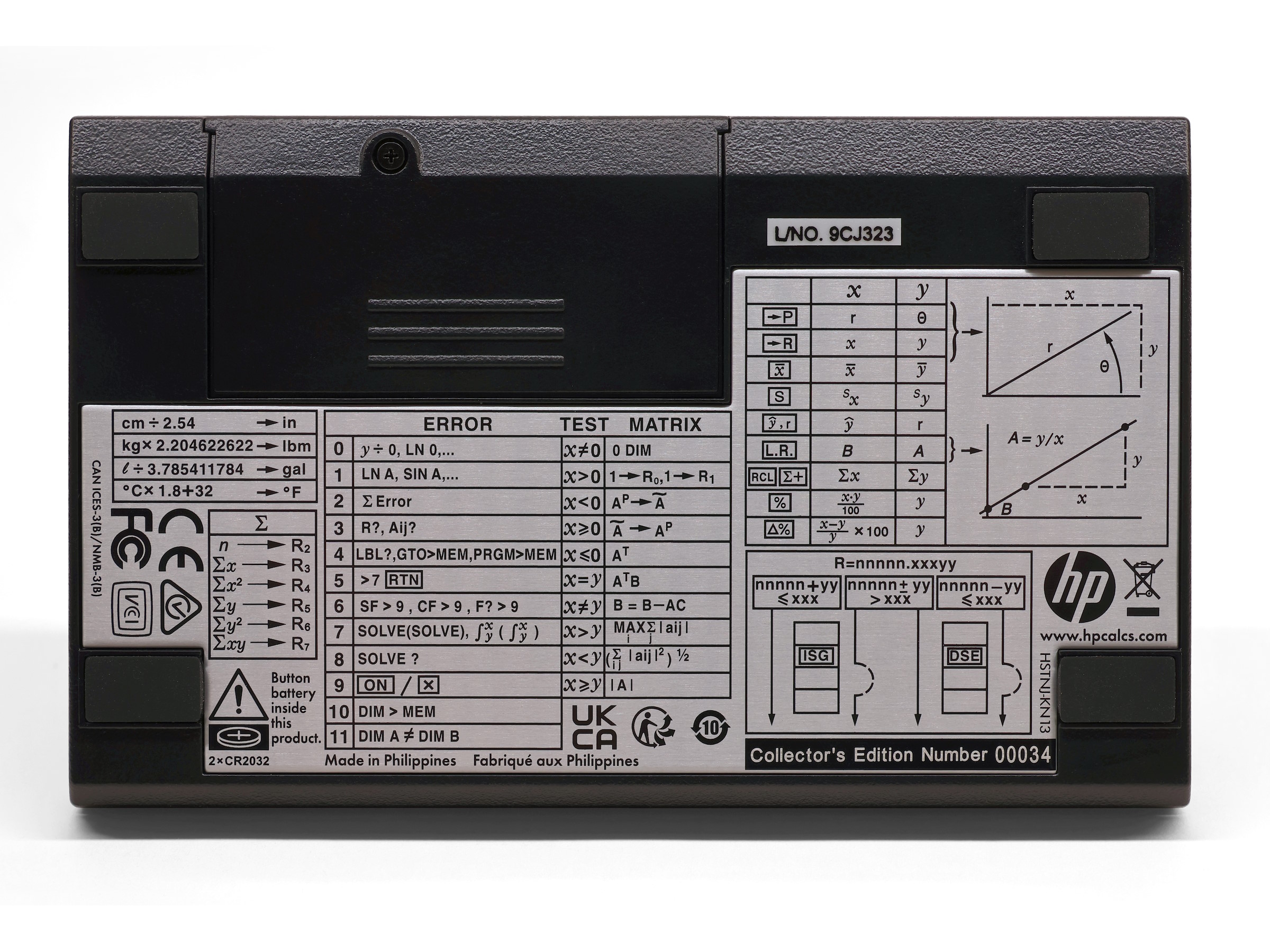
- I'm a lifelong fan of HP calculators. I have a 15c in front of me right now that I've had since the mid-ish 80s. Still works perfectly.
But the 15c 'Collector's Edition' had some issues, and I wonder about the build quality and reliability of this new one, too. Plus: my guess is you can get an original working 16c on eBay for less than this is going to cost.
Honestly, it pains me to say it but I'd recommend a SwissMicros DM16L instead: https://www.swissmicros.com/product/dm16l
- > But the 15c 'Collector's Edition' had some issues, and I wonder about the build quality and reliability of this new one, too.
Build quality deteriorated (from impressive heights) more than 25 years ago, when HP's calculator manufacturing moved to China. Not on account of China itself, but it was definitely a cost-cutting measure, and higher-end calculators were becoming an endangered species even then. For example, keycaps used to be double-shot injection molded, so the legends could never wear out; no more, now they're silkscreened like with everyone else. The new key mechanism could never reach the robustness and reliability of the old one, which is a problem if you're used to every keypress felt in your fingertips being correctly registered.
(Not everything was premium quality. On my late 15C, the faceplate logo wore out and the soft sleeve crumbled to dust after a couple of years. But the machine itself continued to work flawlessly until an unfortunate accident with a space heater.)
Additionally, the new Voyagers (1x series) are not running on the original, custom HP "Nut" CPUs, but on ARM microcontrollers, presumably via firmware emulation. It's impressive that the whole things works so transparently, but as I dimly recall, there were problems with that emulation in the first 15C Collector Edition runs, supposedly fixed now.
So, if you buy a new Voyager these days, you're getting a convincing replica of the originals from the '80s, nothing more. Caveat emptor.
- > cost-cutting measure
They really had no choice, Japanese brands like Casio and Sharp were making dirt-cheap scientific calculators in the '80s, I had one in high school and used it through college. The HPs were intriguing but I could never afford one.
They could have kept their standards up and sold a few to the few people who would pay for them, but that would have been a number that went down every year. A calculator as a veblen good probably would not have worked.
- Yep. I showed this to my wife, also an engineer, and her first response was, “oh, the buttons were so satisfying!” We both had HP calculators. I had a 15C that got me through high school and college engineering. I was sad when it finally died (replaced the batteries after years of use and it never turned on again).
- My wife and I were mid '80s chemical engineers. She liked her 15c, but I went on afterward into fundamental numerical analysis and was extremely happy with my 32S. I recently asked qwen3.6:35b|qwen3.6:27b|gemma4:31b (can't remember which one) all about the current state of replacement LR44 batteries for an "HP 32S Scientific Calculator". It was fucking adamant, aggressively so, that the calculator required 1 battery. LOL no, it sits before me and yes it needs 3. A 6 pack cost I dunno $6 off AMZ? Anyway I have now replaced the batteries in my daily tactile basic algebra calculator for the third time. If I don't have it in hand I use Free42. I... regret not remembering how to program these things, it was so intellectually elegant.
I logged on for the first time in a while to actually talk about nerd things. God I loved the 80s-2000.
- Given that one employee's position is described as "Chief Typography Officer", I will probably not be able to resist buying one....
- The prices for all kinds of vintage electronics have shot out like crazy. Calculators, computers, cameras and other stuff are super expensive.
- I wonder if anyone wants my old red LED HP calculator... it's got some nice chunky buttons. HP-35 or something, ehhh. Looks like maybe $100.
- Those are cool - I’m sure it’d sell eventually.
- I may actually be interested
- Originals definitely more expensive than this reissue (which seems reasonably priced). Still, I will always want the original made in USA.
- Dunno, I have a 15c limited edition (earlier run) and it's been great. My understanding is these are basically the same build as the modern 12c's
- From what I’ve seen, eBay runs more than this for a used original. My collection of all Voyagers ran about $200 each a few years ago.
- Who is the audience for this? I was a big fan of HP calculators at the time. Guilty of RPN snobbery and in posession of the passed by nth generation photocopy 'synthetic programming' document. I still have my 41CV even though it has not been turned on in 20 years.
But a fake lookalike 'collectors edition' of a device that can have only nostalgic sentimental value? Why does this exist? Who falls for this?
- I use HP calculators every day. 12C for most common tasks, 25 in the workshop (it can be operated one-handed!), 15C or 50G for more complex tasks involving units.
Calculators are very useful, using them is a forgotten art. While it no longer makes sense to plot anything on a calculator (I use Mathematica for that), it is still a great tool.
I have a 16C and I use it, but only when developing embedded software where I need to wiggle bits. It is very useful for that, especially with one-key switching between bases (HEX/BIN/DEC).
- I can't answer your question regarding the 16c, but the 12c is still the most convenient tool I have for compounding maths.
I can technically do the same thing with Emacs Calc, but there's something about the physical layout of the buttons that just makes sense. I suppose I could also use a software simulator of the 12c, though.
- I have always preferred some kind of physical calculator for doing calculations. I never need to do excruciatingly complex math, but I have a cherished TI-34 from the early 90's that I have dragged through college and 3 jobs. Full scientific calculator function with 0 batteries, it runs just on its tiny solar panel and the soul-sucking fluorescent office lighting, which is the one feature that keeps me clung to this particular model.
- Err me.
I have a few 42S though so probably don’t need it.
Edit: also three 15C and some slide rules. Think I have a problem.
- > Who is the audience for this?
People on big tech salaries with too much money.
If I saw an original one for sale for 10 credits or less I'd probably buy it as a curiosity piece, but no more than that. I do use a desk calculator but still have my trusty Casio that I bought over 20 years ago.
- It’s not a fake, it is made by HP. Also, it has value as a calculator, not just nostalgic sentimental value. It works just as well as the original.
I own one because a while ago I bought, one by one, iconic world changing calculators to collect. I like having physical history. This re-release seems like a very nice bookend to that collection.
- It is not made by HP, it is made by Moravia Consulting in the Czech Republic under an official license from HP. HP's Calculator Division hasn't been a part of HP's actual org chart since before even the HP/HPE split. It's the modern world thing where corporate brand names stopped aligning with corporate org charts decades ago.
- They are doing this also for the science version, the 15C.
I bought a 15C in the 1980s, and have enjoyed it ever since. It is like a rock. Despite being treated roughly over the years, nothing is wrong with it apart from some dents in the metal parts and my name, scratched on the back. I suppose I've replaced the batteries a couple of times, but that's it. This thing just refuses to die.
The main thing is that the keys still work like on day 1. And I've never seen a calculator with keys like this, with such feedback that you never need to worry about double-presses or missed-presses.
I just love the thing. If it died, I'd buy one of these new versions in a flash. But I think it will outlast me!
- > The main thing is that the keys still work like on day 1. And I've never seen a calculator with keys like this, with such feedback that you never need to worry about double-presses or missed-presses.
This is also the thing I'm most suspicious of with all these retro remakes - it's the physical hardware aspects that get screwed up so often.
If they get this right it would be legitimately surprising.
- I somehow got my 15C's slip case wet and so the calculator sticks out the end a wee bit. And a couple of the rubber feel fell off and got lost. Other than that, it works perfectly despite being treatly roughly as well. Like yours, the keys are still in Day 1 condition. And like yours, I've changed the batteries maybe two or three times since I got it back around 1984, which is unfathomable to me.
It is probably the finest piece of electronics I've ever owned.
- The keys on my 35S, which superficially resemble the keys on my 11C have not been nearly as reliable; After just a couple of years of use, mine started missing presses on frequently used keys.
- They released the 15C before a couple of times.
- i also love my 15c ,used it for many years now i also have 1 on my KDE desktop it works just fine in wayland an in x11
- I would get one of these in a hot minute except that my HP-16C that I got sometime in the '80's is still going strong! I rarely use it anymore but a couple of years back I was working on an app that involved bit-twiddling and the 16C fired right up and was immediately helpful.
- I have an original HP11C within reach. Still works. Had to replace the batteries this year, after 20 years.
If you replace the batteries, get the good Panasonic silver cells from Newark, not "compatible" alkaline cells. The silver cells were intact after two decades.
- Treated myself to a SwissMicros DM16C [1] while waiting for HP to re-relase the original.
- Not a DM16L? I have all the DM*C models and most of the others, not sure about the DM16L though.
- Oh, you’re right, I do have the DM16L!
- Help, help! I can’t escape from that site using the back button!
- This is an HP licensee, not HP itself.
Still nice to see, though the SwissMicros calculators are also very good and will be tough to compete with.
- I believe it is the only official HP licensee for calculators and some former HP calculator employees work with them. This is as close as a legacy HP calculator comes today.
- I think HP sold their calculator business to this company. I bought the iOS version of the 15C emulator directly from HP many years ago, but the app store changed it to this company.
- I remember seeing some article about HP's calculator office in Australia or somewhere shutting down much to employees' frustrations, so I guess this "HP Licensee" thing is the happy ending for that arc.
- I already own the SwissMicros DM41X, DM42, DM15L, and DM16L. Excellent quality devices, and built like absolute tanks! Picking up any of them will leave you astonished, a DM41X (or DM42) with its anodized metal back plate feels like it weighs at least 2x a TI-89 Titanium. I have as many of the HP-41C module files as I could find on MoHPC and other sites stored in my DM41X. They are all very high quality devices, I can't recommend them enough!
- I did never use a 16C, but I have a 42 at home and use it very often. It goes so far, that I also have the 42 app on my phone as a replacement for the default calculator app. I am using RPN, and I think I'm the only one in my age category that does (at least none of my friends who studied ever heard of RPN) - it's such a superior way to calculate. I usually have problems to work with a "regular" calculator due to being used to it "4, enter, 5, times" instead of "4 times 5".
If this would be a 42, I would definetely buy it. My 42 is a gift from my father and time did not only good to it.
/edit switched UPN to RPN, as I got the translation wrong
- You might want to take a look at the SwissMicros DM42 and DM42n, they’re a modern reimplementation of the 42S. https://www.swissmicros.com/product/model-dm42n
- Oh, that looks nice! Thanks! it's a bit early for christmas, but I'll keep that in mind :) .
- You might want to consider iHP48 app, it is my goto phone/tablet calculator running a 48 ROM. My goto desk calculator is the DM42, though I occasionally use my 50g for units or on the iHP48 app instead.
- I had a 42s, which to this day is my all time favorite calculator. I later “upgraded” to a 48sx, but never had the same love for it.
- My HP-42S is still running strong 30 years later
- I have one of the originals. It's useful if you do low-level programming a lot, and in a pinch you can also use it as a standard calculator. The biggest limitation is that the screen can only show 8 digits. In binary mode, this can be awkward if you're working with variables that are more than 8 bits. The calculator has functionality for scrolling around the number that's being displayed to try to work around this, but it's still a little annoying compared to newer calculator designs that can show more digits at once.
- What would you use it for? I’ve done plenty of 16 bit hex math back in the day so I can see some level of handiness there, but never quite got what it was meant for, or why someone would want a physical device for it. However, I’d love to hear more!
- It's useful for anything where you have to deal with bits and bytes, for example programming a driver on a microcontroller or handling serial communications. It's also keystroke programmable, which means you can easily write a program that simulates the processor you're working on doing a series of bit operations, then run it on a bunch of different inputs to see if it works on the full range of inputs. Depending on the platform you're targeting, this can be a lot faster than jumping straight to writing the code and debugging it.
If you want a concrete example of something it's good for, a while ago I had to write code to read the value output by a Neptune water meter. These meters use a very strange and inefficient signaling protocol, where each individual data bit has a start, stop, and parity bit. I had to write a program to read the data out of a packed 8-bit buffer, validate it, then convert it to a number, which involved a bunch of bit operations.
Obviously a physical device isn't necessary for stuff like this, it's more something that's nice to have than something that's absolutely necessary for low level development. For example, Windows comes with a programmer calculator but it's not programmable and it doesn't use RPN so this is a little bit nicer for me.
- And my eyes were opened. Ok, now I get it. I wasn’t even thinking about the programmability, but that makes perfect sense. Thanks for solving this mystery for me!
- HP generously gave me a 16C at the end of an internship. It was a weird beast! Amazing a simulating different types of integer arithmetic. Not at all a replacement for the 11C, 12C, or 15C.
- An HP 48S was my constant companion during engineering school and RPN was a lovely introduction to elegant expression-scaling.
The specific ergonomic feel of those buttons remains unrivaled.
- Oh yeah. You can bang out your inputs so fast and with so much confidence on those keys.
- For me, custom calculator capabilities is one of The top 5 reasons to carry a mobile computing device in my pocket.
I have too many calculator apps I hardly use, but nevertheless .. love to collect.
- Which ones are your favorite? I like Soulver for math with units.
- HexCalc and speedcrunch are my gotos whenever bc isn’t within reach ll
- What's going on with tech companies now releasing "limited editions" or "limited runs" of a calculator? I find that a hit ridiculous. Not long ago there was a post on a japanese made Casio laccquered calculator that costs a fortune. Have people started to collect calculators?
- Not quite: people never stopped collecting calculators.
There’s a difference between this and the Casio though. It’s a pretty, limited edition display piece. These are genuinely useful computation devices, for people who like using physical keys to solve problems more complex than a basic calculator could handle. There probably aren’t that many cases where someone needs to use a physical HP calculator anymore, yet some people just enjoy using them anyway.
The kinds of people who’d want to use a re-issued HP probably wouldn’t be too interested in that Casio, and vice versa.
- HP calculators were an important part of my formative years. I have a 12C, 15C, and 16C (all original models). I also have an HP-35 (red LED digits) within reach right now. That was the calculator I used for high school exams, because we weren't allowed "programmable" calculators so I had to go a bit retro for the time.
The 16C was an interesting model. It had a lot of potential capability with the different word sizes and bitwise operations, but I think it fell short in practice because the operations it could do just weren't that useful.
My favourite model is the 15C, it got me through four years of math, physics, and computer science university classes. The integration and matrix functions were super useful because it was hard to do some of that stuff in your head.
- I have the clones from swiss micros.
https://www.swissmicros.com/product/dm16c
They are more portable and really good.
- I found an HP-12c at Savers for like $2 about 2 years ago! It's a "financial calculator" and I don't really know how to use it :-)
- I got mine from my father for high school graduation. It is one of my most prized personal posessions.
- If this uses similar parts as the HP-15C Collector’s Edition in 2023 (which seems likely), then be advised that it doesn’t match the quality of the original in terms of display, key feel, and key labeling (colors). The back side of the 15C CE is also pretty ugly in my opinion [0] compared to the original [1].
[0] https://commerce.hpcalc.org/images/15c-ce-back-medium.jpg
[1] https://upload.wikimedia.org/wikipedia/commons/4/47/HP-15C_C...
- The originals (I still have my 1987 HP-15C) used silicon-on-sapphire technology, normally used for space, that ensured the amazing battery life. The keyboard domes had a complicated fabrication process to ensure optimum feel. The keycaps were double shot for durability. No modern calculator is going to be made to that standard, it would cost at least $1000.
- I loved the keyboard on my HP-48G. It had such a nice crisp tactile feel to the key presses - a bit of snap - that I got to where it could usually operate it by touch without looking.
(These days it's stored safely away with batteries removed, so I don't use it that much anymore. For convenience, I usually just use either Droid48 on my phone, or Emacs Calc at my computers.)
- The LCD screen polarizer may eventually detach[0][1], effectively ruining the screen. Unfortunately, it's not easily replaceable. I think it's not impossible the enthusiast community will eventually come up with a solution, but until then I'd use your 48G as much as you can. After it's done, either get a Prime while they still sell on eBay or get a SwissMicro 42n for similar keyboard feel and nostalgia factor.
[0] https://www.hpmuseum.org/forum/thread-18710.html
[1] https://www.reddit.com/r/calculators/comments/1r8gtvr/hp_48g...
- I’d pay that much, but alas.
- They can be found on ebay.
- I have two originals, which is why I could make the comparison, but they are not in pristine condition like a new one would be.
- I might even buy this in spite of the horrible "Collector's Edition" marking (who designs these things? this font is terrible), but somebody would need to try the keys and tell us if they cheaped out on the keyboard again.
- I used a 33C in HS and college. Finally in med school during my diversion into the lab, something happened to the little bubble display. And had to upgrade to an 11C.
The beauty of an RPN calculator was that nobody asked to borrow it.
- Surely: it nobody borrow ask did?
- I was never able to get into RPN, but I always heard great things about these.
- Back in the day it was useful to know RPN. Because somebody will ask to borrow your calculator, and if you hand them an HP they'll say "oh... thanks, but no thanks". You get to be nice and you don't have to worry about some bozo forgetfully walking off with your calculator.
- I never thought the HP of today would do this. 20+ years ago, I was first enamored by a 16C a much older coworker owned. Sometime after that, I bought one on eBay for around $100 (IIRC). Inflation adjusted, this reissue is a deal!
- I still have my 16C, and it still works perfectly. I got it in a swap for a 15C and 11C, so I got the reissue 15C when it came out, and it's not up to the quality of the original.
- I wish they would re-release the HP50-g, I had one somewhere but it got lost and I _loved_ that thing!
- Ugh same. I had a 49g and a 49g+ in high school. The 49g broke down and the other got robbed when my student room got burgled a couple years later.
Learned a lot of RPN programming on those things!
I saw one in the wild a couple months back but had to say it didn't live up to my memories. Super slow and clunky interfaces compared to our modern touch screens.
- db48x/db50x is probably your best bet
- Probably runs in an emulator on a modern MCU and still has more performance than the original.
- I had the Hp15c (and still have) but always deeply longed for the hp28s, which was the first to implement a lisp-like programming language in a calculator. Had I bought that one, who knows how different my computing life would have been…
- The HP28s is amazing. The manual even has a program to convert an algebraic expression to rpn.
In high school it was mind blowing.
But I didn't do anything serious with programming. Normal languages seemed annoying, usr/rpl useless limited as it was to a 4 bit calculator.
Maybe if someone had told me usr/rpl is just lisp. But, it's for the best. I loath computer screens today.
- I still have my 28s from the late 80s. Also really rugged except for the achilles heel of a battery door.
- Same. HP should sell a replacement battery door.
(Edited) Actually it's not so much the door but the housing.
- Not coded in Rust? No AI?? No age verification??!
- Gosh I need one so badly. Used ones are up to about 500USD.
Pity the international shop is down
- hp48 is still on Android for free, as HP released the ROMs to public domain while they were still an awesome company. The unit converter is still very handy. =3
https://play.google.com/store/apps/details?id=org.ab.x48&hl=...
- Most of the point is the button-feel, though. If I'm just gonna use a computer, I might as well use a full REPL.
- I use hp48 app on the iPhone.
Obviously it does not have the tactile feedback of the original. But it’s a far cry from using on a desktop with a mouse.
Using a REPL as a replacement does not mimic the experience, I don’t think. Not for me at least.
Mind, I’m talking a generic REPL. Like a CL REPL or similar, obviously not some custom calculator REPL.
First off, you’re missing the stack, which is significant. CL can almost mimic this with , *, and *. But while it provides a free, handy value store, it’s not the same. You’d end up with contrivances like:
Then there’s the value of the special keys (i.e. SIN et al, gives a new feeling to the term “function key”).(* * **)So, for me, a calculator and its hand held form factor, especially something like the high end HPs, go hand in hand.
No doubt someone could (and likely has) code up a dedicated calculating experience, but a generic REPL I find to be unsuccessful in that role.
- If you want to use a REPL as a pleasant calculator you really want an APL-family language or a modern concatenative language like Factor. Sexprs are horrendously verbose in comparison.
- ‘dc’ has been a thing on Unix forever. It uses RPN, provides arbitrary precision arithmetic, and is programmable.
- Running something like Julia in Termux is possible, but not a trivial install process. =3
- Give me a 48 and we'll talk.
- My 50-year-old HP-21 with red LED display still works. I'm very fond of it. RPN forever!
- Whoa! My parents had one from back in the day. I think one of their companies gave them out.
I still remember the way the buttons made a nice tactile thunk as you pushed them.
- With this and Casio's S100X-JC1-U is there some kind of retro calculator fever?
- That Casio isn’t a retro calculator, it’s a work of art calculator.
- I need to unload my bomar mx100 calculator.
But my 11c is still perfect.
- It's always interesting that they use ARM chips to emulate the original firmware.
- if that's true, it seems really wasteful honestly. why not reimplement the functionality using a native instruction set rather then emulating some other processor?
- That seems extremely efficient to me. That'd be a bad way to build a brand new calculator, perhaps, but the quickest way to get an existing, what, 40 year old?, firmware up and running with the least number of gotchas.
I doubt there are competent and cost-effective engineering teams in existence who could exactly match HP's numeric libraries in a $150 calculator that's guaranteed to sell a tiny number of units.
- 117 USD if ordered before July 31.
- Absolutely love HP calculators. Almost fourty years ago, my HP28s introduced me into programming in RPL, a stack based Forth like language combined with elements from Scheme (Lisp), and symbolic calculation. It was a language that was way ahead of its time, nothing I had seen in Pascal or C. Only a few years later in Mathematica. From there I learned Scheme, and was introduced to the book SICP. All of this had a lasting effect on how I program and think.
HP started my journey so to speak :)
I also had one of those mentioned in the article, just for nostalgia. Rock solid, RPN based, lovely product. The kind of product companies do not build anymore (products that will last you a lifetime)
- Maybe for $49 (maximum), I would buy this, but $116.96 (on sale; $129.99 if not) is too much. There is no RAM in this thing; why so expensive?!
- This must be the original "mac vs Windows" divide: I could never get my head around HP calculators. TI all the way. SR-52, TI-59/58. Sinclair if budget was tight. That said, I do have an HP-85C...
- This is cool, but I am a HP-42S forever person
- HP 20S or GTFO
- oooh. i have an original. it doesn't have the 'Collector's Edition' etching. Does that make it a fake?
- I would love a programmers' calculator but I really hate RPN. I wish they would make one without it. Back in the day they did it for efficiency. But that's no longer an issue these days.
I do still have a mint HP48GX but never use it for the same reason. The successor the 49 had normal math as an option but it was not as iconic.
- RPN felt so weird and alien to me, and then one day I felt my brain pivot, and now it's the only method I can bear. RPN isn't just more efficient for the calculator to process. I mean, it is, but that's not the selling point. It's way more efficient to use. It requires the least number of keystrokes necessary to enter a formula, and never requires parentheses for grouping. You can start at the innermost nested, hairy bits of a formula, then quickly work your way outward. That's the part I love and would hate to be without.
- When I started studying electronics in 1975 I didn't have a calculator, they were very expensive. Then rumours started about an upcoming low-cost Texas Instruments calculator, and IIRC early 1976 I could buy one - the TI-30. As did many of my classmates. The next year or two I used that one, and other similar calculators which entered the marked.
Then one day a guy some two classes above me handed me a HP calculator to try.. and the RPN immediately clicked with me, I could just enter arbitrary long calculations without ever messing up anything or having to keep track of parentheses in my mind. From then on I never looked back and I was on HP calculators ever since (up to and including the Free42 on my phone today).
I have an original HP-16C as well, I used it a lot back in the day, until calculations and transformations of hex, octal and binary was so ingrained in my mind that I didn't really need it much. It's in a drawer, but it's still good. I think I'll make some more use of it now that I'm near retirement age and just doing retrocomputing.
I've heard about the supposed loss of quality of later "HP" calculators, and I may not want to buy this one anyway (as I have an original), but I'm also waiting for someone to review the keys. The keys! That's HP calculators as I learned to know them.
- [dead]
- Yeah I understand. For me I just never could get my head around it. My brain doesn't work that way, and I'm the kind of person that always needs to bend their tools to them rather than absorb a new way of working. For example, I deeply hate opinionated software where you have to learn the workflow the developer intended. It can be powerful but I don't work that way. I have my own ideas how something should work and I adapt my tools to it.
RPN but also something like Gnome doesn't match. So I use things like KDE that have huge amounts of configurability. I also deeply hate processes and methodologies at work and I often ignore them leading to endless stress for my more bureaucratic coworkers :)
TL;DR, me not liking RPN doesn't mean I think it's bad. It's just not for me and that is more a 'me' thing than an RPN thing.
- Nah, I get it. I have a streak of stubbornness, too. Just saying, in this specific case, the odd way to do it has real, genuine advantages and isn't just odd for the sake of being odd. It's not so much an opinion as a philosophy.
If the opportunity arises, I urge you to try making yourself use it for a few days and powering through it. If that a-ha moment comes to you, it changes how you look at arithmatic in general. Or it may never happen, and that's OK, too.
- I did use it, back in the day. But the problem is, I use a calculator too few and far between so every time I had to go through this adaptation again.
Also I tend to avoid arithmetic, I hate maths :) What I would like mainly is a binary/hex converter and the ability to do some shifting and XORs etc.
- [dead]
- I absolutely love my HP48SX and HP48GX (I have both) and the RPN is what I like the most. But if you don't like RPN, just type a regular expression between simple quotes and evaluate it.
- Yes that is true, but that only works in expression mode and that is not always suitable.
- It's simply not for you then. That's okay.
I'm the opposite. I can't use a non-RPN calculator. Getting the numbers out of my head and onto the stack is how I achieve clarity in what I'm doing.
I used the 49 in high school until I wore out the substandard keyboard. Then I did what I should have in the first place and bought a 48GX which I still have 20+ years later.
- I felt the same and got a Casio CM-100 that has similar functionality. Not as nice as the HP but it does the job. Much cheaper too if you can find one.
- They did it for user efficiency, not machine efficiency. And it is still better today for hand calculation.
- As I read it was also about including the highest amount of features in the tool. But to me it's more like Dvorak. Sure, it's more efficient if you learn it and really absorb the mehtod but most people don't bother.
Personally I'm not very flexible in that way, I want my tools to adjust to me not the other way around.
- [flagged]

201 points by dm319 22 hours ago | 125 comments