- I think a lot of medical diagnosis could be solved with mass data collection if it was cheap enough. Right now, blood draws are somewhat routinely done because they provide a lot of human-interpretable indicators from a small number of values, and there is some evidence that e.g. "dogs can smell cancer" etc. (i.e. some diseases cause detectable odors).
With a big enough data set of [all kinds of bio values, including ones considered irrelevant for that disease] labeled with diagnoses, I suspect we could get very fast and accurate automatic diagnoses, even from a limited data set currently considered uncorrelated. Rather than going to your primary care physician, you'd go into the standardized, mass-produced and thus reasonably cheap everything-scanner, and you could likely get a more accurate diagnosis (or at least "things to check") than the average doctor would be able to give you under the practical constraints they typically operate under (time, available information/diagnostics).
This goes in that direction, and I'm really excited to see where it goes. I could imagine that given enough training data, ML models will be able to pick up on minute details that make it possible to diagnose diseases that weren't historically considered ultrasound-diagnoseable from this kind of detailed ultrasound.
I think combining it with gas chromatography/mass spectrometry of e.g. breath or blood/sweat/urine samples would also have the potential to be a cost-effective diagnosis method - lots of data, probably not all too useful for human interpretation, but would open the potential to walk up to a machine, breathe into it, spit into it, pee into it, give it a swab, and have it come up with an accurate diagnosis without invasive testing. If mass produced, the cost of something like this could easily drop below the cost of a typical doctor's visit. (I googled it and it seems like GCMS is already used for some diagnoses, but screening only for a few specific diseases rather than "throw ML at it and try to diagnose everything").
- It's a controversial and complicated idea. The downside, and the reason why most doctors do not recommend full body scans, is that every human body is a bit weird and there will almost always be something "wrong" that will be visible in a full body scan. This can lead to unnecessary testing, anxiety, and even unnecessary procedures. Many of these oddities flagged by the scan would never have caused any actual issues had the patient never been aware.
While there are many individual stories of full-body scans detecting early-stage cancer before it became symptomatic, there seems to be a general sense among doctors that implementing full-body scanning on a population level would lead to overall more harm than good. The thinking is that it is better to do regular targeted screenings for diseases that you're in a risk group for (e.g. colonoscopies, mammograms, cancer marker blood tests, etc.) rather than full-body scans.
I'm not a doctor, and I personally do find the idea of full-body scans very appealing, but I also know that if the scan detects a possible cancer, I wouldn't be able to just ignore it if the doctor tells me it's likely ok. Any time I felt any pain or any sort of symptom in that general area, I know I would worry about it. Maybe that's worth it for the potential life-saving results, but it definitely is a cost of this type of scan that needs to be acknowledged.
- Exactly - I had switched to a one meal per day setup and have been mostly following it for a few years.
Then after a routine “heart health” check all my indicators were super out of whack - the doctors thought I was on my deathbed - but I am perfectly happy pain free, in shape, physically active person…
Then _i myself_ had to dig into all these tests and figure out that they were measuring the wrong thing - since they try to time where your body is “just about to eat after a fast” - normally for most people in the morning before breakfast, but since my first meal of the day is usually around 20:00 - my body had adopted to have higher levels of various things just to stay on top of my lifestyle choices.
Anyway I had to educate some doctors since they haven’t really had a case like mine, so they weren’t thinking critically of how to interpret the results…
I imagine an automated test _could_ take these things into account with large enough dataset, but it would need to do a lot more reasoning than statistical correlation.
I do believe current sota models should be good enough to come to the correct conclusions with the right harness though.
- Reminds me that a few years ago my wifes grandfather (80+) was wondering if he should cut back on the amount of exercise he was doing. He would regularly be knocking on our door at 6am to see if one of us would want to got for a quick 10k run or to hit the gym.
He was a firefighter in NY in his youth and had never stopped exercising even after retirement.
He went to his GP explained his workout routine and was basically told there is no precedent for it as people his age tend to not be running 10km a day. In short he was told if you're not in pain or fatigued keep at it.
I think he's nearly 90 now and has cut back the running to only a day or so a week, but last time we went to visit he was in his garage bench pressing 50kg
- If the current state is anything to go by, an automated test would not only flag your out of distribution results but try to gaslight everyone reading its output with additional false indicators to map you into an area that's in distribution. Statistical models cannot accept the existence of extremely rare edge cases.
- Modern LLMs routinely beat human doctors at diagnosing "extremely rare edge cases".
They have unmatched breadth of knowledge by default, and can maintain attention across entire medical histories.
- Citation very much needed.
- > Modern LLMs routinely beat human doctors at diagnosing "extremely rare edge cases".
There is a selection bias here. Not saying it wouldn’t work, but right now you hear about exceptional cases, not when the LLM wants to amputate for a wart.
We all work with LLMs, right? It hasn’t been long at all since an LLM gaslit me while attempting to recover an unbootable laptop. I should have been recommended a few simple steps to try; instead, it was unable to ignore the irrelevant details and led me on an hours-long chase. To me that means the LLM will also struggle to ignore irrelevant medical information.
- One obvious alternative plan, presupposing that Full Body Scan is dirt cheap, is the following protocol:
- At 25 years old or whatever you get a FBS. Pretty much no matter what, this FBS will not be used to do more checks, procedures, and so on.
- ... and now we give you another FBS every so-many years, and only those things that are different from the previous scan are investigated.
There's still an issue with needless procedures, but the amount of 'weirdness that are not going to cause an actual issue had the patient never been aware' is significantly reduced by looking only at changes. i.e. most 'weirdness' shows up early and is fairly stable.
The difficulty is the moral issue. You cannot show that first scan to the patient. Even if every soul agrees beforehand that the rule is that nothing on that first scan, no matter how scary it looks, is further investigated... any medical issues raised by patients are used as a major information input for diagnosing issues. If I show a patient a scan that has this tumor looking thing on the left lung, then no doubt a few months later they'll be back complaining about shortness of breath and a pain on the left side of the torso. The mind is a powerful thing. At that point you can do a scan and see... the same nasty tumor looking thing we saw on that first FSB, and we're right back to the issue of these scans doing more harm than good.
Is it morally acceptable to hide that first scan from the patient?
- All doctors say this, and that sort of drove me away from healthtech. As if there were absolutely no way to take a step in a direction of fixing it.
The faster and earlier we start to scan everyone regularly, as long as scanning methods aren't invasive, the more certainty we'll have what to warn people about and what not to tell them. Perhaps with the regular screening (imaging quarterly, if the scan is fast) you could see what is growing and what isn't.
- Healthcare resources are very limited, you'd overwhelm it with lots of "yeah that's a defect, but 40% have it", things that would go away on its own, false positives, things that do not require urgent intervention, 10x increase of hypochondriacs and health deterioration caused by anxiety
You'd have a system where every resource is allocated for diagnostics, but no medical staff to treat it
Also a significant part of population avoids screening even if they are not required to paid anything from their pocket
- Maybe it's not a coincidence an AI company is building this thing...
- Yeah I'm wondering where exactly people think we'd find the millions of additional MRI machines and technicians to run them to make this somehow viable, as if the current ones are not pretty much at 100% capacity at all times.
- MRI machines cost in the six figures [0], last 10+ years and could reasonably do thousands of full-body scans a year. That's basically free by healthcare standards. Rent for the room to put it in would cost more in most cities.
MRI operators are specially trained technicians, because these are complicated machines. But like, semi trucks and photocopiers are fantastically complicated machines, and we seem to be able to keep a pipeline of people trained to operate and maintain them.
So I don't think there's an economic blocker for giving everyone a full-body MRI scan every year or two.
[0] https://www.blockimaging.com/bid/92623/mri-machine-cost-and-...
- What are you reasonably expecting to find in a full body MRI? Besides the notion that a "full body MRI" is not a procedure that is routinely done anyway and lasts upwards of an hour. It's not the scanner that is the limiting economic factor.
- Right. I'm replying to the commentator who questioned how we could possibly purchase and staff enough MRI machines to give people regular full body scans.
I'm saying there's no question that would be economically viable. The reason we don't and shouldn't do it is that it wouldn't be medically valuable, even compared to other cheap interventions.
- That's the real problem! That healthcare costs are a goldmine for Big Pharma instead of being a cheap and widely available service. And, as someone said before, the huge amount of data it produces, would decrease the rate of false positives to zero in no time! And your arguments about hypochondriacs are very similar to those that were once given against teaching reading to all people!
- > That's the real problem! That healthcare costs are a goldmine for Big Pharma instead of being a cheap and widely available service.
I thought we were railing against Big Hospital/Big Insurance here? They'd love a cheap diagnostic.
- The targeted scans and tests that we already do offer surprising little benefit.
Mammogram screening based on randomized-trial all-cause mortality, has not shown a measurable reduction in total deaths.
Randomized colonoscopy screening has not shown a statistically significant all-cause mortality reduction.
- It's more statisticians saying this, and not doctors per se. You run into issues of signal detection theory, false positives, and the lay confusion that Bayesian P(A|B) !== P(B|A).
You're right that we could take steps to fix it, but unfortunately, those steps involve mass education that every human body has anomalies, and many of those should just be ignored.
We'd get a wave of anxiety, lawsuits, and unnecessary interventions, until humanity collectively internalized this.
- It's also doctors. Medlife Crisis on YouTube, Barbell Medicine, others. BBM have an article on priorities for overall health and they link to a tool maintained by one of the professional bodies on what routine screens to have done and it's pretty conservative. Even my doctor on seeing an "abnormal" lab result said it was likely spurious given my lack of complaints and all the rest of the results. That said they still recommended a follow-up because they kind of have to given professional ethics. BBM (again) made a similar point: resistance training is known to cause liver-associated enzymes (AST, ALT, etc) to rise, that doesn't mean you can ignore a high value.
The steps to fixing it is to not take the test that takes you from a prior of 1/100000 to a posterior of 1/1000, because you're going to ignore it anyway. And you can't depend on multiple testing because those test results can be correlated.
- Brave of you to bring logic to a Silicon Valley discussion about their next grift
- [dead]
- This Silicon Valley mentality applied to a mechanistic view of the body is a fucking disgrace. This will fail, and luckily we won’t have to endure more of Silicon Valley’s dunning krueger on steroids about medical solutions. The Silicon Valley has NO CLUE of the complexity of clinical science, yet they hold this populistic view that everything can be foxed with tech and nothing stops the hybris. We all can see where that leads
- Aren't most of the current/latest advancements in health care coming from tech and software?
- > every human body is a bit weird and there will almost always be something "wrong" that will be visible in a full body scan
Would this be solved by routine scans, so you have a baseline you can compare against? Ignore anything slightly odd in the first scan but monitor for changes over time?
- Wouldn't help much.
* Some kind of scans, like CT scans, use ionizing radiation and should not be done too often. * Looking at only imaging scans it is often impossible to tell apart a cancer and a benign growth. (More invasive tests would still be required, which was what the parent posters were warning about)
- If the whole population had a full body scan every quarter, the “weird” things would feel more like the noise they are.
But we would have great data over time, both individually (weird tends to only matter if they are changing) and as a population.
- Maybe it would end up fine “in the long run” but you cannot ignore the significant issues arising at the beginning (and at each release of a more performant tool): what do you do if you find something that “shouldn't be there".
- Without clear hypotheses you will have a lot of false positives. Which are quite costly in healthcare.
- How do you measure the body regularly without potentially introducing problems just by measuring it?
- The fundamental problem is that you generally can't diagnose simply from shapes. Scans show shapes, shapes cause concern, concern leads to invasive procedures, results are negative.
- Are people really going to perform invasive procedures over mere concern if there are no symptoms and the doctor recommends against it?
- It's worse then that unfortunately. Even when invasive tests are positive, and we think we caught a cancer early, we know from population statistics that the reality is that often nothing would have happened. So we don't even truly know how to tell a cancer that will kill you from one won't. And we don't really know what it is that we don't know.
This is more true for some cancers then other though. Prostate, breast, and maybe melanoma are the worst in this regard. This is why prostate and breast cancer screening programmes are controversial, although the needle is swinging towards them being more useful as surgeries and treatments get better. Some other cancers like pancreatic cancer will always kill you eventually, so it's always good to catch them. It's a nuanced problem.
This whole issue is called "overdiagnosis", and personally I used to be obsessed with it. Being aware of it mostly caused a lot of hand wringing and grief, it's just easier to believe that every cancer you catch is a good thing. However, one of the broader issues is that we will never know what we don't know if we don't look. So there exists another perspective that all the suffering caused by overdiagnosis will eventually pay off in the long term. This is the "collect all the data for science/AI" perspective, and I've personally tentatively adopted it myself, although perhaps that's just because it's nicer to believe that you do some good even when you do harm. I think it's more likely that [novel cancer therapies](https://www.nature.com/articles/s41586-026-10738-7) will solve the "harm" part of treatment before we solve overdiagnosis.
The reality is that important breakthroughs are often entirely unrelated to the data for you are collecting, and even worse that possibly helpful data is locked away due to regulation and never used. This is kinda why I've come to make some kind of peace with private clinics scamming people with whole body MRIs, as I'm sure they're secretly selling the data which might lead to some good. However, they would probably do even more good if they didn't exist so they didn't jack up the prices for MRI machines by inflating demand. The marketing they do is the most morally reprehensible part of the whole deal, as it's usually just lying and creating health anxiety for profit. The fact that midjourney here is marketing themselves in this direction is giving me some serious Theranos vibes. Quick and cheap MRI equivalents would be really useful in the clinic, and it would have to spend a few decades there to prove it is useful before moving on to the "spa" stage. That they are trying to market a render of an idea directly to the wellness crowd firmly puts this in the "scam" folder for me. The fact that midjourney is mostly irrelevant now also fits well with this, making it likely that this is either a marketing stunt or a desperate pivot to get funded. Hopefully there are not that many suckers who will put their VC money down on this loosing bet.
- > If the whole population had a full body scan every quarter, the “weird” things would feel more like the noise they are.
That's a tautology. We already have quite robust methods for detecting developed anomalies, treating every anomaly below standard human-to-human variation effectively raises the noise floor to already developed anomalies, defeating the purpose of population wide routine scans.
- If you think the premise and conclusion of Op's statement form a tautology then you agree with him strongly.
- I think the anodyne to this is - and I admit the degree to which this is indicative of my biases! - more data, especially early on. Getting a good baseline before you have really any significant chance of most cancers to be able to do within-individual diffs, effectively, might be a big deal.
It might also reveal that every MRI shows ghost artifacts a half a dozen times that make it longitudinally useless, of course. I'm not foolish enough to think that epidemiologists haven't thought of this.
- You're absolutely right, and I share the frustration.
I'm thinking a possible solution to this signal-to-noise problem is to embrace the longitudinal view: instead of comparing each scan with the normal across the population compare only against past self, unless there's a risk factor that warrants it.
This way we could presumably make use of plentiful scan data and mostly look at the stuff that evolves in suspicious ways, not what looks suspicious.
- "It's a controversial and complicated idea. "
It is neither controversial nor complicated to detect some cancers by scent.
Taking the "headspace" of something is also not really complicated.
There are people who can reliably smell/detect Parkinson:
https://www.npr.org/sections/health-shots/2020/03/23/8202745...
- You gloom on one aspect, the smell. OP focuses instead on full body scans themselves, and the irrelevant issues with everyone's bodies they would highlight.
- *glom
- This always feels like a thinly veiled excuse to ration healthcare. Would these same doctors refuse a full body MRI to a billionaire paying out of pocket?
Anything found can be monitored with focused follow up scans. It doesn't have to be immediately biopsied if it's in a location where that would pose a risk of iatrogenic harm.
- At a population level, this would be both extremely time-consuming, and rather expensive.
More generally, no test is perfectly accurate, and for low base rate conditions the vast majority of positive tests will be false positives.
Like, again, as a data person I adore this idea in principle, but there would be a lot of details that we'd need to figure out to make it a reality.
- All the reasons you’ve listed are excuses why my government healthcare stopped having annual checkups. But to me it’s just worse quality care
- Sorry, but that's a morally corrupt idea.
- I've heard this argument before and it's always seemed downstream of capacity constraints and the current incentives of the healthcare industry.
There's a reason why billionaires like David Rockefeller, Larry Ellison, and Rupert Murdoch are able to live much longer lives than average, and having an oncall health team (that I'm sure does frequent testing and monitoring) is a big contributor to that.
More testing and data collection doesn't mean that every single anomaly would need to be investigated or communicated with the patient, but would provide a better longitudinal view that can help with disease prevention and health optimization.
- A sample size of 3 is hardly statistically significant.
From what I could found, billionaires die on average at ~83 years old. ( https://strygin.substack.com/p/how-billionaires-die )
It's not far off what a decent health care system is able to provide in most wealthy countries. It's even somewhat lower actually.
It's difficult to assess the risk factors, but in the end, I have the feeling their additional medical staff and their ability to "cut the queue" (S. Jobs-style) just barely offsets the additional common risk factors (stress, long hours, segregated life), specially if we compare to the upper-middle class.
In the end, there is no magic $100M pill giving you 10 more years. And in truth, access to food, drinking water, a non-toxic environment and really basic healthcare & medicine (vaccines, antibiotics) probably already brings you at a fairly high life expectancy.
- It's obviously a lie to get us to accept no tests due to limited machines. The same as when COVID started masks "didn't help" because they didn't yet secure enough supply for everyone, then when they did, suddenly the masks helped.
Every system that exists as a black box is more understandable with more sensing, not less. Our bodies are not special.
It's also ridiculous that the proposition goes like:
1. Doctor knows some tests will flag tumors or variations that look weird and that we shouldn't then go investigate all of them
2. Doctor shuts off their brain and will then investigate all of them by doing invasive procedures
Just knowing how many such variations there are and if they grow or not is useful information. But the doctors pretend like they are super smart before the test and super dumb right after.
- This kind of thinking (that it’s an obvious lie, perpetrated by a cabal) is the sort of superstitious bullshit that is going to jet us all killed. Look up Bayes theorem. As yourself how good a test would have to be if the base rate is low. Wonder what the probability of harm might be if the next advised test was invasive and the patients was anxious because a lump had been detected.
- You should read til the end! No cabal, just stupidity and believing other people are stupid instead of telling them the truth and expecting them to act smart based on the information.
Ask yourself, do you think billionnaires have yearly MRIs or that they wait for later because the doctor and themselves will be anxious? It's an argument that treats regular people as stupid.
- It's not the same doctors saying they themselves are simultaneously smart and stupid. It's "smart" doctors saying that as a point of policy, it is not a good idea for biomedical companies to try to make a buck off of popularizing unnecessary diagnostics, because anxious patients will by chance or by intention find a "dumb" doctor who will agree to perform invasive procedures. (Have you ever heard a tech person say that the tech world has a lot of stupid ideas? It's the same thing.) Look up what happened with South Korea diagnosis vs. mortality rates when they instituted national thyroid screenings in the 90s.
> Every system that exists as a black box is more understandable with more sensing, not less.
With perfect humans in a perfect society, maybe. But such is ignoring the elephants in the room here, from the actual experts on the topic.
- So do you think the doctors should hide the data from you so you don’t know anything looks weird, or tell you it looks weird but they don’t think it’s worth investigating it? And do you think the average patient will say “ok that’s fine, I’m not getting a second opinion and if I die my family will sue you into the grave too”?
- >> It's a controversial and complicated idea
sure, and there will be downsides.
But that data will be valuable nonetheless.
- [dead]
- Don’t make me tap the sign.
Bayes Theorem: https://en.wikipedia.org/wiki/Bayes'_theorem
There’s a very good reason we don’t test asymptomatic people in low incidence populations. Basically all positives are false positives when you do that, no matter how accurate the test is.
When you’re testing healthy randos for everything the odds of a positive being false have so many 9s it would make an SRE weep.
Unless this is accurate to a degree previously unheard of in medical science it’s a boondoggle, and I can’t help but notice there’s no mention of accuracy.
Unfortunately that’s just basic statistics.
- I heard the same argument from my doctor when I wanted a blood scan.
But what's the intention? If you do a scan and then try to find everything that is wrong about you, you're 100% right, there will be false positives and unnecessary panic/medication etc.
However if you just collect data for months and years and WHEN you get a symptom you have a lot more data then we should be able to give better diagnosis faster. If we do that for long enough as humanity and there is data sharing the accuracy of the whole thing will increase a lot.
- This. All diagnoses are "given this set of symptoms and test results, which is the most likely issue".
By having a whole slew of test results already, you will have much better priors.
- So you are certainly correct but you can also tighten up your definitions for true positives as you have more information on your false positives. There may exist additional signal as well.
To your point though I think there is a difference between collecting and evaluating additional data sources and using them as diagnostic tools.
I suppose I fundamentally disagree with the implication of your post that there is no value in gathering further data for these reasons, it would seem to suggest we’re already diagnostically optimal and could not do better with additional signal.
- Sure collecting more data makes sense. We agree there. If that gets you to the required degree of statistical confidence my argument is moot.
- Positive for what, exactly? Quoting convnet, above:
> The downside, and the reason why most doctors do not recommend full body scans, is that every human body is a bit weird and there will almost always be something "wrong" that will be visible in a full body scan. This can lead to unnecessary testing, anxiety, and even unnecessary procedures. Many of these oddities flagged by the scan would never have caused any actual issues had the patient never been aware.
The fundamental problem is that you generally can't diagnose simply from shapes. Scans show shapes, shapes cause concern, concern leads to invasive procedures, results are negative.
Also, overdependency on "spas" for health information could lead to an atrophy of other sorts of medical information gathering and diagnosis. e.g., there's no mention in the dreamy description of this spa experience of getting a blood draw or a patellar reflex test.
- The root comment is talking about adding blood, breath, urin, spit... analysis. For body imaging only I agree with you. But if we add all this, I guess we'd be able to rule out many false positives
- The argument has some merits, but we should remember that, from the point of view of Bayes, you could apply the same argument to symptoms, which is only evidence. High odds of a false positive, means that you have not enough evidence, not that you have not useful information.
- That's precisely where medicine is headed: personalized medicine.
You [hopefully] won't have to become a rare missed diagnosis because you didn't fit the demographic for this or that screening test.
Cost of genomic analysis is exponentially decreasing, and so much progress is happening so quickly.
Consider for example how in cardiology we advanced from ASCVD's 10-yr prognosis, to the PREVENT 30-yr prognosis. And still most providers are using the ASCVD score for their patients.
- You’re dealing with populations here. Literally the odds of a positive being false would be over 90%. Much higher in the more rare conditions. I’m not exaggerating. That means every almost every follow up you do is a waste of time, money and limited resources, denying care to those who need it. Including you when you actually do need it. It also exposes you to the risks of unnecessary follow-ups like infection. Your expected outcome is worse this way.
The chance a positive is real is so low you may as well just point to a body part and get it biopsied.
A positive from this kind of test is statistically meaningless.
- It's scary in both directions.
If you let it give out tons of false positives, then patients are trained to ignore it when it cries wolf.
If you dial it back so that it gives out fewer positives, then now it starts giving out false negatives and not helping sick people.
- Heh, Signal Detection Theory strikes again! This problem is as old as detecting whether a radar blip is a WW2 bomber on its way or not.
Sadly, there's no perfect threshold when the signal and noise distributions overlap substantially, just different trade-offs.
(Love CI, btw!)
- That doesn't sound like a useful test then. Instead use tests with fewer false positives.
- If this argument was as solid as you say, then all routine checks would be pointless.
I don't know about traditional blood testing, but a permanent implant which checks HR, pressure, glucose, temperature & oxidation would be pretty useful, not necessarily to diagnose anything, but to provide data for doctor when patient has actual symptomps.
- They kind of are. Spain doesn't have yearly physicals, and during a GP visit, they don't even take your blood pressure. Blood tests are extremely uncommon, unlike in British medicine, where they take your blood pressure every time and blood tests are so prevalent people usually request one from time to time despite having no symptoms. Spain's example showed the above (or the lack of) doesn't increase all-cause mortality and even excelling in longevity statistics.
https://www.rieti.go.jp/en/columns/a01_0455.html This japanese article found "No clear-cut evidence exists to determine whether undergoing health checks leads to greater longevity and/or lower medical expenditures."
- Several published papers agree. There is in fact little evidence to support regular checkups if you’re asymptomatic.
https://pubmed.ncbi.nlm.nih.gov/31642821/
And blood pressure is especially pernicious, basically every doctors office measures it wrong so the results aren’t particularly useful. Many use the wrong size cuff for example, or don’t give people time to relax before a reading. A ton of people have white coat hypertension, high BP only because they’re in a doctors office.
https://pmc.ncbi.nlm.nih.gov/articles/PMC1120072/
I saw a paper that showed only 36% of cardiologists did it right.
- Math does indeed make for solid arguments. If you want to make a counterargument then you have to address their math, which you didn't.
- Testing healthy person for any illness by definition has infinite number of nines in false positive rate.
Problem is we never know who is healthy. That is why we are doing the test.
- You can just run more tests to get increased statistical power.
- No you can't. Statistical tests assume independent data points. Testing the same individual repeatedly would be pseudoreplication, leading to wrong conclusions.
If you mean run different tests, where you collect different kinds of data from the same individual, sure but that's not something you can "just do" in the general case.
- Many smaht people have already pointed that out.
It's news to no one that tests are imperfect.
Do you have any concrete solution to that? Anything of value?
- Yes, don’t do tests on asymptomatic low-risk people until you can demonstrate that a positive result has any meaning whatsoever.
- Hypertension is asymptomatic for years and is prevalent in every demographic. Leaving it unattended it can cause stroke, heart attack, or organ damage through long-term vessel strain, by which time damage may be irreversible; detecting it on time can prevent this with lifestyle changes and medication.
Diabetes is asymptomatic for years and is prevalent in every demographic. Leaving it unattended it can cause damage to blood vessels, nerves, kidneys, and eyes through chronic high blood sugar, by which time complications may be advanced; detecting it on time can prevent or delay this with treatment and lifestyle changes.
Hyperlipidemia is asymptomatic for years and is prevalent in every demographic. Leaving it unattended it can cause artery blockage through cholesterol buildup, by which time heart attack or stroke may occur; detecting it on time can prevent this with diet and medication.
Kidney disease is asymptomatic for years and is prevalent in every demographic. Leaving it unattended it can cause kidney failure through gradual loss of function, by which time dialysis may be needed; detecting it on time can slow progression.
Glaucoma is asymptomatic for years and is prevalent in every demographic. Leaving it unattended it can cause irreversible vision loss through optic nerve damage, by which time blindness may be permanent; detecting it on time can preserve vision.
--------
I'm SO glad you're not my family doctor!
- At least the top 4, unclear about the 5th, are strongly associated with obesity. That would make someone high-risk and testing potentially warranted in like 70% of the population. Asymptomatic and low-risk is what I said. The incidence of hypertension is so high in the general population it’s almost always statistically supported (even though basically every doctors office takes it wrong, even cardiologists, amazingly).
On the other end of the spectrum, what doesn’t make sense is testing a random person off the street for Ebola. The prevalence approaches zero and symptoms are fairly noticeable, so any positive test is definitely wrong.
Most diseases are in between and have to be evaluated case by case, not buckshot.
You may be particularly interested to hear that there’s little evidence to support regular checkups in most adults beyond blood pressure testing and cervical cytology.
> Given the lack of favorable evidence and the potential adverse effect, primary care providers should consider the fact that general health checks, beyond the screening interventions shown to have benefit, likely have little or no effect on important health outcomes. Some of the interventions with demonstrated benefit have sufficiently large effects that a uniform application is warranted (blood pressure measurement and cervical cytology screening). In others, the trade‑off between benefits and harms is so close that patients should be involved in fully shared decision making regarding their participation (breast and colon cancer screening).
https://pubmed.ncbi.nlm.nih.gov/31642821/
I suspect your doctor would agree with me. See if they’ll test you for Ebola, for instance. Not because you have symptoms but just cuz.
- The decision as to whether mass screening is justified or not is complex, and varies a lot by test/condition/population etc. Luckily there are lots of smart people whose job it is to do these caclulations.
In your list, 1-4 are common enough, the tests are accurate enough, the costs of intervention are low enough and the benefits of early intervention are high enough to justify screening, which is why they do generally screen for them at least in hgiher risk groups. The other two are more mixed, which is why mass screening is less common.
All the evidence for full body scans is that they are not justified for asymptomatic people. The false positives are high, the costs of these false positives are high, and the imporved outcomes are too low to justify them. If you want one, go ahead, but realise that almost anything it finds is likely to be false either positive or not likely to ever cause a problem, and you'd have to deal with the worry and invasive tests and even surgery in aid of something that may never cause any trouble.
- There is this infamous DANCAVAS study [1] in which they ran cardiovascular screening on older population and found absolutely no benefit in doing so. Note that while the linked study claims there has been a benefit (reduced mortality in men aged 65-69), the apparent effect was caused by improper statistics (primary endpoint did not show benefit, only subgroup analysis, which however lacked statistical power to be reliable). And indeed, their follow up study showed that there was no benefit in the subgroup. [2]
Many a dollar is wasted every year on trying to prove population-wide screening prevents mortality or increases patients’ quality of life and every time we don’t cheat with statistics we get the same answer - population-wide screening isn’t effective.
1: https://www.nejm.org/doi/full/10.1056/NEJMoa2208681 2: https://www.escardio.org/news/press/press-releases/No-signif...
- Even at a smaller scale, I was shocked to go to the hospital in China and literally the first thing done was a blood sample, scanned under about 30 metrics, took about 15 minutes after the same was take. The results were sent straight to my phone. That sample had some horrendous results, so I then skipped the queue and got straight to see a doctor who already had all my numbers up on screen before he spoke to the for the first time, meaning he could immediately put me on an antibiotic drip.
- Why is this shocking ?
- Theranos2
- The problem is: Since we don't regularly full-body scan healthy people, we don't know how healthy, or say, still ok, looks like. This will create a lot of false positives and potential harm from unneccessary follow-up procedures and treatments.
- The idea here is to make scans very common and regular, hopefully from early age of the patient. It could be like a blood pressure measurement at CVS.
- There's a ton of variation within medical testing and tons of different conditions affect test results in similar ways. VERY FEW tests (test classes maybe: biopsy, microbiology, skeletal Rö) can yield diagnoses in the first place. Most testing is used to support (not confirm!) and reject possible interpretations.
This non-invasive everything-scanner sounds more like science fiction.
- Other tests should be solved too (fecal/urine/blood). Perhaps we need more R&D in here to accelerate progress.
We already have patients trying to track their own health over longer time which is great. We then just have to make AI good enough to spot warning signs (without patients asking). Or parhaps we need to make those tests easy and cheap and regular.
- > Perhaps we need more R&D in here to accelerate progress.
In general yes, just that "more" is monstrously massive to the point of it being closer to science fiction than reality, IMO.
To reiterate, various assays fluctuate rather wildly over the course of various body cycles. The reason(-s) your doctor should remind to get a blood drawn in the morning after a period of fasting is that the sample is taken at a somewhat steady state and the result is comparable to reference values without too much of a margin.
Anyone with a requirement to manage blood glucose levels will tell you that CGMs are vastly superior to finger pricks first and foremost due to the sample rate available and comfort reasons secondarily. With a finger prick test the patient is only somewhat aware where in the curve they are, which makes the test only a rough estimate due to this temporal error margin. A lot of people do not zero in their readings with finger pricks as they are mostly interested in the deltas.
Suppose you manage to make urine sampling relatively accurate and super cheap (e.g. tens of eurodollars per analyzer or cents per test strip) so you can have poorly-supervised, long-term studies with huge cohorts. However, unless you somehow control for sample collection conditions, all this baseline variability suddenly infects your whole dataset and effectively raises noise floor. It's not unreasonable to expect that whatever was found to be a useful signal under controlled conditions to fall below noise floor under uncontrolled conditions.
That's basically THE problem with the hypothetical test-it-all machine. Again, maybe in some cases that could be extremely useful, but in a lot of cases that would be counter productive. However, what CGMs hint us at is that various kinds of Continuous X Monitors could provide insights into body reactions to things, which is, currently, effectively not a signal in general medicine. Once the test-it-all machine is reframed as an array of continuous monitors and the useful signal is reframed from long-term drifts to short-term deltas it may unlock some additional diagnostic pathways.
- false positives are a real problem
- Only if you let them. The false positive thing is a nonissue that only arises from assuming you would respond to information a certain way.
- That makes no sense at all, unless you're saying that people should respond to all such information by ignoring it.
- You could repeat the test, perhaps on a more frequent interval to keep an eye on it. You could follow up with a more specific test, or do confirming blood work. In the meantime you can adjust your diet as a precaution, or get motivated to get in shape just in case.
There's plenty of room between "go under the knife" and "ignore altogether."
- There is a lot of space between ignoring and doing invasive dangerous operation after some blot was spotted on some imaging diagnosis.
- In which case, why bother getting the information in the first place?
- I don't really get what this means. A false positive causes issues inherently - you don't know if it's right or wrong. It's noise which is bad for care, and it's anxiety-inducing for patients which is also bad. It produces worse outcomes for everyone. There isn't a "choice" or assumption here, you respond to a positive as if it's accurate until you know it isn't. This is a known issue. Hell Scrubs did an episode about the negative impact of full, generalized body scans on a patient's wellbeing decades ago.
- > walk up to a machine, breathe into it, spit into it, pee into it, give it a swab
Maybe take it out to dinner first?
- In the rest of the world diagnostics aren’t expensive at all and medical data is centralized already (blood, MRI are almost routine for hospital visits, all data stored in govt systems).
During Covid it was useful for improving protocols.
- > pee into it, give it a swab, and have it come up with an accurate diagnosis without invasive testing.
Somebody should make a startup based around the idea of diagnosing diseases through eg. a drop of blood. Probably need a bunch of big name investors though
- [dead]
- So, on the one hand, this is interesting! Reducing radiation from CT scans is a noble cause on its own. If on top of that it could make tomography cheaper and easier, you could imagine getting earlier detection of aneurisms, fibrosis, cirrhosis, thrombosis, stenosis, even plausibly cancerous masses (along with plenty of over-detection).
On the other hand, nothing here substantiates this promise. We've got a video render of what a hypothetical device could look like. It's probably more than nothing (they got exclusive license on these butterfly chips in 2025, and it's at least plausible that the best solution to the data bottleneck in an absurdly noisy system like this is real-time AI image processing)... But it's certainly less than something. It's a hype video that doesn't prove feasibility of anything, yet.
EDIT: This is all in reaction to the second video on the announcement post[0], which is much more informative than anything on the page currently linked.
- AI hype aside, this is one of those projects I'd like to know the open source stack of and the academic research behind. It's actually overlaps with an idea that started circling around in my head back when (deep) neural networks were the new hype cycle.
What's the relation between sensor density and resolution? If their array could give femtometer resolution, how much could you drop the density when you only needed to detect forearm muscle movements through the skim.
The way Ctl-labs was trying achieve the same results always seemed like it had fundamental physical limitations due to the nature of electromyography (to this software engineer...)
- > Reducing radiation from CT scans is a noble cause on its own
Is it? Linear No Threshold has largely been rejected at this point. https://jnm.snmjournals.org/content/early/2024/06/21/jnumed....
- We have no evidence in favor of the linear no threshold model. That is not the same as saying that we have evidence against it.
- There is some evidence for hormesis - but yes no model is proven right now. LNT is the most conservative model and part of why it sticks around.
A good primer: https://pmc.ncbi.nlm.nih.gov/articles/PMC2477686/
- LNT does also damage, as people refusing necessary CT scans or countries switching of nuclear power because of fear.
- Sure but we don’t prove negatives for a reason - it’s impossible. We assume the null hypothesis.
- LNT is the null hypothesis. No one disagrees a linear model fits the data very well in high doses. If you want to argue that model doesn't work in low doses, you need a model with more parameters and sufficient data to fit it. The issue is that, at these low doses we want to differentiate, we're also looking at effect sizes that are hard to separate from noise, and sampling biases that are hard to erase. There's still lively and ongoing debate.
- Well problem is that humans are so noisy through lifestyle, enviroment and genes that any proof for either is really hard.
- Your link does not support, and in fact refutes, your claim
- I'm not putting my head under. How do we know this won't cause aneurysms? Damage eyes and ears? Getting a medical device approved takes time because of concerns like this.
- It might not actually cause harm or strange effects to people's bodies, but I'd certainly feel better if it was tested and used by doctors in a hospital and not some "spa" since those tend to be poorly regulated and where all kinds of quackery takes place (https://www.aafp.org/afp/afp-community-blog/med-spa-industry...).
The safety of the device itself is a concern, but so is the trustworthiness of the output. Midjourney already has some very questionable history with medical imagery (like this totally legit image of rat testicles published in "Frontiers in Cell and Developmental Biology" https://upload.wikimedia.org/wikipedia/commons/c/cc/AI_gener...)
- > The safety of the device itself is a concern, but so is the trustworthiness of the output.
And the safety of the data as well. Am I supposed to entrust full body scans to a startup?
- From my understanding of the post, the waves that are created are smaller than light waves, and there's no evidence that light waves, sound waves or sub-sonic waves have any aneurysm-causing effects.
(I researched more and found in the video a value) The waves are 50 nanometres, and this is basically the equivalent of having a full body ultrasound. We've been doing baby ultrasounds for decades with no ill effects, so I can't imagine this being different
- We already ultrasound babies in the womb, so one would hope this has been studied.
- Before ultrasound, they used to x-ray pregnant women to see the fetus. At that time, someone might have said "one would hope this has been studied"... unfortunately that practice went on for about 60 years before being stopped in the late 1950s.
Side note: kinda crazy they had medical x-rays in the 1890s. X-Ray imaging was discovered in 1985 and used clinically within 2 years.
But I do agree with your point, these days, I hope we're better about studying the potential dangers of current technologies we use.
- We also used to x-ray people for shoe fitting/for lulz.
- that's not a video render of a hypothetical device, that's a real video of the real working device, fwiw
- > the real working device
Could you expand on the term "working"? Do you mean like "working to slowly lower a person into water while videos of animated Figma UIs play back on a monitor?" Or do you mean some crazy kind of "working", like "the ring of devices we see are scanning the organs of the woman we see and the images appearing on the monitor are those just-captured organ scans?"
- It's just a render? Where's the video?
- The first video appears to be real. Who knows if it's a working prototype or just a mockup, but the fact that it's held together by C-clamps and other stuff you could get at Home Depot makes me lean towards the former. If it was purely for marketing they'd probably make it look more polished.
- > The first video appears to be real
The video is clearly from Midjourney /s
- The first video has the actual device (whether it's functioning or not) and the second video is a render.
- This reeks of peak bubble, it’s ok say that.
- This is really interesting! And perhaps surprisingly doesn't trigger any immediate major technical red flags (as someone who has worked with MRI and phased array beamforming), as many HN HW articles do.
My only criticism from the tech video would be that they spend some time lauding the nanometer deflection sensitivity, which might lead some to believe that's indicative of the image resolution. It's not, and it's somewhat of a distraction -- that's just giving us amplitude information, which is comparatively less important than correlated time/phase across the 100k sensors. They do later on state ~mm resolution, which is still great!
Doppler and motion blur may be an issue (e.g. heart beating), as one slice requires a full ring of sequential exposures. But still way faster than MRI, so probably fine.
On a lighter note, it could seriously change the meaning of get FUCT (Full body Ultrasound Computational Tomography)!
- MRI physicist here as well. I have a basic understanding of ultrasound, and this looks like an array of transducers organized to perform tomography, just as CT did for Xray.
However Ultrasound quality depends highly on transducer-skin contact.
Any physicists here to comment on the effects of sonar through liquid and the effects on image resolution and field of view?
- I have a mixed response:
1. It kind of makes sense that an AI imagery company would apply that to other novel applications of imagery and computing and try to do something cool with it.
2. Midjourney as a brand is all over the place and this feels -off, somehow. I think from a branding pov they should have just started a different company with a different name. Perhaps a single image-focused umbrella company named [Name] with Midjourney and this medtech company as separate subsidiaries.
3. AI imagery companies suddenly making medtech products and spas feels very “we don’t know what to do, so we’re going to throw spaghetti at the wall.” That doesn’t necessarily mean it’ll be bad, just that it’s not typically what you’d do if you’re working on something super successful already.
4. AFAIK they are entirely self-funded and so this really isn’t about VC scaling or anything like that. But that doesn’t mean they’re immune to the same cultural pressures.
- The pivot to do things they want as AI research lab is perfectly understandable, but also..weird, like their loyal userbase are mostly creative people, and this pivot have ZERO things to do with those audience at all.
It also gives a vibe that they gives zero damn about to those creatives audience, or the things that made name for them in the past anymore, or that what I feel as their subscriber... I know that David Holz have his own unique way of doing things but it's still...weird!
oh, and the hypetrain on X. yikes..
- Yeah, exactly. This would have been a cool side project company from the founder and team.
Doing it under their main brand is very weird and I don’t quite see how it translates to creatives at all.
- > enough to give regular, monthly scans to a billion people.
There is a part of me that thinks it would be cool to get cheap full body scans. I like being able to see inside of myself. I can think of a lot of situations where the low-fidelity images coming out of this (they're not good compared to real medical imaging, if you've ever looking at MRI/CT up close) could be useful for coarse analysis of certain conditions that come and go or need to be monitored over long periods of time.
What I don't like is the idea of getting people to do full body scans every month just to be safe. This might sound like a good idea if you haven't looked at the literature on preventative full body imaging. Looking for bad things inside the body sounds like a great idea on the surface.
The problem is that imaging, especially when it's as rough as these ultrasounds, and possibly worse when augmented by AI guessing at what it's seeing, can lead to a lot of unnecessary procedures. The net effect can even become more harmful than the number of real problems it catches. There's a long history of research on this as many companies have tried to commercialize full-body scanning in the past. It frequently leads to situations where there's an unknown or ambiguous spot on the imaging that the person reading the scan can't rule out, which turns into a lot of anxiety and eventually more imaging, biopsies, or unnecessary surgeries. It's easy to think "better safe than sorry" until you realize how often these benign but ambiguous findings show up on full body imaging.
So my initial thoughts on this are that it would be good to make cheap ultrasonic imaging accessible as an as-needed service to use for specific conditions. I do not think it's a good idea to go down the road of trying to scan the entire population once a month and then run it through AI to see if anything pops up. The number of false positives would be overwhelming and lead to a lot of unnecessary procedures to calm the resulting anxieties.
- This style of argument has always bothered me, because the correction to misdiagnosis or mistreatment is not to stop looking, it's _git gud_.
For sure, we have to be realistic about what processes will systematically have error, and if we can't stop a doctor from doing bad things with a piece of data we should shield them from it, but the tools to make scalable, calibrated risk estimates based on large data dumps is getting better every year.
- > it's _git gud_
There are physical limits to detection and technical parameters that make some situations indeterminate even for the best of the 'gud'. It is frustrating that, hearing an argument from many different individuals over a long time, you assume that each speaker is missing the critical insight that you possess.
> but the tools to make scalable, calibrated risk estimates based on large data dumps is getting better every year.
So your suggestion for indeterminate scans is more scans? There is no 'large data dump' personalized to you except for your own imaging.
> if we can't stop a doctor from doing bad things with a piece of data we should shield them from it
The doctor isn't the problem, it's the people who would be seeking out monthly imaging without symptoms
- I go to the doctor every year for a checkup without symptoms. Why a year? Why not every six months? Two weeks? Day?
If the false positive rate is demonstrably low, I can't see the risk. People who think they need a doctor will go to a doctor with or without a fancy scan. People who want to play armchair physician will play armchair physician with or without a fancy scan.
- > If the false positive rate is demonstrably low, I can't see the risk
The false positive rate is the entire risk.
When you go to the doctor for a physical they don't run all of the blood tests they can. They only run them for specific symptoms and for specific preventative measures where we've calculated that the benefits outweigh the risks of a false positive.
Some tests have been removed from routine exams, or at least discouraged, because they were producing more false positives and harm than what they were saving.
Full body scans are deep on the end of the spectrum of tests with high false positive rate when ordered without supporting symptoms. That's the risk.
> People who think they need a doctor will go to a doctor with or without a fancy scan. People who want to play armchair physician will play armchair physician with or without a fancy scan.
Not really how it works in real life. When you get a full body scan, especially with ultrasound, there are a lot of benign things that can show up that vaguely look like non-benign things. Even if the interpretation is "probably nothing", many people start worrying and think they need to get more tests just to be safe. Even people who don't see themselves as "armchair physician" will start thinking that they should at least rule out the worst case because they wouldn't want to die of cancer having known that something might have been there.
- You can get scans without your normal doctor recommending them. The point is that there is evidence that scans obtained ‘just because’ are harmful as they lead to unnecessary procedures at the population level
- But does it also catch more issues early?
- Rarely.
More often it leads to people thinking they have issues when they don't.
The same thing happens with blood tests: You can order all the blood tests you want if you're willing to pay for them. If you order enough, you will get some that show up as abnormal. You can start spending tens of thousands of dollars ruling things out and never catch any real issues.
- How do you get the false positive rate low? There's a lot of things that look weird on a scan that turn out to be benign. And if you tell patients "well the chance this turns into a serious disease or cancer is low but you can get this optional procedure to fix it now if you want" how many do you think will take them up on it?
A new chargeable procedure is for for the hospital but maybe not for patients imo.
- Why do you do it at all?
Many countries with far better outcomes don’t do this, is it necessary, or is it just the product of an insurance-driven health industry which prioritises interventions over health?
- > If the false positive rate is demonstrably low
Regardless of how accurate a test is, by Bayes Theorem if it's done on enough healthy people the false positives will swamp the true positives.
- I have libertarian enough tendencies to think that if a person wants to self-operate, or pay for an operation that doctors are telling them is not justified given the evidence, then they should have right to do it. But I don't think that's what people normally mean when they say that eager screening causes harmful overdiagnosis.
> So your suggestion for indeterminate scans is more scans?
The solution to imperfect evidence is consistent and calibrated risk estimation of both disease and intervention.
- The risk estimation is why people aren’t recommended to get scans! There are studies on ‘VIPs’ who get ‘executive MRIs’ and wind up getting treated for things that would never have justified intervention.
- Isn't the way we decide what justifies intervention by comparing observational data, action and outcomes? Currently our observations are limited by many things including the cost and side effects. More frequent or better observations will improve the assessment of what justifies interventions.
- That sounds more like a capitalism issue, to be honest. Treatment = revenue, so of course there will be unscrupulous individuals who will bend their oath and let patient anxiety drive care.
The trick seems like it would be to strongly incentivize waiting and watching any symptomless anomalies if further investigation is invasive. If you're getting 60 second scans every month then something growing will be catchable and something static or that disappears can be ignored until the next scan.
- Maybe there is a bias for action within our moral and legal system. Fundamentally if you can deal with uncertainty correctly or "perfectly" wouldn't more information always be better?
- exactly correct. if a bit of knowledge is dangerous, the correct response is not to choose ignorance, it is to get more knowledge about what dangers arise and problemsolve some more there. run it out a few hundred years and it is then no longer dangerous, and strictly better than ignorance.
- That's not how the legal system works, though.
If Midjourney says "maybe you have cancer" but your doctor doesn't take it seriously, you might sue if you do end up with cancer. You might even win, regardless of whether "wait and see" was the right approach.
Meanwhile, if your doctor gives you an unnecessary CT scan that rules out cancer, hospital both earns $$$ and the doctor doesn't face legal consequences. Your increased chance of cancer risk from the radiation isn't something you can realistically sue over.
- This is fair, but I think it's better stated as you did than couched in language suggesting it's a matter of principle.
- No one is saying that we should stop looking. Especially not the commenter you replied to. They're saying the tech Midjourney presented isn't _gud_ enough to justify frequent scanning.
- > This style of argument has always bothered me, because the correction to misdiagnosis or mistreatment is not to stop looking, it's _git gud_.
Exactly this. I mean, even if the scan is really indeterminate, at a minimum you can simply wait, then scan again. If it's truly something serious, it will become determinate at some point. Doing this is still better than nothing and carries no risks of unnecessary procedures.
- > The number of false positives would be overwhelming and lead to a lot of unnecessary procedures to calm the resulting anxieties.
If the scans are cheap and fast enough, the solution is to not do anything until you’ve observed the mass in question grow over time, not just be there.
- This. The solution to all these "but what about spurious results" arguments is pretty obvious: Wait for some time, scan again, compare the results. We currently can't do this only because the required frequent scans are not cheap enough to do it en masse, so the scanning demands for masses of spurious results would overwhelm the system. Once cheap scanning (and actually good AI interpretation) becomes ubiquitous, this ceases to be an issue.
- I don't understand how people can hate on this. It's probably the most novel & ambitious consumer health device ever? Plus they're doing it fully bootstrapped. Let them cook!
- It seems like the radiology equivalent to a blood testing machine that could be deployed to walgreens and detect 100 diseases with a finger prick.
- But they're bootstrapped and using their own money, not defrauding investors
- True, but on the other hand they have an actual prototype and they don't seem to be going around charming VCs... also, I didn't see anywhere they claimed to be able to diagnose or discover any disease.
So as opposed to bilking the ultra-wealthy to invest in a bunk idea, at worst this seems to be enticing them to pay for an at-worst expensive and possibly useless service. On that scale, it's downright ethical.
- Not hating, but there's no way resolution gets as good as MRI with ultrasound computed tomography (https://en.wikipedia.org/wiki/Ultrasound_computer_tomography). Doing something like searching for room-temperature semiconductors so that MRI scanners are much cheaper to operate would be a more worthy goal.
- There are many labs searching for room-temp superconductors. It's a research area with unknown results.
This project seems doable (just with a ton of data). Not sure about MRI level resolution, but CT is definitely not MRI level resolution but still extremely useful.
- Ultrasonic imaging is definitely not novel. And it requires you tolerate being fully submerged. And all you get is an image that is the SAME quality as an MRI. Except now you are soaking wet.
As a consumer health device, we haven't even gotten the population at large to wear biometrics and the CGM fad is over. Full body scans that cannot be used by a physician are not generally useful. If they aren't targeting FDA approval right off the bat, they are wasting their time. This is not solving any current problem in healthcare- you can get an MRI for $2K cash out of pocket and you get to keep your clothes dry
- > Except now you are soaking wet.
Oh no, how terrible! I have to use a towel and dry out like when taking a bath or shower...
Now, I have no idea whether this promotional video has any substance behind it, or whether 3D-reconstructed ultrasonic scans are usable by physicians right now. But, come on, your complaint is about getting wet?
- what's the novelty? mixing healthcare together with a spa is an idea older than Christ. USCT is decades old.
Their butterfly chips might be cool, but it's not like the article says anything about that. There's only one other comment in the whole thread that even mentions it.
- I find using tens of thousands of ultrasonic chips, submerged underwater to provide you a radiation free full body scan, all while processing a petabyte of data per scan a pretty ambitious and cool project. I hope they make it work.
- 1 petabyte per 60 second scans implies a kind of comical data rate to storage, even at RAM speeds that’s implausible. Imagine we need to write these to hard drives, they happily sustain 150Mb/s on the high end, which would imply you’d need 115,000 hard drives to absorb that amount of writes. Even with top end NVMe drives you’d need a thousand of them writing simultaneously.
- That's likely the datarate of the ADC chips. You would downsample them directly on the FPGA board and maybe perform an FFT or similar transform. 16 TB/s across a few dozen FPGA boards is nothing crazy. After some early stages in the signal processing you might transfer 1 or 2 TB/s over ethernet to the servers. Entirely feasible considering we have 800 gigabit/s ethernet.
- You’re completely right, this is why currently ultrasound reconstruction happens on FPGAs. They would need a lot of them given the number of transducers. https://pmc.ncbi.nlm.nih.gov/articles/PMC6057541/
- There's probably compute done on ram to reduce the file size before it hits disk. Definitely going to be redundant information in the scan.
- I think I hate any single product announcement that involves "We have nothing, but we'll have something next year, and then we'll have 50k locations worldwide just two years later!"
- In my opinion the issue is that many (maybe most) people who've heard of Midjourney associate the brand with AI slop imagery. Whether that reputation is fair or not is beside the point.
- I have a cheap bridge to sell you
- great, just confirm you also have >>$200MM revenue[0] and have also previously founded a hard tech startup!
[0] https://www.theinformation.com/briefings/midjourney-revenue-...
- Exactly. Don’t even try to get into medical imaging until you’ve made a heap of cash off a Discord waifu image bot
- Let's see what you've built.
- Made some bomb spam musubi earlier, thinking about a neutrino detector for the home now
- Classic.
Let doers do.
- If that’s your criteria, wait till you hear this way more successful guy’s pitch for data centers in space!
- If that’s your thinking, I’m sorry but you’re just a sucker.
- [flagged]
- Grifters love you.
- Totally agree.
This community can be much better than that.
- I had to check the date after seeing the headline, and again after opening the page. Thought it was April Fools.
Regardless, as a doctor and full stack engineer, I'm looking forward to learning more about their methodologies, their approaches, but I don't think this is going to be displacing MRIs or remotely close, based off the cursory initial glance. If their vision is to be able to provide end users with more actionable data with some kind of "low fidelity" medical imaging data that is somewhere above zero and or standard imaging and high fidelity modalities like CT/MRI, then this could be somewhat interesting.
Not a radiologist and not medical advice. Just my two cents.
- Is the idea to use AI magic to detect cancer and other bad things?
I could imagine this getting cheap enough that your local gym has one and you get checked once every 3 months.
Curing cancer is one of the only things I’d take a pay cut to do.
- Bayes theorem mostly. False positives rates are extremely important. I mean so are false negatives. So just, like, accuracy.
- False positive rates are extremely important in the medical system as it exists today, where most scans will come without a known baseline and doctors cannot prescribe "biweekly scans for the next 6 weeks to see what changes". If we can achieve the kind of imaging abundance they're imagining (which I don't know how to evaluate based on their short post), I think false positives become much less of an issue, at least in the context of cancer where malignancy is the only problem.
- False positives are important because of Bayes theorem. Even a test that’s 99% sensitive in a high incidence population can be indistinguishable from noise in a low incidence population.
If it has a 1% false positive rate but the incidence is 1%, the vast majority of the positives are false. Then you have to deal with the consequences, including invasive procedures for further diagnosis.
If you’re searching for tens or hundreds of low incidence conditions in the general population at a time it’s absolutely worthless because basically every positive is a false positive. At that point save the scan fee, spin a wheel of body parts and go get a biopsy of that.
This is why doctors are confused why companies are offering periodic full body scans in normal people. They only test people who are high risk or symptomatic to confirm a suspected diagnosis. That extra signal is what makes the test useful.
Go down to the medical diagnosis section for a worked example.
https://en.wikipedia.org/wiki/Bayes'_theorem
Regarding cancers every human has all sorts of weird lumps that are generally meaningless.
In order for this to not be a boondoggle it would have to be spectacularly accurate to a degree previously unheard of. Just from a statistics perspective.
- As we gain more data, might we be able to find patterns in that data that we now cannot see? I'm not only thinking of these regular scans but combining it with other data sources, like maybe regular, more complete blood panels, Apple Watch data, whatever we can get our hands on. Maybe we can find data points that together have a lower false-positive rate, like lump plus increased nightly body temperature plus weight loss.
- As a person experiencing UV sensitive skin, I’ve had multiple wheel-spin biopsies which turned out benign as expected, and at least once a year I find a weird looking spot I have take pictures of and promise to monitor for a bit. I don’t think there’s any reason this kind of stuff couldn’t be extended to other cancers if non-invasive next steps were available.
- If you’re UV sensitive and at a higher risk then you’re already in a high incidence population making the tests valuable statistically speaking. That test is wildly more accurate for you than it would be for me, and even still you’ve been the unfortunate recipient of many false positives. There’s no reason for me or most people to do that since practically 99% or more of the positive tests would be wrong.
Biopsies are expensive, waste time, hospital resources and carry risks of infection and scarring that do not net out positively for people who aren’t in your risk group.
Getting a totally random positive doesn’t put you into a higher incidence category so whatever follow up test you take will be just as inaccurate as the first one.
The reason to avoid them is the tests would be a waste of time, statistically, and expose you to a bad risk-reward profile.
If you knew apriori 99% of the positive tests are false positive why are you taking the test?
It’s literally just math. Sometimes the right thing for you on average is to do nothing, which feels bad, but it’s still the right thing to do.
- > Curing cancer is one of the only things I’d take a pay cut to do.
Send an email to this head-and-neck oncologist's lab. I saw a talk he gave at a Chicago-area national lab on open-source models for identifying malignancies in scanned pathology slides, and was smitten.
- Honestly if these bozos can't even write one first sentence that says what the FUCK this is, they have no hope for commercialization.
- I read the site and it seemed pretty clear? It's a 3d, transparent, high res image of your whole body reconstructed from the wave data from a large number of high frequency ultrasound scans. But it's also a high end spa in San Francisco that softly scans your body. Then, you uh, do as you want with the data (presumably show it to your doctor, who will be perhaps bemused)?
- > they have no hope for commercialization.
Remember, commercialization isn't the goal. They don't need to make a profit, as a company, they just need to get people to invest in their company and not get charged with fraud for something along the way.
- This particular company is literally bootstrapped and makes hundreds of millions of dollars profitably
- This made me spit my coffee out! Thanks for helping me start my day with a laugh. No comment otherwise :-P
- Fair point. Definitely not a replacement; it’s meant to bridge the data gap.
- I can only applaud. Regardless of whether this device is possible, or economically viable, this is a brave move and a bold vision. Taking bigger risks is what what makes the advances possible.
- This is an ambitious idea, but it’s pretty misleading to lump MRI, CT, and ultrasound into a single “body scan” category. They do different things and explicitly do not serve as replacements for each other.
Inventing new, affordable early detection devices is incredible, but being so misleading in their positioning is going to kill long-term trust in this and other new scanning tech.
- They've lost the plot, especially with the spa. And a billion scans a month is absurd.
Is this some AI hallucination post?
- I've been sitting here trying to do sleepy morning train commute maths. 1billion scans per month, 50,000 scanners worldwide (!). 1 minute scan time. Lowers platform at 5cm/cm. FTA. Globally, apparently in 2023 there were 250,000 spas worldwide. [0]
Their numbers would suggest these 1 billion people, getting scanned by 50k scanners, have each scanner doing 20k scans a month. 31 days, 24 hours, we have 744 hours in which to do these. That's 20k scans/744 hours, giving you 26.8 scans/hour. One scan'll be 2.2min. 2 minutes 14 seconds.
If this machine is 200cm big, lowers at 5cm a sec, that gives you 40seconds to lower. One minute to scan. 40 seconds to get you back up, presumably. Even if we're generous and double that, you're at 2 minutes just to lower, scan, and yeet you back up.
Giving you 14 seconds between scans. To clean, maintain, etc. Seems like this machine will output investor AI hype, bacteria, and false positives.
I linked the spa statistics because there's the question of how they'll even get the room for these machines but whatever.
- My thoughts exactly. Some openclaw got loose.
- The spa is brilliant. Think of corporate rec days that also cut insurance costs. Good lord, its like you're new to hypercapitalism :)
- > They've lost the plot, especially with the spa.
Yeah, that's not just 'cart before the horse', it's more like cart before the wheel. They make a bunch of extraordinary claims yet offer zero evidence, info or even a plausible hypothesis on how those claims might be possible at the scale, timeframe (2027) and unit economics implied. Thank goodness they really thought through the accent lighting for a calming user experience though. Otherwise, I might have been concerned they're not serious. </s>
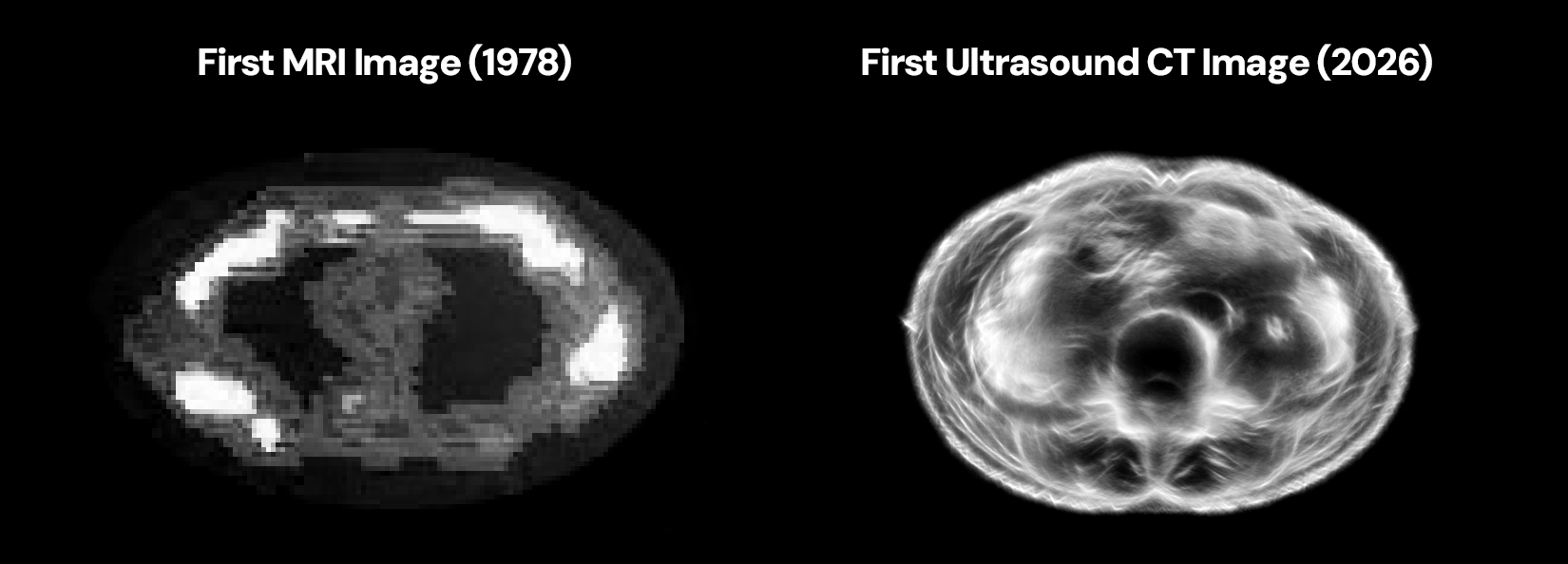
- But they have a picture showing a higher resolution Ultrasound CT result than a 1978 MRI! Surely that's important and useful information by which we can judge their product.
https://cdn.midjourney.com/static/medical/media/first_mri_vs...
- I did see that. And it does look better. Okay, I'm sold! Sign me up for my spa visit including avocado facial peel, genital waxing and computed axial tomography ultrasound.
More seriously, I assumed that CT Ultrasound image is from Butterfly's actual FDA-approved handheld medical device, not the Midjourney 360 submerged ring - as there's no evidence that is working. Since the Midjourney site has no helpful information, I just asked a friendly AI to do a comparison of what's actually proven to work in the Butterfly chip which Midjourney licensed and this 360 degree, full body, submerged concept - and essentially what's not been proven to work are those three differences: 360 degree ring of 40 butterfly chips, full body at once (requiring solving distance and speed challenges as well as a massive signal processing problem to extract and denoise signal), and doing it submerged.
- This is ridiculously optimistic. The technology, USCT with full waveform inversion, is not new.
It’s already used in breast imaging (SoftVue) and hasn’t replace mammography. A body part ideally suited for ultrasound.
More compute many minimize some of the fundamental limits of sound waves (bone and gas) but I would be shocked if they have useful images of 90% of the body parts we image with CT or MRI and even beyond that I question how much it’s more useful than B-mode anyway.
Quite slow which means most things abdomen and chest will be motion degraded.
This may be useful in superficial areas but then why do whole body anyway. Might be some new niches and interesting research but hardly revolutionary in my opinion.
- Exactly, try can get a very limited FOV which is probably why they showcased it on arms/legs first
- Gives me the strange impression of a product that was vibe-brainstormed, vibe-engineered, and vibe-announced.
- I can only imagine the swarm of AI agents constantly feeding into this project at different levels of product development and even management. (To be fair, if it works out, it might become a template for future "AI-led organizations")
- Now society needs to vibe invest!
- Neko Health has been doing this now for a few years. What I heard is that ultimately it doesn’t solve much (other than them privately collecting all your data) because there are lot of false positives and these false positives are deferred to the general healthcare system, which is a major bottleneck.
- There are 100M pregnant women right now. If it works for just for the vanity use of seeing your baby grow (forget the medical imaging aspect) and can be as casual and relaxing experience as they put forward, then I can see such a spa being wildly successful.
- is ultrasonic scanning completely harmless for developing baby? when my wife was pregnant, I remember they wouldn't recommend too frequent ultrasonic scans...
- Ultrasound is totally harmless, but doctors recommend ALARA ("as low as reasonably achievable"). Average baby is exposed to 50 - 90 minutes of ultrasound over three visits, though we had to go more frequently for scans for all three of my kids. This would be 36 minutes if you went in every week. If it was possible to get medical quality anatomy scans and avoid transvaginal scans (either because of the tech or simply just going reguarly enough to catch all the imaging you need) then it would win the entire US market for sure: roughly $3-7B for the ultrasounds (3.5M US births at $1-2k per for ultrasounds). also it's a spa -- prenatal wellness spend in the US estimate at $5-7B.
- They don’t recommend them overly frequently because it’s unnecessary, but it’s not harmful to mom or the baby in any way.
- First of all, this is incredible. Like genuinely insane. Also I bet you can do crazy things with that tranducer. If stuff like this keeps coming out, we have nowhere near enough compute
- I'm giving them the benefit of the doubt and interpreting it in a charitable way because they sound earnest about it, this is incredibly ambitious and cool-sounding, and I wish them all the best. It's something that's some sort of pipe dream, a noninvasive diagnosis machine that is able to use certain generic measurements and then derive insane levels of data from it. We've of course seen Theranos, but the holy grail remains.
Of course, there's always the tradeoff between research data collection and access vs user privacy, and striking that balance is incredibly hard. To make anything like this even remotely feasible you'll need a shitton of data and have it fully available to your researchers as well, while somehow safeguarding individual users. anonymizing medical data is impossible without rendering it near useless. Hoping they can figure that out! (Also, with human bodies being so different from one another, combatting bias is probably an eternal challenge)
- I watched the video first without reading the text and thought, wow, Midjourney has gotten really good, they generated debris in the water exactly like what would happen in real life if the water is reused enough.
Then I started reading the text, and realize it's not an ad for their video generating tool? Cool if each of it can do ~120000 scans per-month. But if I have to step in to a tank filled with debris and discharges from ~3,999 other people (assuming the machine is maintained daily), I think I might have to wear protection and you must not lower me beyond my mouth.
But, if the claim is real, then yea, it could really help. So many health problems can be discovered early with ultrasound scan, only if it can be made easy, cheap and fast. Not sure about resolution and other specs, if it can be as good as CT, then more lives can be saved.
- It's obvious why they're doing this: there's a lot of money in healthcare.
What there isn't is good evidence that these full body scans actually improve outcomes.
- Which is why I pause when they say they're not looking for investor money – in medicine you'd at least have to phrase things in terms of "what already exists, and what's our contribution"? From that lens, I'm not sure what they're trying to contribute: instead of increasing the predictive value of full-body imaging, they're just making it cheaper?
- radiologist here - example images don't look great
- Instead of the value of evaluating a single scan, what about determinations made from evaluating regular deltas between images?
As a layperson, I'm mostly familiar with the concept of "get scanned, and a professional evaluates it"... are there scenarios where the approach of "imaging every few weeks, to make decisions based on trends" is currently done?
(From reading other comment threads here, I suspect the general answer is: other body-scanning startups have proposed the same thing, and it hasn't made sense)
As an aside, I could probably benefit from allergy shots, but the idea of having a regularly scheduled errand to do during the workweek is pretty unappealing, so I never seriously consider it.
- I'm scratching my head about why they would venture into an entirely different field like this, one with tremendous regulatory hurdles, if they know (and surely they must know) that radiologists are going to pan the results.
It's like if LeBron announced he was switching to bowling and was going to revolutionize the sport, then rolled a gutter ball.
- > I'm scratching my head about why they would venture into an entirely different field like this
Never underestimate the audacity of a software engineer with a new toy
> It's like if LeBron announced he was switching to bowling and was going to revolutionize the sport, then rolled a gutter ball.
Well, if you replace LeBron with Jordan, and Bowling with Baseball ..
- The founder of midjourney is not a software engineer.
- Not sure. Image reconstruction/generation is a computationally intensive process, and in recent years DL based methods for improve image reconstruction have advanced fields like musculoskeletal MRI imaging. The physics behind this idea are interesting, but will have to wait to see if they produce images with high anatomic detail.
- I'm pretty sure, like most things, it's better to wait and see what's built rather than take issue with their short marketing video.
- I mean, Michael Jordan did play for the White Sox for a hot second
- It’s because no one has heard from mid journey in a few years so they’re pivoting
- [dead]
- can you say more? dont look great compared to current radiology, sure, but you see no potential in ultrasound diagnosis whatsoever? would it improving 10% change your mind? 10x? what's a good way to think about what "looks good" looks like?
- That's basically the only thing I'm interested in reading about this. Based on my complete lack of radiology knowledge, I'd say the images look... a bit blurry or something? So, what would be an example of something this would not allow a radiologist/doctor to see?
Without those kinds of details, radiologists just expose themselves to: oh so you're telling me this doesn't work as well as the machines you paid ~millions of dollars for and are currently charging your clients a lot to use? Mmm I wonder why.
- But isn’t this much cheaper and easier so even if they are not quite a good, the accessibility and ease and thus much more data is better?
- More data sounds better, but especially in a medical context, you have to be careful, because false positives have consequences. The PSA test is no longer broadly recommended for prostate cancer screening [1]. What harm could it do, you know more about your body, even if it's a noisy predictor? Most prostate cancer is slow growing, and something that men "die with" rather than "die of", so treatment can make for worse outcomes, without clear benefit.
It's not clear that we have the health infrastructure in place to know what to do with frequent, low resolution, whole body scans of the human body. How often do anomalies show up and then go away? How often are anomalies purely a scanning/data processing artifact? Who reads the scans and makes recommendations about follow-ups, if any? I think this is the kind of thing that sounds exciting and with low direct risk, but with all kinds of questions that are not only unanswered, but apparently unconsidered.
- > It's not clear that we have the health infrastructure in place to know what to do with frequent, low resolution, whole body scans of the human body.
This is exactly my thinking. There are decades of longitudinal studies behind the recommendations physicians make based on given levels of e.g. cholesterol in a standard blood test. And critically, those depend on standard protocols around administering and testing samples.
This would be brand new and would not have any of that infrastructure. Which all tech starts at, good. But I would expect Midjourney to need to dig in for a few decades to get and analyze clinical results and outcomes.
For body scans, I think about how few people would know if they have e.g. three kidneys (or other distortion), and how that impacts/doesn't impact their health.
Most people do not undergo autopsy after death, so it's possible there are correlates between good/bad health outcomes that frequent scanning would eventually reveal. But it would take significant time for this to be apparent.
- Yes. I spent a bunch of money on many of the optional extra imagining scans on my last health check up only to realize this afterwards. Humans have survived this far without this data. It would be better to spend resources on preventative things or lifestyle things known to promote health, than to obsess over seeing whats going on inside.
- Other than the shapes of the tissues in the images, there is no anatomic detail. Wouldn't be useful for diagnostics. It's substantially worse than conventional ultrasound.
- Would it be suitable for basic body composition (as they claim in TFA)? DEXA is a big business and companies push a subscription model where they encourage you to get monthly scans. The results are really fun to look at and the dose is admittedly very low, but you're still getting rastered by an x-ray. It would also explain the spa angle and hence why they're doing that before going for regulation.
> We’re starting by just giving you detailed body composition maps — and we’ll be submitting regular test results to the FDA for increased capabilities.
As far as I understand ultrasound there's no reason you couldn't do this, it's just infeasible to do a full body scan with a hand probe and you get covered in goop.
- Besides the high probably that those images are fake, and probably this entire device is fake... if it were real then it would mean what they're showing in those images is not even close to an approximation of what the actual data could show you if they put more effort into volume rendering of 3D data (not unlike Voreen).
The resolution of typical DICOM images is much less than what they're saying they are actually capturing, so the reconstructed images they're showing are just terrible for no good reason.
But I suspect there is a bigger fundamental physics issue with this entire thing... I'm not convinced they can penetrate fully inside and all the way around a human with only non-ionizing energy, especially from that far away.
- FWIW, I tried the prototype. It's very real. I scanned my hand and arm. It showed realtime images of slices of my hand as I dipped my hand in the water. Really amazing IMO. I think this will be a game changer when it comes out. It's just so easy to scan yourself.
- Did you get any interpretation of the imaging? It sounds cool (I'd take an ultrasound selfie) but it has to be medically useful for something before enough doctors grade enough images to kickstart the data collection for diagnosing more.
- A problem with large scale "screening" is the explosion of false positives (even at very high specificity) and the follow-ups that those generate will overwhelm our current healthcare systems.
So any machine that does something medical must address this. Either that, or don't be medical. But then you might just as well tell people: "Move around a bit more. Talk to other people. Eat real food, not too much, mostly plants."
But we are always attracted to solutions that fix us in easy ways. The problem is that the issues are often with our behaviours, and those are hard to change. Or perhaps we are finding easy ways now with GLP-1 agonists and our future health and happiness is in drugs... But then why do we need this machine...
- If we scan patient every 6mo starting from age 18 lets say, you could identify the masses in the patient body and track what stays the same, whats growing etc.
- But what if most "masses" are cysts or other harmless structures that form during the 80 years we're walking around? I think that after about their 3rd useless biopsy people start to feel the problem with this.
Of course we can keep tuning and tuning the models, but in the limit it may well make more sense to wait for symptoms. At least that is the current experience.
Now maybe this machine will make sense in screening age 55+, 20 year+, 2 pack+ smokers for Lung lesions (where a much large portion of detected lesions are true positives). We do this currently with CT and this may be better or cheaper. But it doesn't look like it is, and it looks like far (very far) lower res than MRI (often the follow-up of a CT-scan).
- Well that's certainly an interesting pivot, when Midjourney where set to announce hardware, who predicted this?
- After reading this first, it looked almost like a joke, like how Google used to do Google- TISP Toilet Internet Service Provider https://archive.google/tisp/install.html
Even now without Xrays it is very hard to really even see if there are blocks in your artery usuing ultrasound (Echocardiography alone). Ultrasound is used indirectly by measuring blood flow difference between stress and rest - not a spa session anyway. Looks like a prank really
- In the early years of X-rays, doctors found all sorts of patients with major organ displacement, and performed surgery to, for example, hold the liver or kidneys “up”.
It took a while to realise that textbooks since Leonardos time had drawn and based anatomy on (dead) patients lying on a slab. But X-rays were taken with (alive) patients standing up. So of course there was a lot of “your kidney has slipped!”
I fully support and applaud this kind of medical innovation (even if … why midjourney?) but we need to be careful of the medical term VOMIT (victim of modern imaging technology). At some point we need a human doctor to say “calm down, live your life, eat right, exercise right, and accept that somethings don’t need to be panicked over yet - come back in six months”
- This covers a lot more details than the announcement.
EDIT: Actually looks like their announcement has another page linked for more details containing this video.
- > Today we're gonna announce something a little weird and a little crazy, but also spectacular and filled with hope.
Why is that almost every LLM generated article sounds like a LinkedIn motivational post?
(this is not a rhetorical question, I would really like to know why, from all the writing styles, this is the most prevalent one)
- > But suddenly, you have a huge library of data about your health.
With "you" being a VC backed startup aiming for the next $1T IPO. What could possibly go wrong?
- Midjourney is not VC backed. They have a bit about this in the article:
> As a reminder, Midjourney has no investors. We are a totally new kind of research lab. We've seen academic, corporate, and government labs - but we are a distinct (and curious) new thing: we are a community-backed research lab.
- Yeah sure. That's not going to be a sustainable model. Once the tech is available and money is to be made, lots of for-profit alternatives will appear with marketing and lobby budgets that will take over the market.
Remember Open AI was a non-profit at some point. Look at how that turned out.
- I watched the whole video thinking it was generated by Midjourney, the product, and that the announcement was related to fidelity in images/video around human anatomy. This seems like a very strange pivot for them indeed.
- To me it reeks of desperation.
- This will be really interesting for brain imaging I think -- particularly for non-penetrating trauma (blast, crash, falls) in environments where MRI is unsuitable/unavailable, or where potential injuries are very common and thus per-scan cost is critical.
If you scanned every American Football player before/after a game, it would probably lead to an end of the sport. Similarly with boxing, and soccer heading practice.
Also would be super useful in war zones -- you can't MRI due to metal fragments, and can't CT over and over again due to radiation, and right now most of the guidance is "don't get injured again" and is broadly ignored. Being able to scan people near point of injury (or just after high risk activities) would be great.
(Obviously lots of other uses for this in disease screening, etc.; difficulties with ultrasound due to bone, gas, etc.)
- It will be terrible for brain imaging. The ultrasound waves can’t go through the skull and thus can’t image the brain. Additionally you would have to drown the patient since you need a medium other than air between the ultrasound emitting probe and the body which is water in their device.
CT is more than sufficient for imaging the brain in a case of trauma and MRI is not automatically better than CT in every case.
(I am a neuroradiologist)
- Clearly something like this would need to be approved by the FDA, it is literally irresponsible to promote something like this as being more powerful than a MRI.
- Are you implying soundwaves are dangerous?
- You shouldn't promote something like this as being useful for medical purposes, because some patients might think this is real and start sending their doctors these "scans" or even worse, some shitty doctors will use them to diagnose tumours in their patients so they can then make banger bucks out of their new hallucinated cancer patients.
Stuff like this needs to go through approvals for obvious reasons before they can advertise them for having medical purposes.
- That was probably not GP's point, but they can be. Sound-based weapons are a thing: https://en.wikipedia.org/wiki/Long-range_acoustic_device
Of course a lot of it is about the energy and overall exposure, and the harms of this, if any, are more likely elsewhere, but it's completely reasonable to question extraordinary promises made by people who up to this point have shown no expertise in the field.
I swear, it's like some people have already forgotten about Theranos.
- "Dangerous" is a loaded term. But yes, even "soundwaves" can cause harm, same way use of pharmacological medical interventions can cause harm. Dosage, application methods, side effects, etc. all exist for medical use of ultrasound too. https://pmc.ncbi.nlm.nih.gov/articles/PMC8954895
- Looks like an array of ultrasound probes which is fine.. how does this deal with bone obstructing windows? the example with an abdo is feasible and fine but you cant do that with brain or easily with heart /lungs
- I've worked optimizing MRIs trying to make them faster and more accurate, they're amazing machines (distinguish white matter from grey matter in the brain is very non trivial), but super complicated and expensive. To me, the paradigm change that could come from greater accessibility and throughput to analyze all that data would be having longitudinal baselines (scans every x months), which right now only very few people can access, and for the same reason there's not a lot of data to build accurate models.
- I think it's a bit odd to compare this to an MRI. The physics are totally different and there are things it fundamentally won't image in the same way because it's basically just ultrasound.
The approach sounds like something which appears in a few research articles from the 2010s (ultrasound computed tomography), although submersion to make the ultrasound transmission more efficient seems novel.
It's possible the "spa" approach is used because it's hard to achieve the level of cleanliness required in a typical health facility using a shared bath.
- This is a full body ultrasound?
Medical I don't care about futuristic sounding stuff. Just show me evidence based and clinically useful testing.
Use AI and new scans to help sure but prove it works otherwise this could be another dead end.
- Hell yeah, my AI image generation company is now running an alternative medicine AI MRI-alternative imagine spa. Hell yeah.
- > As you descend you pass through a ring made of half a million tiny squares each the size of a fine grain of sand, and each capable of acting as both a tiny speaker and a tiny microphone.
Is this actually possible? It seems really ambitious to aim to open by the end of 2027.
- Awesome work. The second video is great. I don’t know enough about medical science to consider viability and shortcomings, but I’m impressed by the dream. Keep cooking.
And even if the device fails, I’m sure the spa will be nice.
- This is very ambitious and commendable. They are putting their bootstrapped money into something incredibly cool and potentially useful. Regulatory will be hard, but perhaps they can do something like a class 1 device which doesn't diagnose anything / is used by physical therapists and they sell them to gyms. I also expect the resolution to increase rapidly. If they can convert profits from generating weird ai images into new medical technology thats a win. Good luck! They will probably fail but this is what ambition looks like!
- This is one of the creepiest "big AI" product launches I've read. I know it's becoming a meme, but that spa looks like something from a Black Mirror episode.
If they were just creating a new less-invasive and differently informative alternative to fMRI / PET / EEG / CT for researchers and doctors to use in hospitals, where experienced human doctors were given agency in finding out how best to use the tool and interpret the results (understanding all the caveats that go for full body scans, false positive rates and so on[0]), then that would be amazing, a tiny step forward for the human race. But packaged like this, eww.
- Thank you very much, Midjourney.
If some of my doctors were software engineers I probably would be dead by now.
Or mid-dead.
- And slide 25, although it is questionable if this is really the result of such a device like Midjourney is presenting.
If it is then wow!
- I had to check whether this was some kind of an april fool joke.
It looks like a legit attempt. Wow. This is insanely innovative.
- > Midjourney Spa
Those visuals look straight out of the Backrooms
- It reminded me more of Blade Runner, especially with the gold lighting.
- I feel confident I can pass the Voight-Kampff test
- I don't really understand the connection; they went from image generation to medical scanning?
- is it not similar? taking raw data, some vector of data and constructing a visual image
- There's deterministic algos for it and have existed for ages.
Medical imaging is literally the last of the last places where you want to hallucinate a tiny little blob.
- > Medical imaging is literally the last of the last places where you want to hallucinate a tiny little blob.
Where's your sense of fun and adventure? /s
- One thing invents a bunch of fake bullshit using artist's work and the other is supposed to give you an image of something real and meaningful that wasn't just hallucinated or patched together. All from the guy who brought us Leap Motion, a gimmicky product that failed to live up to the hype. This isn't exactly encouraging. If it actually works we won't need a press release on their website, we'll hear about it in medical journals and it'll be doctors singing its praises. You'll find it being used in hospitols and not pop-up spas.
Only after that happens will I have to even consider how comfortable I am with the idea of handing over what they suggest will be massive amounts of highly personal medical data to this company and how much I trust them not to exploit that information for their own purposes and profit.
- [dead]
- Very unexpected but also really uplifting to see that they would spinoff a division to tackle this - it's ambitious. Obviously they've identified that the vertical is big enough and that they have the expertise or novel approach to tackle it, but i'm really curious to know how this came about internally.
- Impressive vision. Excited to see how 'Ultrasonic CT' handles real-world clinical validation challenges.
- Interesting but many issues which have been listed here are valid. This is my take on the largest of them.
Preventive testing is not always positive. False negatives creates a false sense of security and false positives drives unnecessary medical procedures. For example, what if this instrument sees "something" and a doctor then follows up with a biopsy, x-ray or explorative surgery. These will all have negative side effects. There has even been a debate of if mammography is a net positive. I think it might be but I'm just saying that even such a thing is debatable. The question is not only if the these early tests find anything, its also a question of whether detecting it early changes the prognosis. Maybe its untreatable anyway? Or maybe it would still be treatable if detected later? And then comes the cost of course, is it economical to do these scans on a population level relative to the alternative cost.
Building medical systems is not for the faint of heart. I was part of a startup building a Micro CT system with the long term goal of using it to detect tumors in biopsies live during surgery (1 um resolution for cm-sized samples) without waiting a week for the normal analysis. We also started with non-medical instrument (general research) and we never got to the medical instrument before we ran out of money (we engineers were too bad at sales). But we did study up on the (European) standards quite a bit. They are not crazy in any way. Its simply that you follow good engineering practice BUT it is hard to move from building a non-medical system to medical system after the fact. The standard is a process standard so it basically says "You should have followed this process when you designed your product". And you need be real careful setting your Intended Use and showing that you have Verified and Validated that your system can be used for the intended use. So most likely they need to build one product now (Body Composition Analysis), use that for research and then set up their Quality Management System before they rebuild everything from requirements to risk analysis to test plans to hardware to software. 10 years is probably on the low side for this and quite the cost.
- Genuine question.
Outside of providing access to their core AI products at a free or discounted rate, what philanthropic initiatives are OpenAI and Anthropic pursuing to improve the lives of people in developing countries?. I can't recall seeing anything on their blog recently about it. Happy to be corrected.
- That video gave me ESB Han Solo carbon freeze vibes. Not sure if that was the stylistic intent they were going for. I guess there's a good chance those who worked on the video weren't even born when it was released.
- People on here really need to understand what the incidentalome is.
- So if it works: Awesome.
The spa approach is a little weird. FDA workaround?
- It's probably hard to make it hygienic enough to be standard hospital equipment to be honest
- I think it is because they want something that feels nice so people will go there more often?
So they get more data of the same person over time.
- AI is about to find out the difference between talking and doing. Exciting!
- Always trump with the savior card when bad PR¹ starts creeping in.
- This is pretty, but it's goals make it sound under-thought and somewhat silly. Typical "SF is coming to save the world" stuff.
> Our ambitious goal is by 2031 to have a fleet of over 50,000 scanners worldwide - with a total scanning capacity of a billion scans a month - enough to cover a huge percentage of the global population, or enough to give regular, monthly scans to a billion people.
> What This Leads To
> Whether or not our scanners are a service that everyone uses, to us, the most important thing is that everyone will be able to use them.
There is no way these will be available to a billion people. This is a luxury product for rich people, which is fine, but they cannot afford to run these for a billion people every month. Think of the infrastructure—both human and physical—to provide that. Think of the distribution of wealth across the world. Come on.
There are so many small, boring details that will have to be ironed out: many Americans won't fit in that machine, kids will not sit still, you'll have to clean them constantly (people pee in warm water), buying and re-tooling property for spas with zoning and licenses is arduous and jurisdiction-specific, etc. etc. etc.
What they are pitching and focused on (data, models, tech) is the fun part. It's not nearly most of the problem.
I'm not sure if they believe this (naïve, unserious) or if they don't (lying). Either way doesn't build trust.
- I'm sure I read that 30% will be immortal there, but suddenly the blog post changed... :)
- I'm sorry, a billion full-body scans a month?
For what possible reasons? Are people going to be doing these things recreationally? Cause otherwise you're talking about scanning the entire world's population, including the very young, the very old, the mobility-impaired, and those without easy access to US-based facilities (i.e.... people who are part of the small fraction of the global population who do not live in the US), twice over, every 18 months.
What possible use could there be for doing this?
I recognize that the presser says the scanners will be deployed "around the world," but let's be real, this will probably be 80% US.
- "What possible use could there be for doing this?"
I've encountered this attitude before, and I always find it perplexing that there are people who are annoyed by, even hostile to, the idea of frequent health telemetry.
What possible use? How about giving people greater visibility inside their own bodies without having to navigate the labyrinth of the healthcare machine and without having to justify themselves to actuaries?
- A counter point: a fixation on medical diagnoses can be counterproductive to living a good, happy, and healthy life. My implication is that data will lead to self-diagnosis, when maybe it’s not necessary.
There’s a reason most people don’t get medical scans every checkup, they’re simply not necessary for the majority of (healthy) people.
- In Japan, the government gives everyone a battery of full body tests at least once per year. I guess you know better than Japan, right?
The whole argument that "you'll worry yourself sick" is such patronizing trash. It's obviously programming that came from the insurance industry, and you lapped it right up.
- There's a world of difference between the health checkups we get in Japan, and something like a full-body MRI/CT.
You're not arguing in good faith when you equate those.
- Are you joking? 人間ドック is absolutely more than a "health checkup". Maybe do some reading: https://medical.kameda.com/general/en/ningendock/what/
> The Ningen Dock is a comprehensive health checkup system that includes a battery of tests, including blood tests, chest X-rays, and ultrasound scans, among others as well as advanced diagnostic tests as Magnetic Resonance Imaging (MRI), Computerized Tomography (CT) or Endoscopy. These tests can help detect potential health problems early before they become more serious or difficult to treat.
- That is not the same as the annual mandatory health check.
Maybe your employer pays for you to get a more comprehensive checkup by default and you're unaware of this?
But the ones vast majority of population here gets do not include MRI or CT or Endoscopy.
And, _even then_; specific checkups when you're looking for _specific things_ are still very different things than a full-body MRIs.
- [flagged]
- I think there’s actually a difference between getting a battery of tests from a set of doctors (overseen by the government) tailored to your risk factors and a company trying to sell a fully body scan which they think you should casually get all the time.
- I don't read the parent comment to take issue with the use case per se but the billion scans per month figure.
Surely, whatever this is giving you, getting a scan once a month must be plenty. They need a billion people to get a scan every month.
- Because false positives have a tremendous emotional (and, depending on your healthcare system, also monetary) cost to patients.
- because it has negative effects. Over scanning leads to, in particular with the economic incentives of the healthcare system at large not to mention a company like this, over-treatment. It's one of the reasons countries have scaled back mammograms because women have been forced into surgery and treatment with no meaningful improvement in outcomes. Prostate cancer being another one.
My wife's a cardiologist and hypochondriacs with smartwatches have become a frequent occurrence because healthy young people despite regular check ups have convinced themselves their watch telling them their pulse got high that one time must mean they're dying and they'll show up not one but five times.
The same is happening with so called "sleep optimizations" which themselves can produce insomnia as people start to self-monitor and enact sleep efforts.
- Rather than dealing with the issue—hypochondriacs or whatever—you prefer to remove the option for the non-hypochondriacs?
The fact that doctors like your wife think that people who are concerned about their health and want more information is a problem tells me everything I need to know about your (and her) worldview. You've dressed it up as being pragmatic, but the reality is that you're arguing for censorship and against freedom of information.
- >that people who are concerned about their health and want more information is a problem
It is a problem because there's evidence based standards for when examinations are indicated and prolong or improve a person's life. You being extremely concerned doesn't move that needle and subjecting you to tests simply because you're anxious is blatantly unethical and harmful to your psychological wellbeing.
And nope this isn't censorship, it's being mathematically literate and understanding how data production works. Here's an actual real world example. There are aids tests that are 99% accurate. About 30 in 1000 people in the US have AIDS. 99/1 is great odds, let's test everyone, data doesn't hurt right? Except as it turns out if you test a thousand people randomly you'll have 10 false positives and 3 people with AIDS, Bayes in action.
So if you sent every American through body scanners, which are less reliable than that test btw, you'd have quite literally millions of people in follow up procedures for diseases they do not have with their mental health ruined and the system ground to a halt, because producing information is not always the right thing to do.
- That's definitely an important point to consider, in fact something I think everyone in these conversations should be cognizant of, and also why it makes me believe the actual conversation should move to whether the device improves false positives/negatives rates or not (or at least has a chance to), which then might warrant wider access/use.
- A better question is if people are going high-res, why not go high-res with tests whose accuracy is known, and for which there are useful, data-driven treatments?
Instead of casting a net of unknown quality every month, comparing against a null dataset (there does not exist a large dataset of these scans with outcomes for given markers).
Why not advocate cheap, easy blood/urine tests with higher frequency? Those tests do have large reference datasets with outcomes. And they have prescriptive value: there is likely more benefit to catching hypertension or diabetes earlier in more people.
- True, though those things don't have to be mutually exclusive.
- Theoretically if this was possible (and I doubt it is, like c'mon) then it could be used for early detection of cancer.
- From what I've read, full body scans are awful for this--your body forms and kills tumors all the time. The false positive rate is ridiculous.
- The more we measure, the better we get at separating the false positive cases from the serious ones. Especially in a world where AI plays a bigger role in the development of the medial sciences.
Going forward into the future and not measuring more accurately because we are worried about false positives in our current limited understanding is a very conservative take.
- > The more we measure, the better we get at separating the false positive cases from the serious ones.
On what basis do you say this? There is an extensive literature that refutes this. Scanners have been getting much better since the first CT scans and many more people are getting them.
- False positives aren't a consequence of having the data, they're a consequence of misusing the data to issue diagnoses with insufficient evidence. "Just" don't set your thresholds for diagnosis so that you do that.
- I'm not so worried about the data being useful, I'm worried about the machine actually working.
I mean, with that much data, you may be able to understand under what timeframe a tumor is actually of concern. What's so bad about having some false positives?
- > What's so bad about having some false positives?
Having invasive surgery. Undergoing chemotherapy. The former is bad, the latter is basically a 'lets hope it kills the cancer before it kills you' situation.
It's arguable which one is worse, but I'd rather not have to ever partake in either of them again.
- Ultrasound can also detect (some) kidney stones before they start moving and become painful, allowing an assessment of whether a medical intervention is useful or necessary. When I used to get kidney stones more frequently, there was a year or so when my doctor sent me for an ultrasound every few months to try to detect them in advance (!).
I think this is currently seen as too expensive to do for people who have lower risk, but I mention it as an example of something that one could check for more routinely given much cheaper ultrasound scans.
Prophylactic ultrasound exams are also apparently much more plausible on medical cost/benefit than prophylactic CT exams, because the CT exams very slightly increase one's cancer risk (https://xkcd.com/radiation/), where ultrasound doesn't.
(At a friend's doctor's suggestion, I started taking alkali citrate supplements and switched from almond milk to oat milk; I now apparently rarely get kidney stones.)
- There's no reason that ultrasound imaging equipment needs to be expensive. Overall the parts are pretty cheap. I think everyone should have one next to their toothbrush. Whole body ultrasound scans would also be useful, although harder to place inside everyone's homes.
- I would guess build a health prediction model. Instead of next text token or next frame in a video, how about next 12 months or years of body health?
Hopefully it doesn’t become Gattaca.
- > What possible use could there be for doing this?
The point is to generate an enormous unlabeled dataset. Historically, ML for medical imaging depended on a small number of labeled images - small because you needed to have an expert study the image and label it as healthy/cancer/etc. But the "GPT breakthrough" was that it was better to use vast unlabeled datasets - in the case of LLMs, text - than small labeled ones.
- Who reads these scans and who assume liabilities for missed reads?
- AI[no one]. The customer.
- > What possible use could there be for doing this?
Umm...the same use we get out of an annual physical or dental checkup.
- Lol. This isnt for everyone. This is for the rich. They are going to sell these things for personal use, for installation in homes. Take the top 100,000 families in the US, those that can afford a home unit. Scans then become as normal as taking a bath.
We are well on our way to that classic scifi trope of the villian being introduced as they soak a special tub of goop. (Dune, GOTG, Star Wars)
- The top 100,000 families taking this scan every day would still put them 2 magnitudes below the target.
- A Ferarri can do 200mph, but almost never does. Rolex watches come with helium valves, not that anyone understands what they are for let alone uses them. Luxury goods are always about untapped capacity.
- What? This comment chain is specifically about the target of a billion full-body scans a month using 50,000 units.
That's about 1 scan per unit, every 2 minutes, 24/7.
- 50,000 hypochondriacs could pull that off easily
- It's really not OK to victimize the rich like this either.
- Hot take: the rich (especially the upper strata of the rich) are perfectly comfortable victimizing the non-rich in some material ways (from monopolistic practices, to lobbying against labour interests and union busting, to regulatory capture, to name a few).
To the extent you can really call pointing their behaviour out as victimizing them, I would consider bad PR to be a fair tradeoff.
- I can’t tell if this is serious or a top tier joke.
- Rich people have a phobia of death, unlike the rest of us for whom depression, disease, and injustice have really removed the sting of death and turned it more into "eh, if it happens it happens." So worry not: The rich wasting their money on biohacking fads are not being scammed, they are being consoled.
- Isn't therapy or enlightenment ultimately cheaper?
- [dead]
- Poor good. Rich bad. Good stuff should go directly to poor good people, never go to rich bad people. But that thing is for rich so by definition it is bad and not for the poor
- > What possible use could there be for doing this?
Early detection of disease, as well as every kind of physical issue with the body you can imagine.
The incredulity of the question seems rooted in the medical culture of our current time. It's easy to imagine a science fiction future where scans happen not every 9 months, but daily, in your home, and the idea of not constantly checking your full body would be as strange as not brushing your teeth is to us...
- Sounds like programmers woke up from a fever dream and decided they can come up with an idea and flesh out the details later.
- > But suddenly, you have a huge library of data about your health.
Why don’t they approach this as a regular medical product?
With this spa angle I’m worried about hidden motives; perhaps data collection is a major goal. Or maybe this tech is not reliable enough.
- I think getting more medical data could prevent a lot of health problems, and collecting it in a relaxed and frequent environment could be interesting. This announcement is honestly just... a bit weird. They're talking about wanting to do a billion scans a month, but they haven't even mentioned what the ultrasound data can tell you about your health, nor have they showed a physical demo of the product. I think the latter is the most important part, does it actually work?
- So how exactly is the scan counter going to hit their target of a billion per month? Are they scanning us while we sleep?
- https://www.medbridgenz.com/post/phased-array-ct-china
Remind me of this, radar based.
- This is the most insane thing to happen to medical imaging
To understand Midjourney Medical (MM), think about current major options: - CT/X-ray: harmful if done too much && can't do for pregnant women - MRI: slow, have to stay still, no metal - Ultrasound: really low fidelity
Midjourney Medical is fast, high fidelity, and perfectly safe!
The holy trifecta.
Insane vision. Insane work. Hats off to the team
- This is absolutely a scam. Seems incredibly fishy.
- Are we at peak AI yet?
AI company announces AI thing using AI video mock up
- Will there be a way to use this scanner for people that are unable to stand up because of a disability or medical condition?
- Great point. Scanning healthy people is one thing, people who truly need help (like myself) is another!
- This is next level "never let them know your next move" type of play. I hope they win.
- ER Nurse here:
This produces images as good as an MRI- did I get that right? We already have those- they are relatively cheap ($2000 if you paid cash) and have already been scaled.
The only difference seems to be the speed of the test. But how long does it take to be lowered in and out of the water, not to mention the fact that you are soaking wet afterward. An MRI of the brain takes 15 minutes, only requires you to lie flat on a table, and then you can go about your day.
So we already have this technology- ultrasound is well understood, and free to perform, a bedside ultrasound is around $40k.
These are not medical grade images, so I am not certain how they will reduce medical costs by 50%- no FDA clearance means the images cannot be used for medical diagnosis. Meaning if it finds something serious, you will STILL need imaging at the hospital for the finding to be actionable.
Baby boomers are about to hit the healthcare system hard- and none of them will be able to tolerate being dunked underwater. This technology cannot scale to hospitals, the main consumers of medical imaging.
I appreciate the hopeful outlook, but creating a more elaborate and expensive way to have an MRI done seems like a bit of a fools errand, especially when 50% of bankruptcies in America are due to medical debt.
What are the metrics this will report? What information does it provide that is not already available via other existing means? What is the benefit of daily or monthly full body MRIs? What are you monitoring? How will this achieve the goals they claim 'cannot be overstated' but also cannot be enumerated...
Access to better imaging technology is not a barrier to obtaining medical care, there are imaging centers on every corner. MRI and ultrasound technology are already as advanced ad this, utilize the same ultrasonic technology to obtain images, and are already manufactured at scale.
I am really struggling to figure out the problem this is trying to solve
- It’s valuable to have input of healthcare professionals here. I don’t disagree with the majority of what you’re saying.
However, the value add here is it can do your whole body a lot faster than doing a full body MRI (which would take hours at least?)
- Here is the music from the video: https://music.apple.com/us/album/on-an-evening-at-the-lake-f...
- They should ask their LLM for fun things to do in prison! Or ask Elizabeth Holmes.
- This is interesting & ambitious!
Not a physician, I wonder about the general efficacy of random scans vs more boring traditional things like bloodwork. That is: is there more clinical power in doing blood + urine labs monthly or body scans like this?
- Welcome back theranos
- Why not have 5,6 rings at different levels and do it live in 3D?
- This looks like straight from a sci-fi movie. Crazy how fast things are becoming to look like alien tech. Pretty amazing.
- 20 or so years ago while working for a Startup in the Home-Health EMR Space - it was my job to develop and integrate the proper processing of incoming visit forms. After an outage, I performed an audit of our incoming forms and noticed some anomalies in the billing patterns of doctors belonging to one clinic. In other words, these doctors either had the highest concentration of extremely sick patients - or they were committing Medicare fraud.
At the end of the post mortum with the CMO, as I was getting ready to leave I decided to bring this to his attention. I’ll never forget the change of mood preceding the dressing down I received: “do not ever put yourself in a position to make clinical decisions.”
3 months later, the charting anomalies were so egregious that the CMO’s spot-checks led him to sit the medical director of that physicians clinic down for a chat. They were good doctors, but they were over-billing. A year and a half later their practice goes under pre-payment review, and four years after I wrote a script that noticed an anomaly - the head MD of the practice was sent to prison for 4 years after collecting millions of dollars in over-billed house calls.
I loved working in healthcare, and I still miss it to this day. I don’t know where I am going with this, but right now I believe there is a diagnostic technology out there that is being used in veterinary science or piloted in some other country that could save a statistic level of lives …. However, due to the fact that doctors practice medicine and we don’t, as a group they act as defacto gate-keepers (which they are entitled to be as clinicians), the best thing you can do is to incentivize them with money (like Obama did) with Medicare bonuses for using an EMR that logged CCRs and alerted the doc if the patient didn’t have certain vaccine information in the elderly.
If the first guy to wash his hands was seen as a lunatic, the first geriatric practitioner to give over an iota of their clinical practice to automate Rx dispersal while navigating poly pharmacology concerns will go to jail for a narcotics crimes or will be labeled to heretic until Medicare pays them all for it.
- Why is everyone so negative about this? Getting a CT or X-ray and then having AI do early screening on cases that doctors can pass along doesn't seem like a bad idea to me.
- People are responding negatively to what looks very much like vaporware from a company stepping way outside its domain into medical imaging with a bizarrely positioned announcement post. Medical imaging is a very active field of research with many brilliant minds working on it. If this were truly an MRI killer, they would not be announcing it as a spa.
- After reading to what you said and thinking about it seriously, I do think there were some parts that were too unrealistic. I considered a few things, such as whether the cost of data transmission during streaming, that is, the cost of constructing an entire human body from this single slice, is actually reasonable. Thanks for your comment.
- When I think of 'YAMAHA's case, I believe they can fully realize their own ideas. These people are mainly experts in image-related fields, right? And we're talking about image AI—which, in practice, needs to recognize the characteristics of objects—so it seems to me that it's a fairly relevant field. But since you're more of an expert than I am, your opinion probably carries more weight.
- It is in fact very probably a bad idea. A good search term here is "incidentaloma". The balance of evidence currently appears to suggest that full body scans for asymptomatic patients are a net negative for health.
- Those claims are extremely suspect and completely support the current rationing and power structure of healthcare.
But, even granting they could be true, they would be true under the status quo.
Sure, a one off full body scan might be scary and lead to unnecessary action. But if a technology of the sort being described here were to exist, you would just get daily (or more frequent) scans to monitor the situation. Is that tumor actually growing or is it just a transient thing your immune system is dealing with? Way easier to tell if imaging is cheap, fast, and frequent.
And then there is the data.
No one knows what is actually going on in our bodies. If we had the ability to do billions of scans, imagine the longitudinal studies that could be performed.
It would radically alter medicine.
- How brainwashed by the healthcare machine do you have to be to think that catching asymptomatic medical issues is a bad thing? The argument against is literally:
- patients will worry too much, and - it will cost time and money to investigate.
Both spurious rationales cooked up by an industry that is at least as hostile to humanity as it is helpful.
- [dead]
- Because a lot of the hatred for AI is just hysteria.
- Bravo for this vision. I wish them well and hope they succeed. I look forward to the first real technical reports.
- Midjourney out there making the pool rooms a reality
- Part of me is super excited about this.
The other part wonders if this is the next clinkle.
MJ has shipped stuff before though so I’m optimistic.
- I really wasn't expecting a hardware device from midjourney! Incredible!!
- We are at pets.com stage of AI bubble. This time the business model is LLM-generated, though.
- Assuming it all works 50k scanners running nonstop at 60 seconds a scan is 2.1 billion scans a month. Assuming they aren't lying/exaggerating about anything, and assuming there is no downtime/setup/etc. in between. In other words, reeks of massive bullshit.
- Can someone with expertise explain what kinds of medical imaging are theoretically possible with this kind of sensor?
- If you could obtain volumetric/3D ultrasound data that was not operator dependent, that would be great.
US is a good diagnostic tool, but it can be challenging to read because obtaining good images is very operator dependent. You need to have a good sonographer that can get the right views, knows how to adjust the imaging parameters to produce high quality images. It's not like CT or MR where the tech just sets a few basic scanning parameters and let the machine do its job.
However, see my other comment, the example images they provide on the page do not look great, very limited organ detail.
edit: clarification
- More just interested in medical imaging in general but: unobstructed soft tissue imaging is possible with this, e.g. abdomen. You can get reasonably good differentiation between types of tissues using ultrasound in this context although there is the potential for ambiguous findings where further scans like MRI will be required to get less ambiguous information about it.
Chest cavity, brain tissue scanning etc. will likely remain unrealistic as ultrasound waves won't penetrate bone and the ribs and skull will interfere.
- It has been said in this thread that we shouldn't scan healthy people because false positives. That's a good point. But I also think we are still looking at the small picture: catch diseases.
The slightly bigger picture is to prevent them, and there early warnings can help a lot.
At a yet slightly higher level, some people think that we are about to enter the age of superintelligence. That's a separate debate but it's not something I would disregard entirely. In an age of superintelligence, our goals and tools for healthcare can be different. I'm very much doubt that the medical establishment and we as a society will embrace a world where each person has some model of their metabolism running on some hardware and being updated and monitored 24/7, but this is already a reality in many industries where it is called "digital twins", so maybe this is something you'll go for if you are a trillionaire.
Zooming out and flying higher, the goal is of course to be young forever and let your body stay away in state space from most diseases. Is that something superintelligence can do?
- If this can image a fetus in utero they're already cutting themselves off from India as a market
- For those who think this is a joke, there's no differnce between this concept and data centers in space concept, that's worth $2T. Both are not yet proven to work yet. At least they're not screwing the pubilc.
- Isn't this how MRIs and stuff already work, they just use waves with much more appropriate wavelengths...?
- MRI uses EM radiation in the radiowave frequency band. This is using sound.
- And doesn't bone pretty much block all ultrasound waves? There is a time and place for ultrasound, just like there is for MRI or Xray.
So im curious to know the limitations of this device
- I'm just guessing here but similar to a CAT scan, having actuators/probes at all angles could mean you can get an image around such obstacles. skull is probably an exception and it's the reason why we don't see any head scans in any one of the videos.
- Also I imagine it pretty difficult to get good data from that because of all the muscles that do stuff if put in water and you would hold your breath.
There is no way people will put up with that.
- Can one buy it anywhere? At what cost? Would be cool for real-time biohacking and immediate feedback.
- So... Rampant point of care ultrasound?
Sounds good to me.
- THERANOJOURNEY Why put a person in A Wallace Corp. water tube thing when you can deduct all that from the drop of blood?
- Good luck. Had a friend do a startup that was using similar algos to how Google Maps detect roads in satellite imagery to detect cancer in tissues. Actually worked pretty well - ended up dying in the super long FDA approval phase.
The images and description of the launch seem like they are behind where my buddy was 10+ years ago - so I expect a pretty difficult road ahead, between getting to where it's actually medically viable, and then stomaching the FDA process.
- my first reaction: this pivot makes no sense at all to me.
my second reaction: maybe it does? did they hire up an army of physicists to make better diffusion models or something and they actually have people on staff who can do this?
- > It starts by stepping into a shallow pool of golden light. You then begin to descend into the water. Your body passes through a ring of underwater sensors, each acting like a dolphin, using its echolocation.
...what. You descend into water and it scans your whole body? How do you breathe? How do you come out the other end?
Have they actually invented some type of novel scanning technology, or is this just AI slop gone wild?
- Where is the belly button?!
- Isn’t modern ultrasound already ultrasound CT, just localized?
- Most isn't 3d, it's hand positioned single slices.
- The math does not math
- This is pretty exciting. I hope it works.
- Will they also sample a single drop of blood? That would be fitting.
- Upcoming IPO or acquisition by any chance?
- They made the opening credits from Westward.
Congrats!
- Is this company public? Can I short them?
- It's a plot twist no one expected coming, to say the least.
- we're hitting the hype peak shortly
- I assume this is like Theranos until proven otherwise.
But hey if not, actually cool.
- This would be really cool if it comes to fruition and works in the way they want it to.
Given the source, I will treat it as nonsense science fiction until it’s built, functional and scientifically tested.
- I would have expected a lot more focus on privacy from something designed to regularly and casually create detailed 3D images of humans. The word 'privacy' doesn't even appear in the text.
- This looks remarkably dystopian.
- Health data in the hands of some AI company, what could go wrong
- Strong theranos vibes
- Dipping into the pool of piss is a curious design choice.
- How are people possibly taking this seriously?
> That, collectively, we can begin to change our relationship with our bodies and start to ask questions like: if we can catch things early, can we change our lifestyles to correct them?
We can already ask this question...
> And seeing our bodies change over time, alongside our actions, how much can we improve our health, our minds, and our lives?
Again, we can already ask this question
> We think it's completely possible that with enough early imaging in the future, the world could avoid 30% of all deaths and 50% of all healthcare costs. The cultural, physical, and mental health benefits of all of this are hard to comprehend, but also hard to overstate.
What? I have no idea what is meant here by "hard to overstate".
> You want as much data as you can get about your health as quickly and as cheaply as possible. In other words, you want a technology optimized for getting as many “megabytes per second per dollar” of information about your body.
Thanks for including the "megabytes per second per dollar" unit breakdown, I didn't understand the first sentence at all without that!
> And we live longer, healthier lives, better lives.
More AI slop
> When you step into the water, you’re standing on top of a platform. The platform is connected to rails and begins to descend into the water - an elevator gently lowering you at around 2 inches, or 5 centimeters, per second.
More AI slop. You'd only be done in 60 seconds if you're exactly 5 feet tall
- 2 inches / sec * 60 sec = 120 inches = 10 ft ? It also doesn't seem like it scans your head from what I've seen.
- > "Fullbody Ultrasonic Computational Tomography"
FUCT, huh? Genius marketing move.
- They'll get so much money, all the 60 year old billionaires in SF are so desperate not to die.
- It's great to see money made in one of the few remaining unregulated fields like math and software applied to problems in the heavily regulated healthcare industry. There is an asymmetry in healthcare innovation that nobody ever got fired for blocking a good thing, but you can lose your job for approving a bad one.
I'm also following the very inspirational journey of the former Gitlab CEO who battles cancer by founding companies with his own money [0].
- There's a certain type of people the Midjourney folks are involved with in SF. They're high on their own supply. See also hacker houses etc
- But why? It doesn’t say why?
- The app known for making shit up (as in: that's it's whole shtick)... Getting into medical advice?
- Generative models have been used in healthcare for a while for things like drug design and data generation. Not to mention all the algorithms (and probably ML) used in generating results for MRI and CT scans. I don't think this is that crazy provided they can prove it's effective.
- You can't be serious about conflating a host of technologies with fucking image generation or all things. This is the worst HN comment I've seen in months and there's been loads of competition.
- I was trying to say there's precedent for using ML in this field. I don't think they even said this product is an image generation model. It's probably some ML version of this https://en.wikipedia.org/wiki/Ultrasound_computer_tomography
I also found this researcher on their staff who studies tomography https://scholar.google.com/citations?hl=en&user=idvD2yYAAAAJ
- I wish them all the best and hope they succeed, but can’t help but suspect they’ve fallen into deep LLM psychosis. Even if you assume they can build this thing and it works as described and then get past all the regulatory hurdles, the scale of infrastructure they’re talking about is enormous.
- can’t help but suspect they’ve fallen into deep LLM psychosis
This is what came to my mind first too. It feels like the sort of thing you could come up with after a lot of ‘that’s a great insight!’, with the LLM eventually projecting absolute certainty that it’s a ground-breaking idea that’s definitely going to work.
I’m not sure whether I like that this is my knee-jerk reaction.
Do they have any sort of prototypes of this hardware that’s going to be working reliably in their custom-built spa in the notoriously difficult-to-get-permits-in San Francisco by the end of next year?…
- > David Holz is the Founder & CEO of Midjourney, a generative artificial intelligence (AI)-powered platform that allows users to generate unique artwork such as characters, images and depictions through short text prompts.
I guess they pivoted from making ai-artwork to ultrasounds?
- They founded LeapMotion previously which was pretty big and totally unrelated to AI. They've been doing all sorts of shenanigans it seems
- Also fmr cofounder of leap motion, which developed a mouse that didn't you to touch it!
- > can’t help but suspect they’ve fallen into deep LLM psychosis
What do you mean here?
The idea came from LLMs? They built this with LLMs?
- Yeah. This is a "Long Blockchain"-tier pivot and it will go nowhere.
Current Vibes:
- They are probably referring to the very real and unfortunate phenomenon wherein people use LLMs as sounding boards without consulting other humans, current frontier LLMs being heavily sycophantic in their responses.
This tends to create a feedback loop where unsound ideas are amplified.
- So the idea is Midjourney uses LLMs as a sounding board and came up with this idea?
- You can just build things
- “Just building” radiation emitters like CT scanners is a bad idea.
- This is ultrasound. You didn’t read the article. It’s perfectly safe.
- What the actual fuck
- The scans take 60 seconds, but at their stated numbers each machine would need to do a scan every 30 seconds 24/7. At this point I stopped reading because I don't have time to parse slop.
- Well, the math is the other way. If you assume a 30 day month, you have 2,592,000 seconds each month to perform scans in. With 1,000,000,000 target scans and 50,000 machines, that's 20,000 scans per month per machine.
2,592,000 seconds / 20,000 scans = 129.6 seconds/scan
If you really hate your customers and don't care about cleaning out the tanks between scans, you could make this work. They have to be either able bodied to be able to move in and out quickly enough, or if they're not you just toss them unceremoniously onto the platform and drag them off after.
- Apologies, must have got the maths wrong somewhere in the middle, but anyone who has ever had a medical scan will know that 2 minutes is laughable.
Realistically, a 60 second scan is going to take ~10 mins minimum, and will operate 8 hours a day, let's say charitably 7 days a week. Assume 50% utilisation due to staffing, repair, holidays, etc, we're looking at ~36m a month, or 0.036% of what is being pitched here. (8hrs * 6 scans * 30 days * 0.5 utilisation * 50k machines).
- Yep, and with full body submersion, they'll need to change out that water regularly. And people think data centers waste water, Midjourney says, "Hold my beer."
- you can build the datacenter right next to the tank and use the now-warm cooling water to pump into the tanks!
- Need an update from Elon about what he meant when he said "Midjourney is not mid" and what he thinks now https://x.com/minchoi/status/1766131045177409784
- This shit is immune to parody, it’s the most California thing to ever exist. “We’ll fix your health problems with an AI spa”. A spa. Give me a break.
- This is kind of cool shit that makes Silicon Valley great. Thanks for switching it up!
- At least it isn't yet another AI wrapper product and it is a bet on useful hardware.
- [flagged]
- [dead]
- [dead]
- [dead]
- [dead]
- spa as a regulatory bypass is clever, body comp data first and diagnostics later. 500k transducers doing full body ultrasound in 60s is a massive hardware bet for an image gen company tho
- I just want more people to take on crazy big bets.
- This is a joke, right?
- Yes it's a joke, instead of this project we should wait for officially approved doctors to come up with this in 2060
- What reason is there to believe that will happen?
- Wait is this just an ultrasound tomographic scanner?
- Any which way we can get to the Torrent Nexus fastest <thumbs up emoji>
- For the uninitiated: https://en.wikipedia.org/wiki/Torment_Nexus
- Hmmm… such a slow rollout. In this age of AI assisted development I would expect them to move faster. I would be concerned about Chinese tech replicating this and then selling it to competing wellness spas.
I guess some type of software platform would add some competitive distancing?
I get the benefits of regular scans although I also know that they tend to catch a lot of otherwise benign tumors that can cause a lot of stress.
- it would suck if Chinese tech advanced medical care faster or made it cheaper.
- Being realistic is good
- It's interesting to see an AI company need to pivot so hard in order to find revenue. I guess this means there is very little easy money to be made as more and more models get created, shared and downloaded by others.
- Just an crazy idea, but if I were an unethical AI company that wanted to make better AI generated images of people's bodies, I might be tempted to offer very cheap full body scans in an unregulated fancy looking pop-up "med spa" where I could just use my AI to generate fake but impressive medical-looking pictures and then tell everyone who came in the results were inconclusive and they should get themselves checked out by an actual doctor in a hospital "just in case".
Maybe I'd even underpay a few people in developing countries with experience reading ultrasounds to check over the images so that if the humans detected anything suspicious I could give my sucker/client something more specific to tell their doctor about. That'd probably get me some good PR on social media as people post about how my fancy spa found their massive tumor or whatever.
Then I'd use their body scans as training data for my image generating AI. The waivers I'd have people sign to use the service would make sure that I wasn't at risk of any thorny legal issues from the use of all those images for training unlike the rampant copyright infringement method I'd been using previously and would also make sure I couldn't be held responsible for anything my scans found or didn't find.
Less cynically, maybe this thing will be nothing at all like that and one day it'll end up being used by real doctors in actual hospitals and save a bunch of lives or something. Who knows.