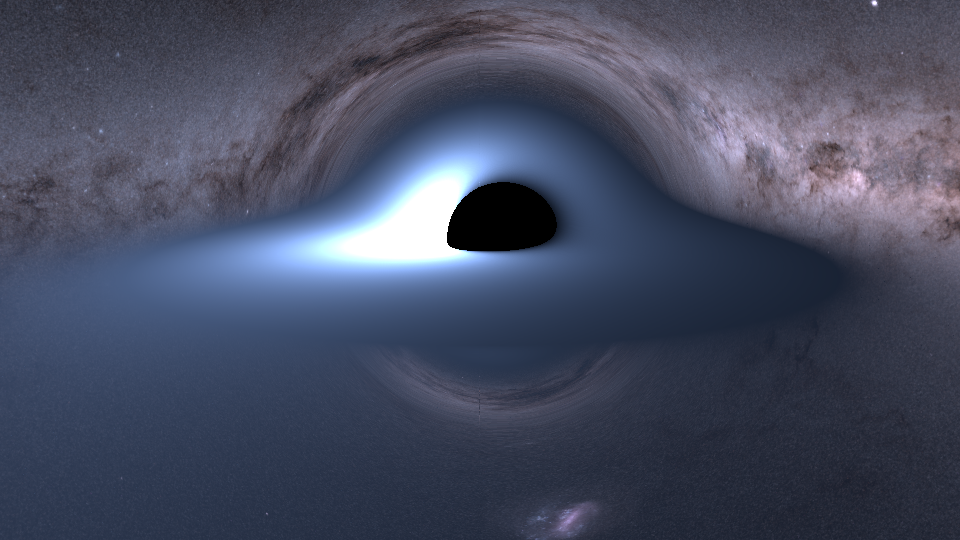
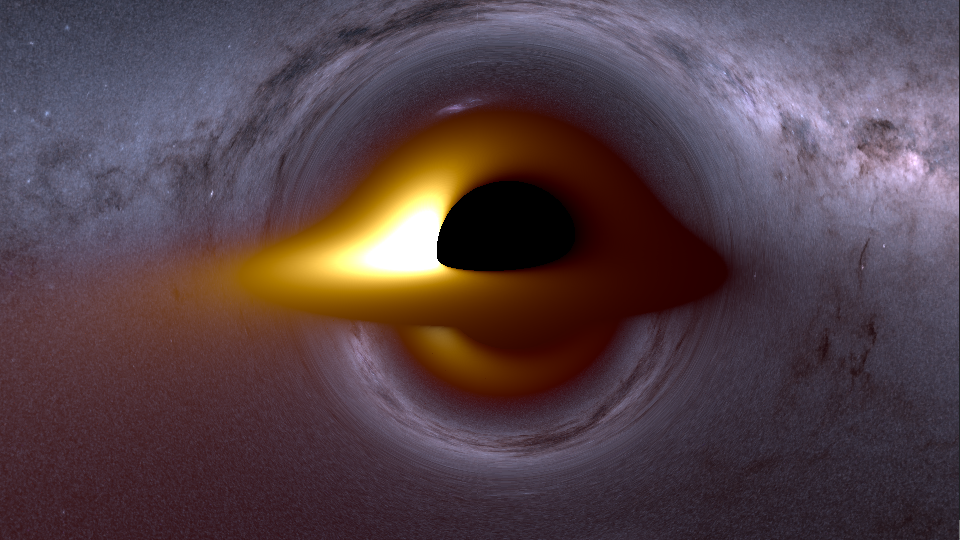
- It’s fascinating how things that were inverted seem to become corrected when I point this at the pre-existing black hole in my room.
- Quite amazing when crossing the pre-existing blackhole and looking back to the room while using this app!
- > unfortunately, WebXR restrictions make AR passthrough and the camera feed mutually exclusive
It looks like Chromium-based browsers might be doable?[1][2]
Meta: About a decade ago, I rolled my own WebXR-like stack with passthrough, and played with an XR Powers of Ten zoomer. Here we are years later, and it's apparently still not something which might be deployed. In some sense, we are progressing so sloooowly.
[1] https://caniuse.com/wf-webxr-camera [2] https://immersive-web.github.io/raw-camera-access/
- Hmm, interesting! I saw that it's a draft, and didn't investigate further. Maybe it does work indeed on some browsers.
Generally, the compatibility story turned out more fragmented than I expected. Eg, on my phone, Chrome can do AR – but cannot do two camera feeds at once; while Firefox is the exact opposite – no AR but can do both cameras at once, so that you see both front and rear lensed around the black hole properly (in the camera mode).
- I tried following the instructions and use it for education/outreach, and somehow I got educated by the past while receiving outreach from the future.
- If anyone's interested in the accuracy, this is very 'visualisation grade' software. Its a bit of a pet peeve of mine that people present these sims as being very physically accurate, when they contain major inaccuracies, some of which are very obvious and/or deliberate. This one has some serious physical limitations
I wouldn't mind at all if it didn't say that this was a *physically accurate* black hole specifically, but this now falls under misleading science communication in a way that often gets hand waved away as if it doesn't matter, so we've got to clear some things up!
1. The accretion disk shouldn't be red, people just expect it because it looks cool. Black hole accretion disks are near universally hot enough to be blue. Interstellar did this too, and tried to handwave it away very unconvincingly
2. This is a non/low (?) spin black hole, which isn't super duper realistic
3. It ignores the position of the camera (which affects the lorentz shifting)
4. The doppler shifting isn't terribly accurate
5. It doesn't model the accretion disk temperature distribution or colour with any kind of accuracy. Usually you model accretion disks as a blackbody radiator, shift it by the doppler, and to display this convolve this against the human eye response (LMS), go to XYZ, then RGB, do a physical tonemapping step, before an sRGB conversion. This instead does none of that - no step of this is done with any physical accuracy. Its not even illustratively correct as we'll get into
6. The actual radiative transfer is very simplified compared to what you'd use for realsies, and isn't based on any real numbers, with very simplified equations. The opacity and emissivity of the disk is arbitrary, as is the size, and it does not correctly incorporate brightness or extinction, eg here https://github.com/aplavin/blackhole.plav.in/blob/2f004bfeca... is super simplified
7. The wrong equation is used for the doppler calculation. They use the I^3 variant, whereas the data you get out of a disk sample is *radiant flux* which is actually F_obs = F_emit / (z+1)^4. This is a very common mistake in image processing, which means that the doppler shift and observer brightness isn't correct. Surface brightness over here https://github.com/aplavin/blackhole.plav.in/blob/2f004bfeca... is *not* a spectral radiance but instead a radiant flux
Stuff like the brightness -> colouring conversion is particularly inaccurate. Eg if you check out the source:
https://github.com/aplavin/blackhole.plav.in/blob/2f004bfeca...
It maps the pseudo brightness completely arbitrarily to colour. The resulting colour/brightness here then doesn't correspond to anything remotely physical. It also performs a *linear* mapping of a linear quantity (brightness) to sRGB (which is a nonlinear process!!), which means that it doesn't even retain any of the underlying physical characteristics of the brightness simulation, which itself is quite inaccurate. Its vibes all the way down
This is all fine if you're doing visualisation, but this isn't an accurate simulation. I wish this was just called a visualisation of a black hole, but its being communicated as if this is super hard science with credentials and all
- I clicked on this because I worked on the infra that simulated the famous blackhole sim in interstella.
I thought "oooh this is interesting I wonder how they are going to do physically accurate on an end device" Recalling how the original particle sim was something like 100TB, took 2 weeks to generate and seemed to write in a way that killed disks. but that was >10 years ago, so what clever stuff has been done to model it locally.
Its been a long time since I've looked at black holes, but what I'm not understanding is why the stars surrounding the black hole are just points, and more over why the lines are straight to the centre of the hole. from memory the way light enters the hole appears non-linear and changes on view point.
- > why the stars surrounding the black hole are just points, and more over why the lines are straight to the centre of the hole
Sorry for confusion! Points + lines are just other users looking at the black hole right now, their camera locations and lines of sight. Nothing more! In the first hours of HN frontpage, there were a lot – and I can see how one can understand them as parts of actual scene :)
I decided not to change their style, not to make them more subtle – half a day later, there are already way fewer users online, and these points/lines don't look as crowded as they did.
- Someone refers to a sci-fi-esque (more imaginative than scientifically accurate) virtual rendition of an interesting scientific phenomenon (black hole) in a fanous sci-fi movie (Interstellar), in their scientific analysis/critique comment on a HN thread about the virtual sci-fi-esque rentition of such a sci-fi object (black hole)(yes, a simplified easy-on-eyes pseudo-accurate rendition of a black hole, for VR/AR immersion at home, counts as sci-fi-esque, IMHO), and someone else who worked on such famous object (black hole) depicted in that exact sci-fi movie, responds to the comment.
Peak HN, right here!
- You have reached the end of the internet. We hope you enjoyed your stay. /s
- On a related note, there's an annoying mistake in one of the Fatalities in "Mortal Kombat 1": Liu Kang teleports with his opponent into outer space, summons a black hole with a snap of his fingers, and throws the poor sod in. But the accretion disc is red where it rotates towards camera, and blue where it rotates away!
- Boy, I really hope somebody got fired for that blunder.
- Some are fair – of course this is a simplified visualization! Observationally, we don't really know how fast a given black hole is rotating, and here I indeed assumed a non-rotating one. It's not an inaccuracy per se, more like a missing feature. The camera mode has a (half-hidden) toggle to enable Kerr metric and set spin, but even there it's not a default.
I consider the colormap choice to be completely arbitrary though, without affecting accuracy. Basically, it represents intensity at a given frequency, the image like one would get from a telescope. It wasn't intended as a faithful optical color representation! And really, in my (admittedly biased) view of a radio astronomer, I tend to assume frequencies invisible to the human eye anyway.
- >of course this is a simplified visualization
Its titled a "physically accurate black hole"! Please don't do this, if its intentionally not physically accurate and heavily simplified! The general public on here don't know better, and it takes someone else with years of experience simulating black holes to dig through your code to show what you've simplified. There's like a few hundred people who have the right experience worldwide to know that you've got some of your equations incorrect
The issue is when you're communicating doppler, if you want to correctly show the change in doppler, you can't make the intensity or colour mapping arbitrary
There's two ways to communicate accurately an example linear change in emissive power:
1. Use a perceptual brightness system, so that a linear change in power represents a linear perceptual change in perceived brightness. This accurately communicates to a viewer the underlying shift in power emission, if you want to show off how a radio telescope perceives a black hole for example
2. Use an emitted power <-> sRGB mapping (with tonemapping), so that a linear change in power is perceived as if it were a physical light getting brighter. This is more "what would this look like to a person?"
At the moment the change in your image brightness doesn't correspond to anything, which means that its not really communicating any science, and it doesn't correspond to doppler. Which is fine if its just illustrative and that's clear, but again vanishingly few people will know this is a visualisation not a physically accurate render
- It's AI garbage - OP asked the LLM for "physically accurate", Claude gave them this, and they didn't know any better.
- >and they didn't know any better.
i think an "astrophysicist at Harvard's Black Hole Initiative studying quasars and black hole environments" who "work[s] with raytracing/radiative transfer simulations professionally"probably has a decent understanding of what's going on...
- You'd think, and yet, they happily slapped the Harvard BHI name on something that doesn't do what it says on the tin. I think ignorance is preferable to deliberate deception, so I assumed ignorance.
- i think they've made some decently reasonable comments explaining their choices, whether you agree or not, and coming in with a shallow dismissal solely consisting of "llm garbage, must be an idiot" is a pretty shitty thing to do (let alone specifically against the rules).
20k's comments open up conversation and engage with the content. yours is just boring, encourages no conversation, and is basically a copy/paste of thousands of other worthless comments. the only thing your comment accomplishes is making hn a worse place.
- Well, I think the tide of LLM flotsam inundating the submissions makes HN a worse place. So I'll keep on complaining, and you can downvote me about it.
- >Well, I think the tide of LLM flotsam inundating the submissions makes HN a worse place.
writing the 1000th "llm garbage is bad" comment of the day is your solution? im not sure i understand the logic, despite agreeing with the premise.
- > Its titled a "physically accurate black hole"! Please don't do this, if its intentionally not physically accurate and heavily simplified!
It also doesn't exert the gravity an actually accurate black hole should :) And also, even on a phone with two cameras, they only cover a part of sphere – while a real black hole would bend light coming from all 4pi directions. Some simplification is generally required ("the map is not the territory") and I don't see "simplified" as being opposite to "accurate".
Colormap choice: it can be a useful mode to show proper linear power -> linear perceived brightness mapping – true! But that's only one of many possible choices, and scales like logarithmic are very common in scientific images.
- >I don't see "simplified" as being opposite to "accurate".
Are black hole accretion disks generally red in real astrophysical cases?
They're most accurately represented as being blue. Red is fine for visualisations because it looks cool (which is fine!), but blue is the physically accurate colour. Visualisations claiming to be accurate like this presenting red black holes is becoming an increasingly large science communication problem
The way that the colour and brightness are mapped together is also not correlated correctly, and some of the equations just aren't right. The doppler isn't correct at all here, partly because its simulated incorrectly (with the camera problems), and partly because the mapping done at the end doesn't correlate to any reasonable brightness
Stuff like this: Its not accurate at all. It isn't simplified, its just wrong - which is totally fine for a visualisation, if that's the intent. But:
>scales like logarithmic are very common in scientific images.
Sure. What scale are you using for the doppler brightness here? Because as far as I can tell, its a piecewise mapping of the form ~pow(x, 2.2), after being run through a non smooth function `afmhot` - a function which doesn't have a linear brightness response. So the brightness in this image doesn't really correspond to anything related to doppler or brightness, and the colour also doesn't correspond to anything involving colour (or the doppler). The entire image's look is basically accidental
Here's a specific comment from the event horizon telescope talking about exactly this problem with specifically the afmhot transform being used, because its important for visualisation:
https://github.com/achael/eht-imaging/issues/85
Which shows some of the problems here
- “Physically accurate” indeed raises the bar significantly.
You’ve already done great work here. That said, the feedback seems to come from someone who spent considerable time analyzing your work. Even if only a few of the suggestions are ultimately valuable, that’s still a meaningful contribution and worth considering.
- Sure, most of the raised questions are reasonable potential feature additions to be made – things like rotating black holes, or linear brightness-to-screen-pixel mapping. They just aren't "inaccuracies", in my opinion.
- Always funny when people claim that scientific term apply to their software and then disregard any founded criticism in a non scientific way.
- Its frustrating because these issues are all fixable, and some of them are just bugs, but there's a mentality in this kind of science communication that ehh it doesn't matter because its just for the public. This does a real disservice to what people are trying to actually achieve in educating the public. Its also, unsurprisingly, a lot of hard work and validation to get from visualisation-grade, to physically accurate, and its a lot easier to not do that
- Note that most of the points you raised are clearly not bugs – most notably, things like non-rotating black hole or colormap choice. At the very most, these can be considered missing features, but they don't affect correctness in any way.
- You seem more interested in putting effort downplaying criticism and upholding the optics of "scientifically accurate thing from researcher in big name university" than actually putting effort on making the thing even better by using the amazing feedback you got...
- You might wanna look up what correct means in a dictionary.
- I don't understand what you are saying.
The only criticism is to call that accurate, when it's simplified. OP ist defending the use of accurate with dumb arguments. The fix would simply be to not claim "accurate" and continue to provide a probably great visualisation (idk, haven't looked at it)
- Now after reading the OPs responses and how defensive they are of some high quality constructive criticism, I don’t even want to go back and play more with the visualization.
- >I don't see "simplified" as being opposite to "accurate".
Is it accurate to model a cow as a sphere?
- To describe cow's gravity? Pretty much so. Then, for visualization and even for many biological purposes, it's accurate enough to mode the cow as a bunch of organs with known processes happening in them. But that's still far from atoms and quarks that constitute the cow.
- Great job. Please consider turning on rotation by default (for those who missed it, it's in the parameters). The overwhelming majority of astrophysical black holes are expected to be spinning (Ker) black holes.
- That option for rotating (Kerr) black holes generally works, but not on all devices in my experiences. Debugging on someone's phone is not that straightword, so I went with the most accessible experience by default.
Also note that the visual difference for the camera warp is really marginal between rotating vs non-rotating black holes.
- > completely arbitrary
You agree that it isn’t “physically accurate”, then… but seem to argue that you shouldn’t be called out for the false title?
It’s fair enough to be called clickbait when you really did score extra clicks with a slick falsehood, surely?
- Arguing about colormap choice seems very strange to be – this is such a common practice in astronomy (and other fields!). The vast majority of images you see in published papers apply some arbitrarily-chosen colormap and color scheme. No matter if you look at observational or theory papers, it's very rare to find a real true-color image. And for a bunch of good reasons!
The only difference here is that I don't show a colorbar with explicit color-number mapping, for simplicity sake.
- >> I consider the colormap choice to be completely arbitrary though
> Arguing about colormap choice seems very strange to be – this is such a common practice in astronomy (and other fields!).
Let's see if I can give a feel for why "physically accurate" and "arbitrary color", when applied to a physical object, seems a problematic juxtaposition. Especially in outreach. Even in astronomy, whose relation with color is... notably flexible. Especially when the colors "arbitrarily" chosen, seem instead optimized for breeding misconceptions. Consider the Sun.
A solar observatory outreach center had a big Sun ball a few meters across. They painted it yellow. When asked why yellow, they explained "It's what people expect".
For years I'd ask first-tier astronomy graduate students (something like): "A five-year old comes up to you says 'I'm told the Sun is a big hot ball! Awesome, I love balls. What color is the ball?' How do you answer the five-year old?". Most said yellow. Of the few who got it right, about half had learned it in a class covering common misconceptions in astronomy education. A follow-up question of "What color is sunlight?" gets most to a "Wait, that doesn't make sense, does it?" moment. Two incompatible memorized factoids, that have managed to remain unintegrated since kindergarten or so.
All fields face challenges of information representation, especially in outreach. But astronomy... is special. Imagine zoology presenting elephants as green, from kindergarten through undergraduate, in education and outreach. PBS and zoos colorize their elephants green, with DaVinci and spray paint respectively, because it's what people expect. A kindergarten student thus misled, only years later might hear "gray", if they become a zoology graduate student, and take a "we suck at teaching" elective seminar, offered at their first-tier center for zoology research, because it just happens to also be a first-tier center for zoology education research.
The closest similar case I can think of in other fields, is video representations of molecular biology. Where a tormented kinesin mouse, desperately clinging to a microtubule wire in a hellish hurricane, with a flailing blur of a vacuole balloon tied to it's tail... somehow gets represented as a lumbering donkey, dragging a massive canal barge, on a quiet summer day. Later revised by making the donkey and barge jiggle in place, for an extra slathering of misleading bogosity. With authors explicitly saying they prioritized "pretty" over fueling misconceptions.
Other highlights include the 2002 "Universe is green" front-page news - outreach outside of their focus, using open-source color software with a bug, and not managing an integrated understanding's "wait, that's not plausible".
Perhaps the app's black background might be changed to green? Given that it's an arbitrarily-chosen colormap, but physically accurate visualization, of a physical object. Or perhaps a nice Scottish tartan, or pink pokadots, for the accretion disk? Both would mitigate the educationally problematic juxtaposition of "accurate" and arbitrary color, by emphasizing the aphysicality of that arbitrary. Actually not kidding (much). When an aphysical representation choice is needed, one can do worse than to optimize for fewer misconceptions, no? Better a tartan Sun than a yellow one?
- You know, I am interested in the accuracy.
I like what OP has created, but out of curiosity, where might I find the most physically-accurate, browser-based black hole simulation?
- I think you're being very harsh. I read it as a side project of a scientist meant to entertain as much as educate. Holding it to the same standards as the Event Horizon project seems pedantic and excessive.
- All they need to do is not put the label physically accurate on it then. If you call something physically accurate and decorate it with your credentials as a harvard phd in astrophysics building radiative transfer sims, people expect it to have a degree of accuracy. This sim, from a physical perspective, is wrong
That's 100% fine if you present it as a visualisation with limitations and I absolutely love people making fun side projects like this and presenting them. I built a whole tutorial series on doing this, because I think people getting stuck into the field is absolutely great, and more power to everyone who wants to write anything no matter how accurate it is
Its the fact that this is being presented and stated as if its a physically accurate sim made by someone with experience in the field so it must be spot on, when in reality its little better than an artists impression of a black hole, that bothers me. Its science miscommunication. Coming away from this, you might think:
1. Black hole accretion disks are red
2. Black holes do not warp the background around them, only the accretion disk
3. You might get notions about the intensity distribution of the doppler shift, or the way that cameras work near black holes etc
None of which is particularly correct, and there's a lot more wrong with it too
- The person you’re replying to did not hold it to that standard — they only pointed out that the standard it claimed to hold itself to was not actual.
If correcting misinformation is “harsh”, reality is fucked.
- I agree. I was able to position the camera so that the entire black hole effect was negated and we were back to having a star. All I needed to do was turn the camera just right.
- but why was the picture taken of black hole have accretion disk yellow?
- They used a greyscale -> colour mapping, it wasn't really red/yellow. It was just for vibes. Its one of my minor pet peeves about the EHT visualisations, but given that its visualisations for effect its relatively fine. I'd have preferred blue given that its such a common misconception, but if you're a paper author trying to get your work publicly recognised then rule of cool is a good enough excuse
- https://www.youtube.com/watch?v=eQZ3LAexNxE
Love, Death & Robots: Black hole used red for the disc, too.
- at 1 - is it red due to red shifting due to gravity?
- They're blue, in general black hole accretion disks are very hot, and anything past a certain temperature looks pale blue as follows:
https://20k.github.io/assets/kerraccrete.PNG
This is a colour and relative brightness accurate example of a hot accretion disk. The size, emissivity and absorption are set to arbitrary parameters, but this is human-eye-colour accurate with correct doppler and radiative transfer for a spinning black hole. Its as correct as I can make a specific model, for what a human would see standing next to a black hole taking into account the limitations of the human visual system
You can get a red accretion disk like this:
https://i.postimg.cc/pV8VWKhw/verycold.png
But it requires the disk to be extremely cold, which is physically pretty suspect
One interesting feature is that the temperature and brightness scale differently, so that its actually hard to observe the colour shift, as the brightness changes much faster than the colour. So its not something you ever really see to the human eye
That said these don't do accretion disk within the ISCO, which is a major limitation
- It's purely my color map choice – the underlying simulated image is simply a number at each pixel. Transforming that number to the actual displayed color is generally an arbitrary choice, as common for the vast majority of images in astronomy/astrophysics papers. The only difference is that I don't show a numeric colorbar here, for the sake of simplicity.
- "an astrophysicist at Harvard's Black Hole Initiative"
He probably knows. It's in a browser, there are probably some trade-offs. Calm down.
- Keep your need for simplified representations of reality (which claim to be complete) out of our information-based community.
- From an information theory perspective, isn’t a representation by definition a simplification?
- Running a simulation in a browser is not going to be a complete representation of reality. To think that is possible is really weird. So really, what is happening, we are arguing over the 'Title'?
- I've done this as have many other people, its absolutely possible and there are good sims floating around. The OPs simulation is just presenting itself as more than what it is
- I remember like 10 years ago when Occulus first came out there was that space simulation demo where you could go around the solar system in VR. You could also "fast travel" by zooming in towards a planet, moon, blackhole.
Yeah, that was the day I learned I have a deep, crippling phobia of large objects. And Melanoheliophobia, which is fear of black holes. The only other time I've felt that way was snorkeling once near a giant 3 story tall bait ball of swirling fish, which was so disorienting and panic inducing that I vomited.
- I did a 'swim with sharks' thing at Sea World (or whatever the Queensland equivalent is) with a few human-safe species of sharks, a few rays, and a selection of other fish. One of the other fish was, as far as I recall, some kind of giant grouper which, as far as my memory tells me, was huge, unmoving, and had it's mouth open the whole time, and it's mouth hole would have been big enough to put my entire head inside (this is according to my memory anyway).
I was nervous beforehand, but once I was in (and had accepted the inevitability of my own death) it was surprisingly calm / calming floating around and having these frickin' aquatic alien species just going about their dailies around me. I went close to the massive grouper just to get the scale right (not that I can really remember, it was 26 years ago). I even looked through the perspex so I could see the non-human-safe sharks in the tank next door.
After the (awesome) experience, I went and looked at the grouper from the outside (one of those underground big perspex viewing rooms) and I was back to being awed / scared by its size, and somewhat refusing to believe that I'd been in there with it. The memory of it is scarier to me than what I remember feeling when actually doing it. It's weird.
- It's Sea World in Queensland, but confusingly I think the company is unrelated to the American Sea World, iirc they bought a license to the name back when it was probably a lot more positive than it is now.
EDIT: Apparently not licensed, just completely unrelated.
- Yes they’re not related and are much more humane imho
No Orcas, good rehab program, seal exhibit is good (no true seals), Polar bears are a bit sad though
I did the seal diving experience which was great - mostly disabled California sea lions and NZ Fur seals (which do well in captivity)
- Dived with them in the Red Sea. They can get pretty massive, and it can be slightly unsettling close up. They are odd creatures.
- If somebody feels no fear while zooming towards a black hole, their brain has some strange wires crossed.
Strongly recommend Outer Wilds. Falling into the black hole the first time was one of my most scared moments in gaming. I was totally panicking lol
- Outer Wilds is exactly what came to mind for me, too. Made a jump...missed. Thrown into a decaying orbit around the black hole. Absolutely terrifying, and panicking didn't help in the least!
And getting close to the upper atmosphere of Giant's Deep for the first time, staring, thinking about the atmospheres of real-world gas giants, knowing that I need to take the plunge.
That game exposed some phobias that I'd only been vaguely aware of before.
- > And getting close to the upper atmosphere of Giant's Deep for the first time, staring, thinking about the atmospheres of real-world gas giants, knowing that I need to take the plunge.
I recommend the game Exo One then.
It's a surreal game of flying a spaceship around in the atmosphere of a gas giant. While beautiful to look at, I know enough that flying around in a gas giant is so terrifying a prospect I never managed to complete the demo of the game. "Oh, how do you falling through pitch black clouds with winds in the 3000+ km/h where it's raining literal diamonds until you reach a lake of supercritical fluid at extreme pressures?" You don't even have to go very far, there's 4 of these in our solar system alone.
- >Strongly recommend Outer Wilds. Falling into the black hole the first time was one of my most scared moments in gaming. I was totally panicking lol
The Outer Wilds is one of the greatest gaming experiences of all time. I would love to forget all about that game to just experience it again from scratch.
- Easy cure, simply watch "The Black Hole",https://en.wikipedia.org/wiki/The_Black_Hole_(1979_film) and you won't ever be able to take them seriously again.
Side effects may include overwhelming hate for Walt Disney Productions.
- Looks interesting from the first glance! I should probably try that game – having both the artistic and realistic pictures in mind :)
- Outer Wilds is a great work of sci-fi but it's not especially physically accurate. I really enjoyed playing it through with my son, and the ending made me weep. The end credits music still gets me a little when I hear it. Excellent soundtrack.
- To be fair, is there anyone alive who wouldn't be afraid of a black hole? It's a celestial body so gargantuan its gravity bends the light passing around it like a lens. Anyone who gets too close to one will literally never be seen again, ever.
- It really doesn’t take much to bend light.
Supernova and asteroids were always scarier to me because they’re potentially planet-ending scenarios. Whereas a black hole is benign as long as you don’t move into its orbit at too acute an angle.
- Someone correct me if I'm wrong, and maybe it depends on the type of the black hole, but if you were to fall directly into one, or even enter an orbit too close, you would still be seen - and seen for an extremely long time.
- Yes, altho "very long time" doesnt do it justice - while your light would be fading and redshifting, mathematically you could detect photons comming off you the whole remaining age of the universe.
- That's... That's even more terrifying.
- They don’t have to be gargantuan (except in terms of mass) - the low end of stellar mass black holes can have radii as small as 6 km.
Many black holes have a bright accretion disk outside their event horizon, so visibility for those is not an issue.
But it’s certainly possible to have maximally scary black holes that have no accretion disk and are small enough so as not to cause significant lensing. You could fly your spaceship straight into one of those without even realizing, until you start turning to spaghetti.
- Yeah I remembered the accretion disks immediately after posting and edited the comment.
> it’s certainly possible to have maximally scary black holes that have no accretion disk and are small enough so as not to cause significant lensing
Now that's a proper cosmic horror.
- The event horizon might have a circumference as small as 12*Pi km but as I understand it, the radius is infinite. ;)
- > Melanoheliophobia
Tangential, but this being a nearly word-for-word translation of “black hole fear” made me realize how odd it is that we insist on latinizing these things.
- Helio- is actually "sun", not "hole", and it's Greek, not Latin, but I 100% agree with you: it's pointless technical vocabulary that only serves to obfuscate. I think in this particular case, it's just some internet neologism (which is a good word, since coinage can mean a couple different things), made based on analogies with older phobias. For those of us who know Latin and Greek, though, all we can really do is shrug at the eagerness to make the clumsiest words possible.
- My headcanon is that the neologism was coined by Vicky Karayiannis, widow of Chris Cornell.
https://en.wikipedia.org/wiki/Chris_Cornell#Personal_life
The modern Greek terms for "black hole" are:
μαύρη τρύπα or μελανή οπή
https://el.wikipedia.org/wiki/%CE%9C%CE%B1%CF%8D%CF%81%CE%B7...
helio- cannot mean "star" in a generic way but invariably refers to our own Sun. If referring to some other star, then we use aster-.
- What would be the correct latin/greek word for it?
- Melanotrypophobia, although the Greek term is "mayri trypa", literally "black hole".
- Any relation to the words melancholy?
- Yes, as the sibling said, melancholy means "black bile".
- Yes, that is cognate with ancient Greek μελαγχολία, and with the same root: μέλας
- Hypochondriac
- I've also wondered the same thing about healthcare and other fields. All the complex sounding phrases are child-like in simplicity in their "native" tongue, yet completely indecipherable to most people in modern times. Quite a weird and undesirable path we ended up going down through inertia.
- It's useful to search for the same thing and get results in different languages
- I’ve long considered medical jargon to be Latin Buffyspeak[1] because it’s usually just describing the body part, often simplistically, but in Latin so it sounds fancy.
- It’s arguable whether it’s weird or undesirable. There are benefits to using unusual words when they have precise scientific or other technical meaning. It helps identify them as terms of art, so that they’re not confused with their native tongue equivalent, which invariably has much looser meanings.
- Sure, but I think there's some cause/effect to consider there. The same logic would have applied in Ancient Rome, but I expect that people would have likely been less casual with their usage of such terms when they also had specific technical meanings.
For example many food dishes we have retain basic naming conventions, yet have well understood meaning. In the US a customer ordering spaghetti is likely to be quite unhappy if they get a cream sauce, even though the order itself is literally just the name of the noodle.
- > I expect that people would have likely been less casual with their usage of such terms when they also had specific technical meanings.
Why would you expect that? It seems the opposite of what we see in practice. Colloquial language typically makes no concessions to technical usage.
Your example works against your own position. “Spaghetti” is an Italian word, much like the Greek portmanteau that started this discussion. The idea that it implies a particular sauce is purely regional, as you noted by saying “In the US”. (I had to ask an LLM what you might mean - apparently you would expect tomato sauce.) Ironically, that would not be expected in Italy.
So here we have a word taken from another language, which has a local connotation which depends on a shared context. As with all language, one has to learn that context. It doesn’t matter that much what the words are. If the word had been “thinnoodle” instead, that’s what you would have learned and been familiar with. (“Noodle” comes from German and entered English about 65 years before spaghetti, apparently.)
- I suppose the difference I see, and the motivation for change, is an issue of familiarity. Everybody knows what spaghetti is and so calling it thin noodle doesn't add much clarity for most people. By contrast many, probably the overwhelming majority, of terms that are in Latin are unfamiliar. And continuing to pile on in that domain just adds to the things people will generally be unfamiliar with.
And these are in domains that people will certainly come into contact with in their life, like healthcare, so it's not like just nitpicking over e.g. pure math's preference for having people's names attached to various mathematical constructs as opposed to something even vaguely descriptive. Very few people will ever interact with pure math in 'normal' life, so it's largely inconsequential.
I mean just imagine we were going to do things over, and in starting to name medical conditions somebody said, 'Hey I have an idea - instead of naming everything in an obvious way let's name everything using some obscure language almost nobody understands.' Nobody would really be on board with that, but we ultimately ended up in that exact scenario.
- I can't play Outer Wilds specifically because of this. Specially because of the black holes.
- > Melanoheliophobia, which is fear of black holes
Thank you for mentioning this. I am an avid space nerd. One day I decided to try Space Engine, and one of the first thing I did was get warped to a black hole. Seeing a literal hole in space time appear in front of my screen was one of the most terrifying things I've experienced. I Alt-F4'd, and never opened that application again.
It's like every single atom, nay, every single subatomic carrier of information in my body was telling me to stay the hell away from that.
- I'm exactly the same. This one really give me the ick: https://www.youtube.com/watch?v=usYC_Z36rHw
- Thanks for sharing – as someone who studies black hole environments daily, I didn't even think of such a phobia existing!
I wonder if some tricks, adjustments are feasible, to minimize the effects of these phobias? I see these visualizations as a pathway to make understanding such a complicated, unintuitive object more accessible – and would be great to make it even more accessible, if it makes sense... Happy to chat more, brainstorm some solutions.
- I have no idea, on screen or even in movies it's totally fine, but I think just in VR where it's so immersive, and then being confronted with a thing that my brain doesn't really know how to understand the size of. Just like, hey there lil guy I know you're big and massive, wait where is your edge...
- For anyone that experiences the same, how do you feel about this picture? https://antichamber.fandom.com/wiki/Eye_Wall?file=Eye.png
It has always scared me and I believe it's for the exact same reason. It's possible it invokes no feelings on you if you haven't seen it in context (in the game it's from) so I'd like to test this
- https://en.wiktionary.org/wiki/melanoheliophobia
Okay, so this appears to be a neologism that may not be found outside of science fiction dialogue. But I can appreciate the humorous derivation here.
Wiktionary defines this as an "irrational fear" which is in-line with other irrational fears known as phobia. So, is it possible to have a rational or healthy fear of black holes? Is it rational to be unafraid of them?
I am unafraid of personally meeting the Flying Spaghetti Monster whilst not wearing a colander on my head, and I am not irrationally afraid that Azeroth will be invaded by Kardashians. I am not afraid that a dragon will bite my head off.
It seems rationally to be respectfully "fearful" of the capabilities and awesome astrophysical properties of black holes, but it would be irrational to be afraid that I could fall into one, or be personally harmed in any way by one. If someone begins "seeing" black holes at the end of their suburban cul-de-sac, then probably get some professional help.
- Sorry but a word for fear of black holes is ridiculous. Black holes are scary period. Anyone not feeling a deep sense of fear during that VR experience is missing something.
- Definitely one of the most malevolent possible objects. Infinitely black, so powerful it will kill you without noticing your presence, unknowable, impossible to get rid of, you will be well aware you can't escape as you fall in before it turns you into spaghetti Amigara Fault style. My understanding is from the outside you can even see the remains of previous victims being stretched and crushed in slow motion.
- VR is fine when it's small cute bunnies or little golf balls that I can kind of immediately get a sense of scale for. Massive thing that tricks my brain like the edge of a gas giant is terrifying, no matter how much I tell myself it's just a screen or video or pixels.
- > Massive thing
Oh, here we go: your sense of scale pertains to volume, not mass. The entire point of a black hole is that its enormous mass is concentrated in the smallest size possible. A golf ball-sized black hole would be a realistic conjecture.
- I think it’s perfectly reasonable to have a word for this fear, but I agree that ‘phobia’ isn’t appropriate because (unless you’re worried about running into one on the way to the shops) it’s quite rational. ;)
- This is lovely, great to see science like this! Many thanks to you and your colleagues!
- Please correct me if I'm wrong, but it feels like the leading edge of the accretion disk (coming towards the viewer) should be significantly brighter than it is shown here, and the trailing edge (going away from) should be significantly dimmer?
Or could the brightness shown be a result of it being Kerr vs Schwarzschild?
- Yeah the doppler in this picture is all wrong unfortunately, the underlying equation used isn't right here (they mixed up spectral radiance and radiant flux). The rendering is also done without taking into account sRGB, and its run through a function that messes with the brightness - so the brightness is really incorrect. Plus all the colours are wrong (it uses an amhot colouring function, they aren't based on anything), and the extinction and emissivity isn't correct either, and the camera basis is also set up wrong so it also has the wrong perspective too. Other than that its all good
- Colormap/colorscale is generally considered an arbitrary choice in scientific plots or visualizations. Linear mapping of simulated emission brightness -> screen brightness could be a reasonable alternative mode, I agree – but it's weird to say that colormap choice makes it not accurate.
- What exactly is physically accurate here though? Because its not:
1. The relative brightness of different parts of the image
2. The colouring
3. The general relativistic effects of a black hole, other than the most basic disk warping effect
4. The relative colouring or brightness change from doppler
When you make a post about a physically accurate rendering, people usually expect it to be a decent representation of the underlying object in *some* capacity
There are of course constraints in terms of what the human eye can see and what we can portray - eg wanting to present alternative radio frequencies, highlighting different aspects of a black hole etc, which is why we make *specific* brightness and colouring map choices. That isn't a justification for making *arbitrary* choices in brightness and colouring map choices, because otherwise you could do sin(brightness * 1000) and call it physically accurate. In fact any output is an arbitrary colourmapping of a physically accurate black hole rasterisation under this definition, including a pure white square
Colour mapping and scale absolutely is very very much not an arbitrary choice, I linked elsewhere the event horizon telescope talking about this specific issue. People go to great lengths to put the work in to make physically accurate renderings, to convey accurately what you're looking at. I'm surprised to see you say that its considered arbitrary for renderings
There's a lot of room for doing visualisations to show off a specific element of a black hole, but the output here is near completely free of any physically accurate content. This is one of the more basic simulations I've seen - and that's before getting into the fact that it contains coding errors
- > What exactly is physically accurate here though?
I'll assume this is a good faith question, hope it was intended like one. I view strong light bending as the key distinguishing property of a black hole, and something we are fairly certain about. This is reproduced accurately in all modes, up to the fundamental technical constraints of the browser environment. Gravitational redshift is another one, and it's also reflected.
Things like the precise matter configuration in the disk (and correspondingly its radial brightness profile) are much less well known, and are less fundamental for black holes as objects. This part is represented in a simplified way – thin disk, with a reasonable-shape analytic function defining radial emissivity distribution.
As for colormapping: I follow the by-far-dominant approach in scientific literature, where color mapping choice is completely unrelated to physical accuracy of the plotted observations or simulations. Having a preference for different color schemes is a matter of taste; suggesting a linear intensity->pixel mapping is a reasonable feature request, but far from a bug or inaccuracy.
- So in your opinion, the primary thing that makes this a physically accurate simulation is that you've calculated the bending of light rays, and the structure, colouration and brightness of the accretion disk doesn't matter at all?
>As for colormapping: I follow the by-far-dominant approach in scientific literature, where color mapping choice is completely unrelated to physical accuracy of the plotted observations or simulations. Having a preference for different color schemes is a matter of taste; suggesting a linear intensity->pixel mapping is a reasonable feature request, but far from a bug or inaccuracy.
It is not true at all that this is the dominant approach in the literature, the event horizon telescope does not use this approach in their papers. I linked a comment from them elsewhere about this in a github PR
Specifically:
https://github.com/achael/eht-imaging/issues/85
>Unfortunately, vanilla afmhot does remain the current default in the eht-imaging library for historical reasons, but this could change soon. *Rest assured we thought of this issue and the paper images are indeed perceptually uniform!*
I would welcome an attempt for you to create a scale, that maps the output pixel brightness to the underlying physical luminance, which I think would show why the mapping is such a problem here from an accuracy perspective, but you're absolutely not correct that you're following the literature here. People are much more careful about presenting accurate data, and your approach would result in a correction being put out
- >> I follow the by-far-dominant approach in scientific literature, where color mapping choice is completely unrelated to physical accuracy of the plotted observations or simulations.
> It is not true at all that this is the dominant approach in the literature
Just to clarify: you are saying that there are not a lot of images in literature rendered with a non-perceptually-uniform colormap (eg, any matplotlib colormap aside from the 5 uniform ones)? Or that there is only one correct way to choose colormap for a given image?
- One side of the accretion disk is indeed brighter than the other – in the default view in the app, the bottom part is brighter. The effect appears quite clearly visible to me, although the exact contrast depends on the colorscale mapping. Here, I tried to find a colorscale that works well for both the disk and the jet, which naturally means the leading/trailing edge contrast can be less than in the linear mapping. Hope it explains the visual effect!
Kerr vs Schwarzschild (static vs rotating black holes) is a much smaller effect visually – that's why it is so hard for us to measure black hole spins (= how fast they are rotating) observationally, even with the Event Horizon Telescope.
- I think the contrast between the two sides is typically greater with an optically thick disk, and it looks like you are rendering an optically thin disk. I think that's the main difference from what I was expecting when I saw it.
Very cool demo! Thanks for sharing!
(For reference, my experience rendering black holes is recreating Luminet's rendering from the late 70s: https://www.ioccc.org/2025/cesmoak/index.html )
- True, the disk is rendered optically (and geometrically) thin. This is done so that real-time performance is attained on devices like phones – volumetric GR rendering would be significantly more expensive. The jet (zoom out to see it) is rendered with full volumetric effects, because it's just special relativity there.
Fortran punchcard style to render black holes?! That's really going full circle to the origins, I really enjoyed reading about Luminet's work some time ago.
- Oh nice, I had not zoomed out enough. I don't think I've seen the relativistic jets rendered before. The AR mode looks great on my phone.
Yep, I had fun learning a lot about punchcards, Fortran, and the math behind black holes. I suspect I'm doing something similar to you in my Fortran implementation, raymarching along the null geodesic to come up with my final image: https://imgur.com/a/czysDls
Also, I have to point out the "going full circle" pun, intended or not.
- Actually, the jet was the first part of the app – I wanted to just see and "feel" relativistic beaming in practice, in physical space. And it was fun and instructive indeed! Really puts into perspective how tight is the jet vs line-of-sight alignment for those bright jets we see across the universe. And how beaming is the dominant effect that determines the jet/quasar appearance.
- I guess the fact we see any at all given the distance and small angles just emphasizes how many there are out there...
- Yes, even observing a single jet pointed towards us (typically, at just a few degrees) is routinely used a strong argument for existence of many similar powerful sources, just misaligned with the Earth. Arguments like:
- See a jet at redshift z ~ 6? There are thousands more!
- See that well-aligned blazar jets are among strongest gamma ray (or neutrino) sources? Gamma rays/neutrinos are preferentially emitted along the jet direction, otherwise we'd seen thousands more equally strong sources.
- This reminds me of a funky Windows screensaver, back in the day. Pretty cool.
- The distortion effects dont work for me on pixel 8 when using AR mode
I just get a flat floating image of a black hole. Am i holding it wrong?
- Yes, as said in the text, unfortunately this is a limitation of browser APIs. You either get AR and no access to the camera feed (this is the AR mode here, black hole floating in your room, simply overlaid on top of the camera feed) or get access to the camera feeds but no AR (this is the camera mode). I didn't find a way around it...
- Same on pixel 10
- I wonder how much of that is scale rather than danger. Really large objects can feel unsettling even when you know they're harmless. VR seems especially good at triggering that response.
- Can you post a demo video of the AR/VR with the effects?
Apparently it is not working correctly on my device, so it would be nice to see the intended effect.
- Sure, see https://blackhole.plav.in/ar_example.mp4 for an example. Should work on most Android phones, even old ones (mine is 7 years), the Chrome browser is generally best for AR.
Interestingly, Firefox seems to be better for the camera mode – for me, Chrome only gives one camera feed at a time, while Firefox allows both front & rear cameras.
And AR + camera warping don't work together, unfortunately – browser API limitations.
- Okay either I'm stupid or not seeing the "relativistic effects".
This looks the same as on my device.
I was expecting some distortion or bending of the background?
- > AR + camera warping don't work together, unfortunately – browser API limitations.
So, you either choose AR and see the simulated emission from around the black hole, properly warped/boosted – but the camera feed remains flat, the browser itself does the overlaying.
Or, alternatively, choose the camera mode, and see the warping of your camera feed.
Not both at once!
- From a certain angle it looks like an eyeball https://imgur.com/a/Dam3XT0
- Them: you can’t see what’s on the inside of a black hole
Me: zooms in
- > https://blackhole.plav.in/
The lines in the demo look upscaled and aliased for some reason.
- Could you please share a screenshot so that I investigate what actually happens? I tested on a few different devices, but far from anything extensive.
- First time I have AR'd. That was cool. How does it keep the hole in the same point in space as I walk about?
- The app doesn't have to do this itself, phones do it for you. ARCore on Android, ARKit on iOS.
- Oh yeah I mean how do the phones do that. I guess it uses dead reckoning with visual cues and some machine learning.
- on iPhone 12 Pro Max and later (maybe only on Pros, I forget) they have a LiDAR sensor built in, allowing for impressively accurate 3D scans of objects with a free app like Scaniverse. But yeah I think AR was the intention there
- Your phone has an accelerometer, which can be integrated twice to result in slightly accurate dead reckoning; just keep accumulating 3-vectors with every time-slice. That's a helluva lot easier than visual cues.
- "slightly accurate" is the correct description, though -- dead reckoning on a cell-phone-class IMU accumulates drift too quickly to keep objects anchored in space for more than seconds at a time. You need something (visual odometry, SLAM) that provides long-term stability, even if it has short-term noise or poor availability, to fuse in.
- When this topic comes up, I'm always happy to share this incredible lecture from many many years ago about sensor fusion and dead reckoning and how you _cannot_ integrate acceleration twice:
https://www.youtube.com/watch?v=C7JQ7Rpwn2k&t=1401s (the whole video is incredible, but this timestamp is the magical bit)
- 12 years ago I had to write the firmware for an IMU. It took me some real effort to convince my bosses that double integration was, for all practical purposes, impossible. I wish I had known about this video back then...
IMU are very useful to known your orientation though. Even an inaccurate IMU is useful to provide an initial estimate to feed vision-based algorithms.
- So you tend to need additional data or assumptions to constrain the double integral?
- In my experience, on Android, it definitely relies on camera: AR doesn't work in dark room, and barely works in slightly-lit room. So it must be fusing camera + accelerometer + ...
- This reminds me of a filter on my mac from the mid 2000s
- Can i make an analogue version of this somehow? That would be ultra cool
- You mean, without a camera and a screen, out of pure physical objects? You can actually reproduce gravitational light bending quite accurately with a properly-shaped lens (some wine glasses are surprisingly close!), see eg https://www.youtube.com/watch?v=PviYbX7cUUg for a classical wine glass experiment, or https://sites.google.com/view/jeansurdej/gravitational-lense... for purpose-made lenses. It only reproduces the so-called "weak field" bending, not light that makes half a turn (coming from behind you) or more.
- Very cool, and very mind bending. Very faithful to the Event Horizon Telescope rendering. A decade ago I got really into black holes for like a few months, and I read Kip Thorne's book called "The Science of Interstellar", talking all about black hole simulations. Have you read it? I wonder how the simulation tech has evolved, as 10 years is a lot. I do wonder if you do like, size estimates of a black hole in my room. Suppose I have a black hole in my room, I'd be curious to know what the mass of that is, like a fun fact, tidbit somewhere.
- The technology has come a long way indeed! The first simulations of how a black hole would look like are from 1979, by Jean-Pierre Luminet – take some time to find and look at them, it's super impressive what they achieved using that era tech! Now, we can get much higher-resolution ones in real time on any smartphone.
I work in the Event Horizon Telescope, studying jets accelerated by black holes, and immediate black hole surroundings as well. I do ray tracing / radiative transfer simulations, and this app is an adaptation of those simulations – with the primary focus on being physically accurate under reasonable assumptions.
And totally, I enjoyed listening to Kip Thorne's lectures and talking to him, he gives them in a very approachable style while remaining honest!
- would be nice to have a “make foto” button for mobile
- Well I thought this is a real black hole.
Forgive my ignorance.
But what would it take to put a fist sized black hole in your room.
- According to this calculator [1] it would take 11.274 times the mass of the earth to create a black hole with a radius of 10cm.
[1] https://www.omnicalculator.com/physics/schwarzschild-radius
- 0.0001 km, or 10 cm would take 0.00003385 suns, or 6.72857 × 10²⁵ kg
Obviously that's not possible by today's physics.
But lets say it was possible, by placing it some where space, how would one make it ?
- I'm less ambitious and I just want a 1 cm blackhole for display purposes, cool thing to show off to my guests.
Imagine my disappointment at finding out that I'm gonna need about 10^47 chonky house cats to make a 1cm blackhole! Where could I find that!
- If you make it 0.887cm you get a nice round one-earth-mass :D
- For a split-second thought they meant a Kugelblitz
(black hole that in theory can be made from concentrating photons from lasers)
- That would be fun indeed! Not sure I would literally want to put this into my room though.
- The singularity is near.
- See also: Black Hole Vision for iOS from Vanderbilt University. https://apps.apple.com/us/app/black-hole-vision/id6737292448
- Yes, linked in the readme! They simulate light bending, but ignore time delay effects.
I think the earliest of these black-hole-camera renderings is https://dominic-chang.com/bhi-filter/ though (also linked in readme) – a direct inspiration for the camera mode in my app!
- Very neat! Love seeing immediately grok'able simulations like this that you can just browse to.
There are a few neat black hole shaders[1][2] on Shadertoy as well.
- this is so cool!
- I tried this, and now my cat is missing!
- Good work! Gimmer two, chief!
Two black holes at once?!?!?? Yeah, I'm crazy like that.
- If you're not careful sooner than later you will have just one black hole or, worse, no black hole! In the latter case your neighbor down the street might end up with one.
---
Reminds me of my favorite Spongebob Squarepants gag. Spongebob and Patrick Starfish were tasked to paint the house of Mr. Krabs, Spongebob's exacting boss at the Krusty Krab. Because of course this is a cartoon, they have to paint with all the furniture and bric-a-bracs still in the room. They are just somehow expected to paint around stuff.
Because Patrick is dumb as a starfish (go figure) they end up with a big paint bubble threatening to burst and cover _everything_ with a layer of paint.
Spongebob (panicked): Eeeek! Patrick what can be worse than one big paint bubble in Mr. Krabs' living room?
Patrick: laughs oooh I know...
He proceeds to blow another big paint bubble
Patrick: two big paint bubbles!
- Wouldn't physically accurate turn your entire screen black? I would expect it to suck in way way more light than the example shows.
- If this app turns the entire screen black, this probably means WebGL is not supported :)
Black holes don't really "suck in" light. Whatever falls onto the black hole itself gets deleted, of course – but otherwise, it bends light rays towards its center. That's why the app shows distortion + black circle in the in middle in the camera mode.
- The event horizon for even the smallest black hole is in the scale of kilometers. If the user is a meter away from the black hole light isn't going to move away from the center of it to your camera.
- Now I think I see what you meant. There actually are no upper/lower limits on the black hole size (in classical physics – ignoring quantum effects). Compressing the Earth to ~1 cm in size would give you a black hole, and its event horizon size would be ~1 cm, not kilometers. And even black holes this small are stable, according to our physics knowledge.
- This is recent conjecture?
I grew up with micro black holes being a possibility, with conjectures such as primordial black hole evaporating down to Planck dimension stability, etc.
- "It really brings the room together" https://m.xkcd.com/1680/
- [dead]
- [dead]

463 points by aplavin 4 days ago | 177 comments